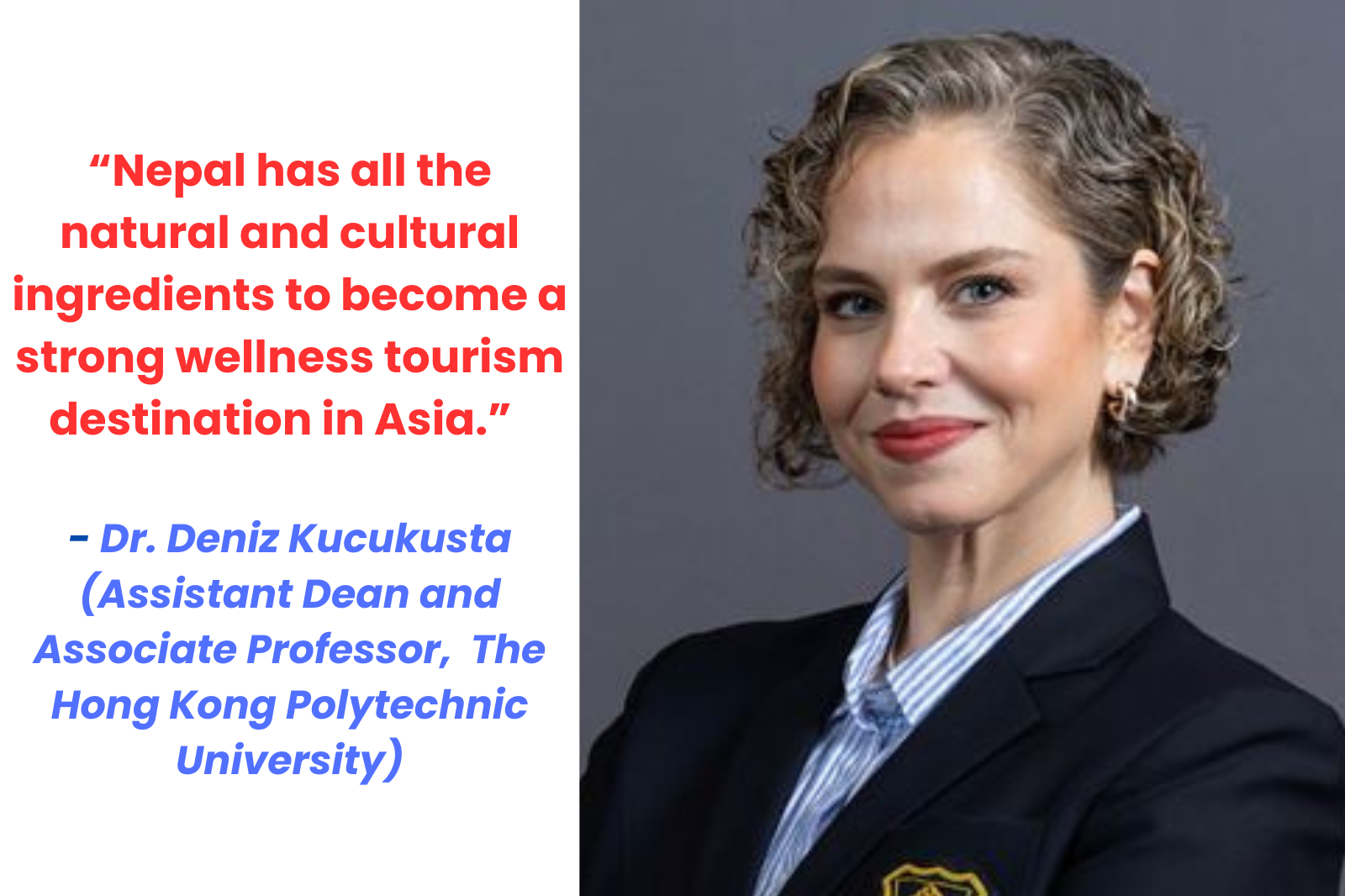
In the serene setting of the Nepal Tourism Board office in Kathmandu, surrounded by discussions on sustainable travel and emerging tourism trends, Tourism Info Nepal had the privilege of interviewing Deniz Kucukusta, PhD, Assistant Dean and Associate Professor at the School of Hotel and Tourism Management, Hong Kong Polytechnic University, a globally recognized academic leader in hospitality and tourism studies.
Prof. Kucukusta brings a strong academic lens to the rapidly evolving world of wellness tourism. Her research and insights bridge industry practice and academic theory, making her one of the key voices in understanding how destinations like Nepal can position themselves in this fast-growing segment.
How do you define wellness tourism in today’s global travel industry, and what key trends are shaping its growth?
She explained that wellness tourism today goes far beyond spa treatments or luxury retreats. “Wellness tourism is about travel that improves physical, mental, and emotional well-being,” she said. “It now includes preventive health, mindfulness, nature-based experiences, and even digital detox travel.”
She noted that post-pandemic travelers are increasingly prioritizing health, balance, and meaningful experiences. Key trends include personalized wellness programs, nature immersion, and integration of local healing traditions. So, Nepal already has these kinds of values and characteristics embedded in its DNA, making it naturally aligned with the growth of wellness tourism. “I think wellness tourism is something that heals the body, mind, and spirit,” she said.
How do you assess the global market size and future potential of wellness tourism?
According to her, wellness tourism is one of the fastest-growing segments in global travel. “It is already a multi-trillion-dollar industry when combined with wellness economy sectors,” she said. “And it continues to grow faster than general tourism.”
She added that the future potential is strong, especially as travelers move away from material consumption toward experience-based and health-oriented travel. “The future, I think, wellness tourism is very different from other kinds of tourism because wellness tourists know what they want. So there will always be interest in wellness because people travel for certain reasons. You will actually find your way to the best places that will deliver those kinds of resources,” she said.
What makes wellness tourism different from traditional tourism?
She highlighted a clear behavioral shift among wellness travelers. “Traditional tourism is often about sightseeing and leisure,” she explained. “Wellness tourism is intentional; it is about transformation, recovery, and self-care.” She added that wellness destinations must therefore design experiences that go beyond attractions and focus on holistic well-being, environment, and emotional connection.
“Yes, when we talk about wellness tourism, if you talked about it several years ago, people probably thought it was all about going to a spa and having a massage,” she noted. “But now wellness tourism is something much more holistic. It provides not only bodily relaxation but also relaxation of the mind and improvement of the spirit.”
She further explained that wellness tourism has expanded into many forms. “Whatever heals a human being can be related to wellness tourism. Art can be wellness tourism, sound can be wellness tourism, and food can be wellness tourism. So the products will shape based on the needs and wants of today’s world tourists,” she said.
How is Asia positioned in the global wellness tourism market?
She noted that Asia holds a strong advantage due to its traditional healing systems and natural landscapes. “Asia is very competitive because of Ayurveda, meditation, yoga, traditional medicine, and spiritual heritage,” she said. However, she also pointed out that Europe and North America lead in infrastructure and branding, while Asia excels in authenticity and cultural depth.
“In terms of wellness tourism, every destination has its own offerings. Some countries have different strengths and different qualities they want to bring forward as wellness products,” she explained. “For example, a wellness product in Thailand could be very different from the wellness product in Turkey or in other parts of Europe. In Europe, there are wellness spas, for example, and they also have hot springs that they actively use for wellness experiences.”
What is Nepal’s potential in wellness tourism?
Her response was optimistic. “Nepal has outstanding potential,” she said. “It combines mountains, spirituality, silence, and cultural depth, all essential elements of wellness tourism.” She emphasized that Nepal’s natural environment and spiritual traditions make it uniquely positioned to attract wellness travelers seeking meaning and healing experiences.
She further added that Nepal has a wide range of wellness offerings across different forms of tourism. “When we think about wellness, Nepal has everything, from mountaineering, trekking, forestry, and spa experiences to traditional healing practices and spiritual approaches rooted in different religious traditions,” she said. “So Nepal has a lot to offer. To me, Nepal is one of the most versatile wellness tourism product providers in the world.”

“Nepal has all the natural and cultural ingredients to become a strong wellness tourism destination in Asia. If it focuses on sustainability, quality experiences, and authentic local healing traditions, it can attract high-value global travelers seeking meaning and well-being.”
What should Nepal prioritize to strengthen its global presence?
She suggested focusing on structured product development and branding. “Nepal needs clearly designed wellness experiences, trained human resources, and strong international marketing,” she said. She also stressed improving accessibility, service standards, and integration of local healing traditions into tourism products.
She further added that Nepal requires a clear national policy and more specific strategies to guide the development of wellness tourism. “It should be more inclusive, involving all stakeholders of the industry and allowing them to actively participate in building wellness products,” she explained. “The importance and preservation of resources must be understood not only by hotels or tourism bodies, but by everyone, including local communities, as each has a role in developing this sector.”
How important are sustainability, culture, and natural resources in Wellness tourism?
She described them as the foundation of wellness tourism. “They are not optional, they are essential,” she said. “Without sustainability and cultural authenticity, wellness tourism cannot succeed in the long term.” She added that destinations like Nepal already possess strong natural and cultural assets, which must be carefully preserved to maintain their value.
She further emphasized the importance of preserving authenticity. “Nepal, in itself, is already a benchmark,” she noted. “The fact that we are still discussing wellness tourism and organizing events like Wellness Week shows how relevant and promising this sector is for the country.”
How significant are initiatives like International Wellness Day in Nepal?
She welcomed such initiatives as important awareness-building tools. “These events help position wellness tourism in both national and international conversations,” she said. She added that such platforms increase visibility and encourage collaboration among stakeholders.
She further emphasized their broader impact, calling them highly effective. “Yes, I think that’s a huge move, and very, very effective,” she noted. “We are still here talking about wellness tourism, extended wellness week. This is really amazing. Events like these, whether conferences, talks, or wellness days, help all stakeholders come together and build a shared understanding. I think this is very useful, and other destinations could also learn from this.”
What role can universities like Hong Kong Polytechnic University play?
She highlighted the importance of research and capacity building. “Universities and research institutions can contribute in many ways, including research, policy recommendations, training, innovation, and knowledge sharing,” she said. She added that academic institutions play a key role in helping destinations understand market trends, visitor expectations, sustainability challenges, and global best practices.
She further emphasized the importance of collaboration. “Partnership between universities and tourism stakeholders can support curriculum development, professional training, and research-based planning,” she noted. “International academic cooperation is very important for building long-term capacity in wellness tourism.”
Finally, what advice would you give to Nepal’s tourism stakeholders to attract high-value wellness tourists in a competitive global market?
She emphasized that the key focus should be on authenticity, quality, and sustainability. “Nepal should not try to copy other destinations. Instead, it should build on its own strengths, the Himalayas, spirituality, local culture, wellness traditions, and natural beauty,” she said. She added that high-value wellness tourists seek meaningful and transformative experiences. “They are looking for peace, authenticity, personal connection, and high service quality,” she noted.
She further explained that Nepal’s strongest opportunity lies in combining its cultural heritage and natural environment with professional wellness services and sustainable tourism practices. “If Nepal can do this successfully, it has a very strong chance to become one of Asia’s most attractive wellness tourism destinations,” she said.
She also emphasizes that potential alone is not enough. To truly compete in the international market, Nepal must move toward structured product development, professional service standards, strategic branding, and long-term policy consistency. Equally important is her reminder that wellness tourism thrives on authenticity and sustainability. For Nepal, this means protecting its fragile natural environment while integrating local culture and traditional healing systems into well-designed tourism experiences.