Nepal recorded a 12.1 percent year-on-year growth in international tourist arrivals in September 2026, despite facing floods, landslides, river erosion and other natural disasters that disrupted transportation and tourism infrastructure in several parts of the country.
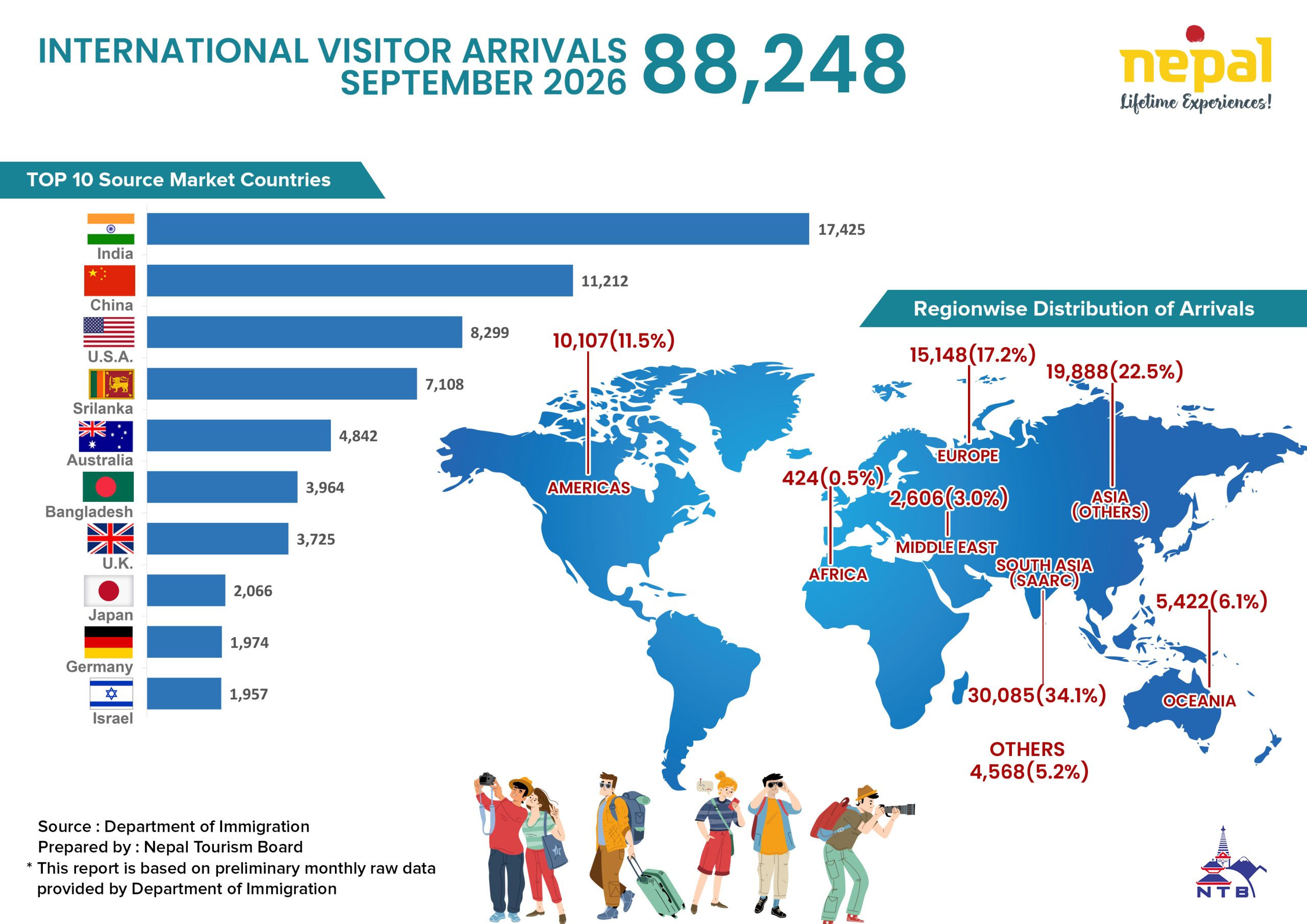
According to data released by the Nepal Tourism Board (NTB), Nepal welcomed 88,248 international visitors in September 2026, up from 78,711 in September 2025, an increase of 9,537 visitors or 12.1 percent year-on-year. However, as September 2025 itself had recorded an 18.3 percent decline from September 2024 amid the Gen Z movement and natural disasters, arrivals in September 2026 remained 8.37 percent below the level recorded in September 2024.
The September figures, however, show varied performance across different source markets. While several Asian markets recorded strong growth, particularly China, Japan, India, Sri Lanka and Bangladesh, arrivals from Europe, the Americas and ASEAN declined during the month.

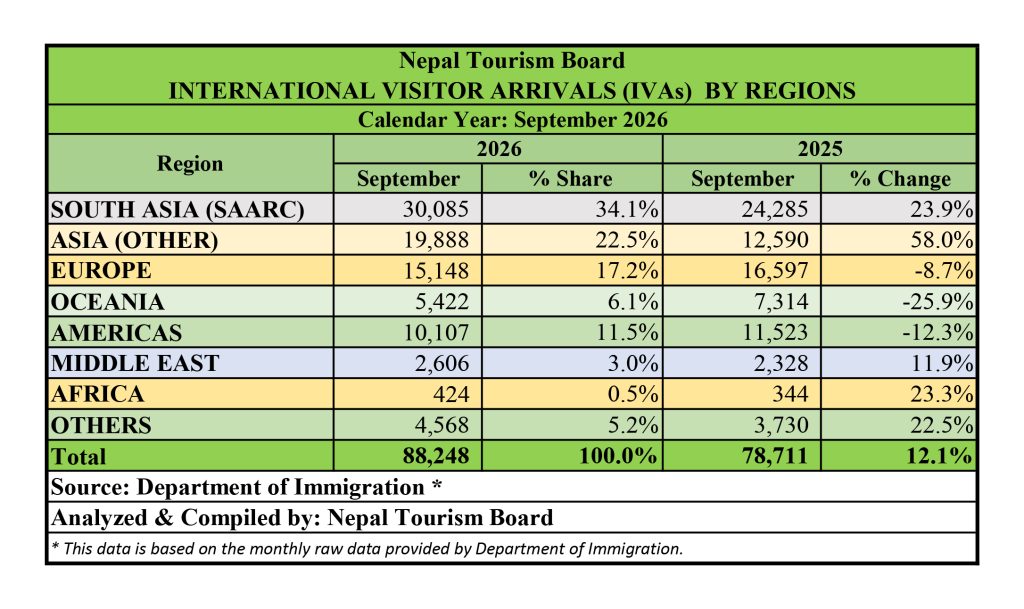
South Asian Arrivals Increase by 23.9 Percent
South Asia remained a major contributor to Nepal’s international tourism performance in September, with arrivals from the region increasing by 23.9 percent year-on-year. According to the NTB data, arrivals from South Asia increased from 24,285 in September 2025 to 30,085 in September 2026. The growth was supported by increases across several important regional markets. India remained Nepal’s largest individual source market, with 17,425 Indian visitors arriving in September 2026, compared with 15,556 in September 2025.
Indian visitors alone accounted for 19.75 percent of Nepal’s total international arrivals during the month. Sri Lanka also registered substantial growth, with arrivals increasing to 7,108 visitors from 4,616 during the same month last year. Similarly, Bangladesh recorded a 31.5 percent increase, with arrivals rising from 3,015 to 3,964 visitors. Bhutan also contributed to the regional growth, with arrivals increasing from 833 in September 2025 to 1,111 visitors in September 2026.
Chinese Tourist Arrivals More Than Double
China emerged as one of the strongest-performing major tourism markets for Nepal in September, with arrivals more than doubling compared with the previous year. Nepal received 11,212 Chinese visitors in September 2026, compared with 5,237 visitors in September 2025. The figure represents a 114.1 percent year-on-year increase.
With the sharp increase, China became Nepal’s second-largest source market, accounting for 12.71 percent of total international arrivals during the month. The substantial rise in Chinese arrivals provided significant support to Nepal’s overall tourism performance, particularly as several traditional Western markets recorded declines. The growth also highlights the increasing importance of the Chinese market to its tourism recovery and international visitor mix.

Japan Records 45.4 Percent Growth
Japan also recorded strong growth among its Asian source markets during September. A total of 2,066 Japanese visitors arrived in Nepal during the month, compared with 1,421 in September 2025. This represents a 45.4 percent year-on-year increase. More broadly, arrivals from other Asian countries outside the SAARC region increased by 58 percent, rising from 12,590 visitors in September 2025 to 19,888 visitors in September 2026. The performance demonstrates the increasing contribution of Asian markets to its tourism sector, with growth in China and Japan complementing the strong performance of South Asian countries.
European Arrivals Decline by 8.7 Percent
While Asian markets recorded significant growth, Nepal experienced a decline in arrivals from Europe during September. European arrivals decreased by 8.7 percent, falling from 16,597 visitors in September 2025 to 15,148 visitors in September 2026. The United Kingdom, one of Nepal’s established European tourism markets, recorded a particularly notable decline. Arrivals from the UK fell by 25.2 percent, from 4,981 visitors last year to 3,725 visitors this September. The decline in European arrivals partially offset the strong growth recorded from Asian markets and remains an important trend for its tourism industry as it seeks to maintain balanced growth across its traditional and emerging source markets.
US and Americas Markets Register Decline
The Americas also recorded lower visitor arrivals in September compared with the same month last year. Nepal received 10,107 visitors from the Americas in September 2026, compared with 11,523 visitors in September 2025. The United States, one of its key long-haul tourism markets, recorded a decline from 9,679 visitors to 8,299 visitors during the period. Despite the decline, the United States remained Nepal’s third-largest individual source market, contributing 9.40 percent of total international arrivals in September.
ASEAN Arrivals Fall by 25.9 Percent
Arrivals from ASEAN countries also declined during September. Nepal recorded 5,422 visitors from ASEAN markets, representing a 25.9 percent year-on-year decrease. The decline from ASEAN, together with reduced arrivals from Europe and the Americas, contrasted with the strong performance of South Asian and other Asian markets. The overall increase in arrivals was therefore largely supported by growth in the latter markets.
Middle Eastern Market Shows Positive Growth
Nepal also recorded positive growth from the Middle East during September. International arrivals from the Middle Eastern market increased by 11.9 percent compared with September 2025. The growth contributed to the overall increase in international visitors and added another positive component to Nepal’s geographically diverse tourism market. Although the Middle East represents a smaller share of Nepal’s overall arrivals compared with South Asia, Europe and other Asian markets, its continued growth provides an additional source of international visitors for the country’s tourism industry.
India Leads Nepal’s International Source Markets
The September figures show India continuing to dominate Nepal’s international tourism market. India contributed 17,425 visitors, representing 19.75 percent of total arrivals. China followed with 11,212 visitors, accounting for 12.71 percent. The United States ranked third with 8,299 visitors, equivalent to 9.40 percent of total arrivals. Sri Lanka ranked fourth with 7,108 visitors, representing 8.05 percent, while Australia ranked fifth with 4,842 visitors, accounting for 5.49 percent. The figures indicate that Nepal’s visitor market continues to be led by a combination of neighboring countries, major Asian markets and established long-haul destinations.
Asian Markets Account for More Than Half of Arrivals
The regional distribution of international arrivals further highlights the importance of Asia to Nepal’s tourism sector. SAARC countries accounted for 34.1 percent of total international arrivals in September, making the region the largest contributor. Other Asian countries accounted for another 22.5 percent, meaning Asian markets collectively represented more than half of Nepal’s international visitor arrivals.

Europe accounted for 17.2 percent, while the Americas contributed 11.5 percent. Oceania represented 6.1 percent, followed by other markets at 5.2 percent, the Middle East at 3.0 percent and Africa at 0.5 percent. The distribution reflects Nepal’s broad international tourism base while also demonstrating the growing weight of Asian markets in overall visitor numbers.
Tourism Sector Maintains Growth Amid Natural Disruptions
The September growth comes against the backdrop of significant natural disruptions affecting different parts of Nepal. Floods, landslides, river erosion and related damage have affected roads, infrastructure and tourism facilities in several destinations in recent months. Despite these challenges, Nepal recorded a 12.1 percent year-on-year increase in international tourist arrivals in September. The performance indicates that international demand for Nepal remained resilient despite disruptions in parts of the country.
The strong growth from India, China, Sri Lanka, Bangladesh and Japan helped offset declines in several European, American and ASEAN markets. At the same time, the uneven performance among source markets highlights the importance of maintaining connectivity, destination accessibility and confidence across both traditional and emerging tourism markets. With 88,248 international visitors recorded in September 2026, Nepal’s latest tourism figures point to continued recovery and diversification of its international visitor base, with Asian markets playing an increasingly significant role in sustaining overall tourism growth.