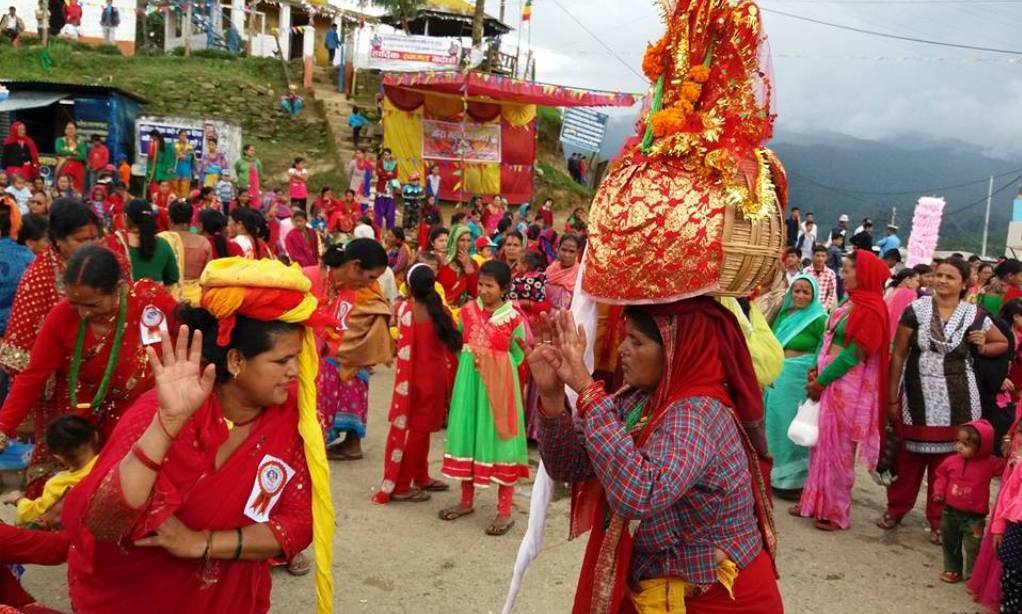
The traditional Gaura festival, a significant cultural celebration in Sudurpaschim, has officially commenced today. The festival, which begins on the fifth day of the bright fortnight of Bhadra, starts with the ritual of soaking ‘Biruda’ (a mixture of five types of grains and pulses) in households across the region. This day is also known as ‘Biruda Panchami.’
On the first day of the festival, women observe the ritual clean copper vessels with cow dung and adorn them with sacred grass (Duboo) and rice grains (Akshata). They then soak five types of grains—black gram, horse gram, rice bean, wheat, and soybean—to prepare the Biruda, which is considered a sacred offering to the goddess Gaura. The soaked Biruda is also used in the worship of Gaura Devi.
Cultural expert Gomati Bhatt explains that the Gaura festival formally begins on Biruda Panchami, following the observance of the Putrada Ekadashi fast. “For a month prior, women maintain a strict vegetarian diet and celibacy. On Biruda Panchami, they soak the grains in a copper vessel, accompanied by the singing of traditional folk songs,” Bhatta says. Women sing local songs, known as ‘Sagun’ and ‘Fag,’ while soaking the Biruda, adding a cultural dimension to the ritual.
Pandit Kabiraj Bhatt elaborates on the mythological significance of the festival, stating that the songs narrate the story of Gaura’s devotion and her request to her husband, Mahadev (referred to locally as ‘Mayasar’), to fetch the necessary grains for Biruda. Despite facing challenges, Mahadev fulfills her request, which is a central theme in the songs sung during the festival.
The soaked Biruda is rinsed on the sixth day (Shashti), and the seventh (Saptami) and eighth (Ashtami) days are considered the most significant. On Saptami, women create an idol of Gaura from a special grass known as ‘Saun,’ which is brought into the ‘Gauraghar’ (a dedicated space for the festival). Saraswati Awasthi explains that the festival is of great importance, where women, like men, wear sacred threads (Yajnopavita) as part of the ritual. “Observing the fast and performing the worship is believed to bring health, longevity, and prosperity to the husband and family,” she adds.
On the eighth day, known as Gaurashtami, the festival reaches its peak with the worship and ritualistic dance of Gaura, accompanied by traditional songs and the playing of Deuda, a local game. The idol of Gaura is brought to the courtyard of the Gauraghar amidst the singing of various local folk songs, including heroic ballads of kings and warriors.
The Gaura festival, which has been celebrated since ancient times, honors Goddess Parvati, the consort of Lord Shiva, who is worshipped as Gaura Devi. According to local traditions, Gaura is celebrated based on the appearance of the star Agasti, either during the bright (Shukla) or dark (Krishna) fortnight of the lunar month. When observed during the bright fortnight, it is known as ‘Ujyali Gaura,’ and when during the dark fortnight, it is called ‘Anyari Gaura.’ Although both are considered highly auspicious, Ujyali Gaura is regarded with special significance.
In celebration of Gaura, various programs have been organized in different parts of Sudurpaschim, including Kanchanpur, where institutions like the Mahakali Literary Society are hosting events. Noted litterateur Ramesh Pant Mitbandhu announced that a Gaura festival is being held at the open stage in Mahendranagar. “We will be showcasing traditional folk songs, including Deuda Dusko and Dhumari, among other activities,” he says. “The festival is organized to preserve traditions and ensure their transmission to future generations.”