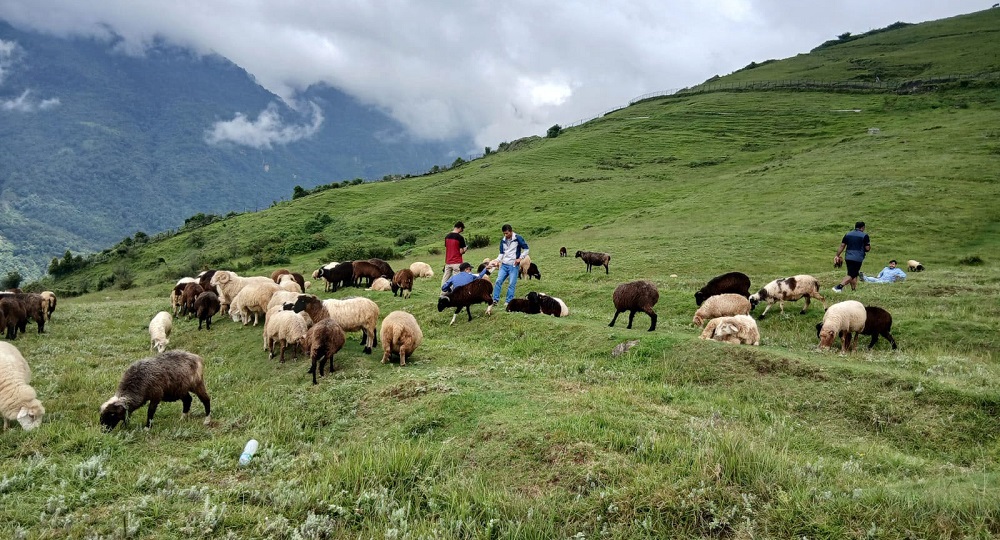
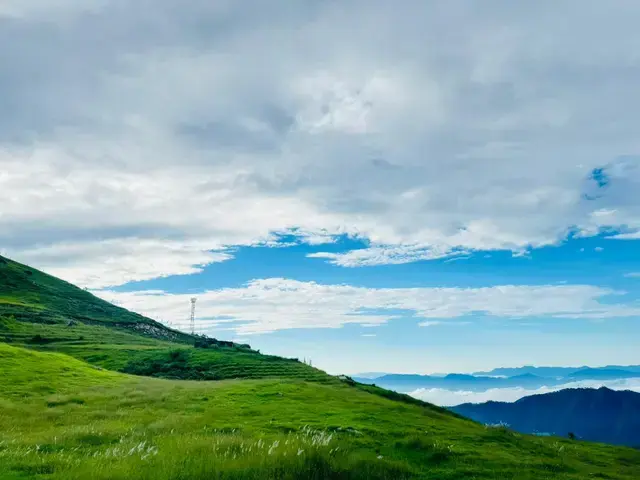
Bhalche Sheep Farm in Kispang Rural Municipality 1, Nuwakot, is gaining attention as a distinctive rural tourism attraction while continuing its primary role in the conservation, breeding, and genetic improvement of the indigenous Baruwal sheep breed. Located at around 2,000 meters above sea level, the center combines a scenic highland setting with livestock farming and a long agricultural history, attracting both domestic and foreign visitors to Kispang. Visitors come not only to observe the sheep farm but also to enjoy the surrounding landscape, while the local government is now working to strengthen the site’s tourism appeal through improved infrastructure and facilities.
A Sheep Genetic Center With Tourism Potential
The center operates under the government’s National Livestock Resources Management and Promotion Office and has around 660 ropanis of land registered in its name, in addition to surrounding pasture and grazing areas. The center is located approximately 101 kilometers from Kathmandu, making it a potential short-distance rural tourism destination for visitors travelling from the capital. Its elevated location, open grazing areas and views of the surrounding landscape provide an experience that differs from conventional urban and heritage tourism attractions. The combination of the natural environment and the opportunity to observe sheep farming has already made the farm a place of interest for people visiting Kispang.
The center currently has 354 sheep, although its extensive grazing areas have the capacity to support a significantly larger flock. According to center chief Dr Shyam Krishna Tiwari, the facility was established primarily to conserve and improve the Baruwal breed rather than to maintain a very large number of sheep for commercial purposes. The center needs a minimum of around 200 sheep to fulfill its core function, but because its pasture can support up to around 1,000 sheep, officials have set a target of increasing the number to approximately 500 sheep. This expansion is expected to strengthen the center’s role as a national resource for Baruwal sheep conservation while also making the farm more attractive to visitors interested in rural life and livestock production.

The centre sells sheep to farmer groups specifically for breeding purposes, following an established government procedure. Farmer groups must submit an application and obtain a recommendation from the concerned ward before purchasing sheep after paying the required government revenue. At present, two farmer groups from Nuwakot and four from Dhading and Rasuwa regularly obtain breeding sheep from the centre. Improved breeding rams produced at the centre are also distributed to farmers according to demand, allowing the genetic improvement program to extend beyond the farm and into sheep-rearing communities in different districts.
Supporting Farmers And Conserving Livestock Resources
The work of the centre extends beyond breeding sheep and distributing improved animals. It also produces and distributes planting materials and seeds for perennial grasses, including Rai grass, Setaria, Kikuyu and Paspalum, which are important sources of livestock feed. Farmers are provided with materials needed for sheep husbandry, including wool shearing scissors and temporary sheep shelters, as well as training intended to improve animal management and production practices. Through these programs, the centre seeks to help farmers raise productivity rather than remain dependent on traditional breeding and livestock management methods.
Dr Tiwari said the centre’s working objective is to encourage farmers to increase production rather than focus solely on raising a large number of sheep at the facility itself. The centre was established specifically for the conservation of the Baruwal breed, and its genetic resource programmes are intended to improve productivity while preserving the characteristics of the local breed. The centre has therefore continued to function as a source of improved breeding stock, technical support and genetic resources for farmers, contributing to livestock development and the livelihoods of communities dependent on sheep farming.
The centre also responds to local agricultural needs beyond sheep production. Although its principal work is focused on sheep farming and the conservation and improvement of sheep genetic resources, it keeps a Murrah cross buffalo bull and a Jersey bull to provide natural breeding services for cattle and buffalo. This additional service reflects the centre’s wider role in supporting livestock farmers in the area. At the national level, the Genetic Resource Centre conducts programs aimed at improving livestock productivity, conserving valuable genetic resources and promoting their sustainable use to contribute to the economic and social improvement of local communities.
Tourism Development Gains Local Attention
The farm’s tourism potential has recently attracted greater attention from local authorities and community stakeholders. A delegation including Kispang Rural Municipality Acting Chairperson Arjun Prasad Neupane, Chief Administrative Officer Kedar Prasad Khatiwada, popular singer Thaneshwor Gautam, CPN central member Buddhi Jisi, Rastriya Swatantra Party Kispang Rural Municipality Chairperson Shiv Prasad Bhatt, Kispang Polytechnic Institute Chief Binod Neupane and media representatives recently visited the sheep farm. The visit reflected growing interest in connecting the agricultural facility with the wider tourism development of Kispang.
Chief Administrative Officer Khatiwada said the rural municipality was working to develop the sheep farm as a tourism centre and was taking steps to establish the necessary tourism infrastructure from the local government’s side. Such development could include improvements that make it easier for visitors to access the farm, observe the livestock and spend more time in the surrounding area. The objective is to build on the farm’s existing visitor interest and turn it into a more organized tourism attraction rather than treating it solely as a government livestock facility.
The farm’s historical background adds another layer to its tourism potential. Before the sheep development farm was established, the site operated as a government cattle farm during the Rana period. Residents referred to the facility as Rajako Goth, meaning the King’s cattle shed. Cattle were raised there, and the milk, curd, buttermilk and ghee produced from them were reportedly sent to the Kathmandu palace. The history gives the site an agricultural and institutional heritage that could be incorporated into its tourism identity alongside the existing sheep breeding activities.
The combination of landscape, livestock, agriculture and history allows Bhalche to develop a form of rural tourism that allows visitors to experience a working livestock centre rather than simply viewing a conventional attraction. Such a model could particularly appeal to visitors interested in farming, indigenous animal breeds, local lifestyles and nature. If supporting infrastructure is developed effectively, the farm could become one of the attractions that encourages visitors to extend their stay in Kispang and explore other destinations in the surrounding area.
From Baruwal Conservation To Modern Sheep Breeding
The history of Bhalche Sheep Farm is closely connected with Nepal’s efforts to improve sheep production and conserve local livestock resources. After the government cattle farm was replaced by a sheep farm under the then Ministry of Agriculture, the primary objectives became the genetic improvement of local Baruwal sheep and increased production of meat and wool. The farm began crossbreeding local Baruwal sheep with foreign breeds known for better wool production and carried out studies and experiments to produce improved lambs suitable for distribution to farmers.
Around 2027/28 BS, Australian Polwarth sheep were crossbred with local Baruwal sheep, resulting in the production of 50 percent crossbred sheep and the beginning of various breeding trials and research activities. The farm subsequently gave greater priority to producing and distributing improved sheep. On Jestha 26, 2030 BS, the then King Birendra Shah visited the farm and instructed officials to expand its activities. Following the visit, the program became more active, with greater emphasis placed on improving the farm’s production and breeding functions.

From 2030/31 BS, improved breeding rams produced at the farm began to be distributed to local farmers and farmers in different districts for breeding purposes. The farm later received important support through the Rasuwa Nuwakot Integrated Rural Development Project, which was implemented with World Bank loan assistance from 2035/36 BS. The project contributed to the development of physical infrastructure and provided support for sheep breed improvement, research, production, and distribution.
As part of the same project, 10 French Merino Darley sheep eight ewes and two rams were brought from France in Falgun 2036 BS for breeding and research. However, other breeds did not achieve the expected level of growth and development under local conditions. As a result, the center eventually focused its activities on the Baruwal sheep, strengthening its role as a genetic resource center dedicated to conserving and improving the indigenous breed.
Today, Bhalche Sheep Farm stands at the intersection of livestock conservation, agricultural development, rural livelihoods and tourism. Its long history, indigenous Baruwal sheep, highland landscape and growing visitor interest provide a strong foundation for developing it as a rural and agro-tourism destination. With better tourism infrastructure and continued cooperation between the genetic resource center, local government and surrounding communities, Bhalche could become an important attraction in Nuwakot where visitors can experience local agriculture, livestock conservation and the rural environment while also learning about the historical development of sheep farming in Nepal.