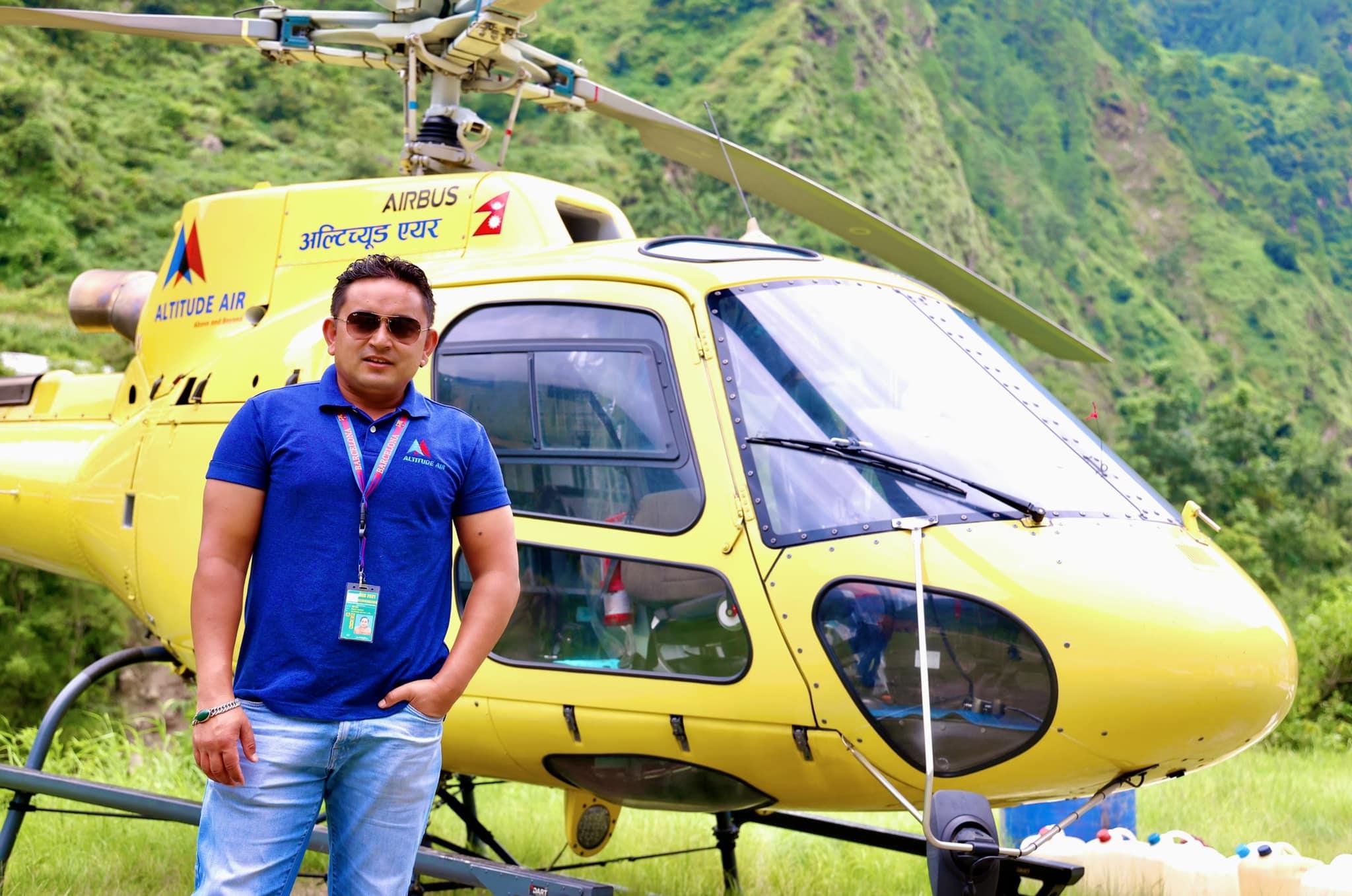
Captain Bibek Khadka, a senior helicopter instructor and captain with Altitude Air, has been at the frontline of Nepal’s flood rescue efforts following the devastating Bhotekoshi floods that affected parts of Rasuwa and Nuwakot in 2026. With roads destroyed, bridges washed away and river channels altered by the disaster, helicopters became one of the few practical means of reaching communities cut off from ground access. Khadka was among the pilots operating in the affected areas, drawing on years of experience in high-altitude rescue, mountain search operations, disaster response and specialised helicopter flying. His involvement in the flood response is not an isolated assignment but another chapter in a career shaped by some of Nepal’s most challenging helicopter operations.
Captain Bibek Khadka: An Experienced Figure in Nepal’s Helicopter Aviation
Captain Bibek Khadka currently serves as a captain and senior helicopter instructor at Altitude Air and is also listed as a member of the company’s board of directors. According to Altitude Air’s official profile, he has accumulated 8,095 hours of total air time, including 5,740 hours on type. His experience has been developed largely in Nepal’s demanding mountain environment, where helicopters frequently operate at high elevations, in narrow valleys and around limited landing areas.
Captain Bibek Khadka’s professional background includes both regular helicopter operations and specialised search-and-rescue missions. Over the years, he has worked in situations involving stranded trekkers and climbers, missing people, high-altitude evacuations and recovery operations. His experience also extends to disaster response. During Nepal’s 2015 earthquake, he was among the helicopter pilots involved in emergency operations as Nepal’s aviation sector mobilised to reach affected areas and isolated communities. That combination of flight hours, mountain experience and rescue exposure has become particularly relevant during Nepal’s latest disaster.
The 2026 Bhotekoshi Flood: Flying Where Roads No Longer Exist
The Bhotekoshi disaster has created an unusually difficult operating environment for helicopter crews. The floods changed the geography around parts of Rasuwa and Nuwakot. Roads and bridges were destroyed, river courses shifted, and familiar landmarks used by pilots for navigation disappeared. Ground-based communication has also been unreliable in some of the narrow valleys.
Captain Bibek Khadka also explained how helicopter pilots operating inside the affected valleys have developed a strict system of coordination among themselves. Aircraft travelling through the narrow valleys keep to their respective sides; pilots continuously report their positions, and information about approaching helicopters is shared over radio. The conditions have also made landing significantly more complicated. Captain Bibek Khadka explained that some established helipads were washed away and that ground in the affected areas could be wet and unstable. Pilots therefore cannot simply land wherever survivors are visible. They must first assess the ground, approach path, obstacles, and aircraft weight before deciding whether a landing is safe.
The flood operation has also turned Trishuli into a major staging point. People rescued from affected locations can be brought there before receiving medical assistance or being transferred to Kathmandu, while relief materials are gathered there and distributed to different settlements according to need. Captain Bibek Khadka has described helicopters as essential to reaching communities isolated by the disaster, noting that the loss of roads and bridges has left aerial access as the quickest way to reach many places. A Reuters photograph from September 3, 2026, also identified Khadka as the pilot flying a helicopter toward the Upper Trishuli 3A Hydropower Station in Rasuwa during the aftermath of the flash floods and mudslide.
From Saribung to Annapurna: A Record of High-Altitude Rescues
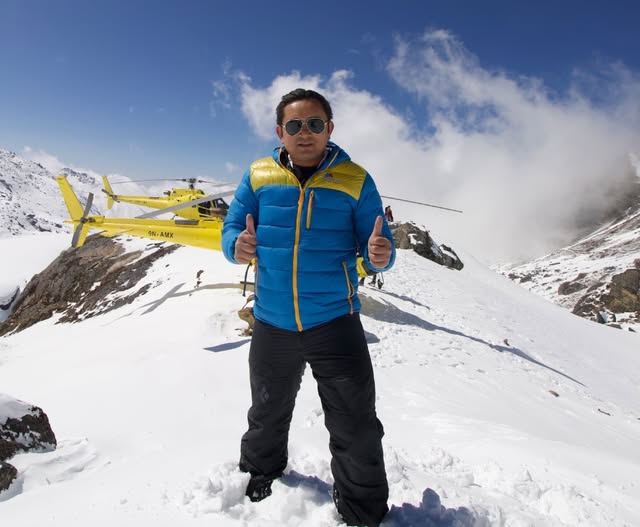
Captain Bibek Khadka’s ability to operate in difficult mountain terrain has been built through years of high-altitude missions. In 2016, while flying for Simrik Air, he was involved in the rescue of 20 people stranded in the Saribung area of Manang after a severe snowstorm. The group was trapped at approximately 19,200 feet, requiring a difficult helicopter evacuation.
His most technically notable operation came in April 2019, during the rescue of Malaysian climber Dr Chin Wui Kin from the Annapurna region. Khadka was flying an Airbus helicopter for Simrik Air when he conducted the climber’s long-line evacuation from approximately 6,500 metres. Aviation Nepal reported that 13 long-line operations were carried out during the mission, describing it as a record-setting achievement in Nepalese helicopter aviation.
Long-line rescue is used when a helicopter cannot land safely near a person. A rescuer or load is suspended beneath the aircraft and moved to a safer location, requiring precise control from both the pilot and rescue team. Khadka’s experience with this technique continued in subsequent years. In 2024, he was involved in high-altitude rescue and recovery missions, including operations in the Everest region and on Dhaulagiri.
Dhaulagiri, Lobuche and Other Missions That Defined His Career
In October 2024, Captain Bibek Khadka led an Altitude Air helicopter team involved in the recovery of the bodies of five Russian climbers who had died during an ascent of Dhaulagiri I. The operation used long-line techniques to recover the bodies from approximately 7,600 metres, lowering them individually to base camp before they were transported to Kathmandu. Earlier recovery attempts had been prevented by adverse weather. The operation demonstrated the extremely narrow margin for error involved in high-altitude helicopter recovery. The helicopter had to operate at an elevation where aircraft performance is significantly affected by the thin mountain air while the rescue team worked on steep and exposed terrain.
Captain Bibek Khadka was also involved in the 2024 Lobuche rescue of Japanese climber Yukie Morita, who had fallen at high altitude and required a long-line evacuation. His work has also included aerial searches in Nepal’s mountain regions, where the challenge is often locating a missing person across enormous and difficult terrain before an evacuation can even begin. These missions have established a clear pattern in Khadka’s career: he has repeatedly been called upon for operations where conventional helicopter landing is difficult or impossible and where pilot experience is critical to the outcome.
When the Rescue Pilot Becomes Part of the Rescue Story
Captain Bibek Khadka’s work has not been without personal risk. On October 29, 2025, an Altitude Air Airbus B3 helicopter, registration 9N-AMS, crash-landed at Lobuche while attempting to land. The aircraft had departed Lukla at around 7:41 a.m. for a mission to assist stranded foreign tourists. Khadka was the only person aboard and survived the accident without injury, while the helicopter sustained substantial damage.
Following the incident, the Civil Aviation Authority of Nepal issued additional safety measures for helicopter operations in snowy and high-altitude areas, including restrictions related to whiteout and fog conditions and requirements concerning snow-covered helipads and winter landing equipment.
The following year, Captain Bibek Khadka was again operating in difficult mountain conditions. In June 2026, he was involved in an Altitude Air search for missing mountain guide Dawa Sherpa in the Everest region. The helicopter searched from around Everest Base Camp toward the area below Camp III before Sherpa was located alive.
Only weeks later, Captain Bibek Khadka’s expertise was being applied to a completely different type of emergency: the Bhotekoshi flood. The terrain may have changed from snow-covered Himalayan peaks to flood-damaged valleys, but the fundamental requirements remained similar: accurate judgement, terrain awareness, communication, aircraft control and the ability to operate safely where conventional access has failed.

A Pilot Whose Experience Has Become Part of Nepal’s Emergency Response
Captain Bibek Khadka’s career illustrates the increasingly important role of helicopter aviation in Nepal’s tourism, mountain and disaster-response sectors. His 8,095 total flight hours and 5,740 hours on type represent substantial operational experience, while his documented missions show years of work in high-altitude search, rescue and recovery operations. The 2026 Bhotekoshi flood response has now added another major chapter to that record. This time, the challenge is not a single climber stranded on a mountain or a recovery mission on an 8,000-metre peak. It is an extensive disaster zone where the landscape itself has changed, communities have been isolated, and established landing areas have disappeared.
Khadka’s role in the response demonstrates why experienced mountain pilots are so important during disasters in Nepal. Their responsibility extends beyond simply flying an aircraft. They must read terrain from the air, assess constantly changing conditions, coordinate with other pilots, and determine when a rescue or landing can be safely attempted.
From the 2015 earthquake response and the Saribung snowstorm rescue to the 2019 Annapurna long-line operation, the 2024 Dhaulagiri recovery, the 2025 Lobuche accident, and the 2026 Bhotekoshi flood response, Captain Bibek Khadka’s career has been closely connected with some of the most demanding aspects of Nepal’s helicopter aviation. Today, as helicopters continue reaching areas isolated by the floods, his experience is being put to work once again, this time not only as a pilot, but as part of a wider aerial lifeline connecting disaster-hit communities with rescue, relief, and medical assistance.