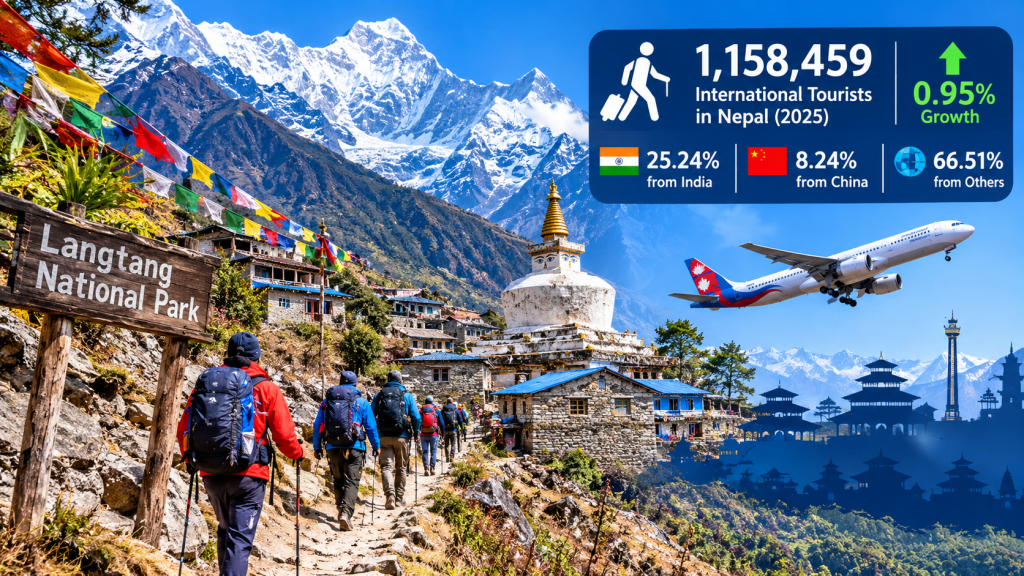
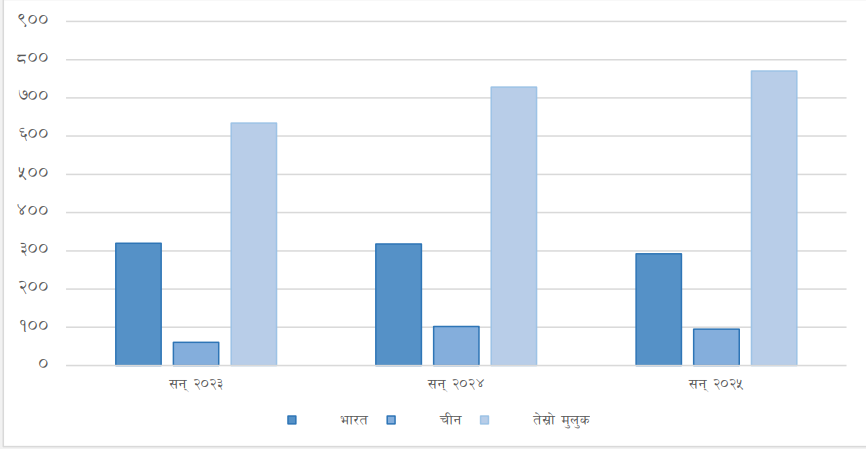
Nepal recorded a modest increase in international tourist arrivals in 2025, with the number of visitors reaching 1,158,459, according to the Annual Report on Economic Activity Study 2082/83 published by Nepal Rastra Bank (NRB). The report shows that tourist arrivals increased by 0.95 percent compared to the previous year, when Nepal received 1,147,548 international visitors. The increase indicates a gradual expansion of tourism activity, although the growth remained relatively limited compared with the country’s broader tourism potential. The report has also highlighted the changing composition of Nepal’s international tourist market, with visitors from India accounting for the largest share, followed by China and other international markets.
India, China Account for Significant Share of Tourist Arrivals
According to the NRB report, 25.24 percent of tourists arriving in Nepal in 2025 were from India, making the southern neighbour the largest source market for Nepal’s tourism industry. Tourists from China accounted for 8.24 percent of total arrivals, while visitors from other countries made up the remaining 66.51 percent. The distribution highlights Nepal’s continued dependence on neighbouring markets while also demonstrating the importance of maintaining and expanding arrivals from diverse international destinations. India remains particularly significant due to geographical proximity, strong cultural and religious ties, relatively easy connectivity and the large potential market for leisure, pilgrimage and other forms of tourism.
The Chinese market also represents an important component of Nepal’s international tourism sector, while visitors from other countries collectively constitute the majority of international arrivals. The figures suggest that Nepal has considerable scope to diversify its tourism markets further by strengthening air connectivity, destination promotion, infrastructure and tourism products aimed at different segments of international travellers.
Nepal’s Aviation Sector Serves 38 Airlines
The report has also highlighted the role of air connectivity in supporting Nepal’s tourism industry. According to data from the Civil Aviation Authority of Nepal (CAAN), a total of 38 airline companies were providing services in Nepal as of the end of Ashadh 2083. Of these, nine were domestic airlines and 29 were international airlines.
Despite the presence of a substantial number of airline operators, the combined daily seat capacity of airlines operating in Nepal declined by 16.10 percent, reaching approximately 11,733 seats per day. Domestic airlines accounted for around 2,333 seats per day, while international airlines had a daily capacity of approximately 9,400 seats. The decline in overall seat capacity is significant for a tourism-dependent economy because international air connectivity directly influences Nepal’s ability to attract visitors from major source markets.
The reduction in available seats also underscores the importance of maintaining stable and reliable aviation connectivity as Nepal seeks to increase tourist arrivals. Expanding international routes, improving flight frequency and ensuring competitive airfares could play an important role in supporting the recovery and expansion of Nepal’s tourism sector.
Langtang National Park Emerges as a Major Tourism Destination
The NRB report has separately highlighted Langtang National Park as an attractive tourism destination, particularly because of its combination of natural beauty, biodiversity, religious heritage, cultural attractions and adventure tourism opportunities. Established in 2055 B.S., the national park extends across parts of Sindhupalchok, Rasuwa and Nuwakot districts, reaching northward toward the border with China. The park covers an area of approximately 1,710 square kilometres.
The report identifies Langtang as an important destination for both domestic and international visitors because of its Himalayan landscapes, mountain ranges, lakes, trekking routes, religious sites and rich biodiversity. The area’s natural environment and cultural heritage have helped establish it as one of the important tourism destinations within Bagmati Province.

Himalayan Landscape and Biodiversity Strengthen Langtang’s Appeal
The presence of high Himalayan peaks is one of the major attractions of the Langtang region. The report highlights mountains including Langtang Lirung at 7,243 metres and Himchuli at 7,864 metres as prominent features contributing to the area’s scenic appeal. The region is also associated with major river systems, with rivers originating from the national park contributing to the Trishuli River toward the west and the Sunkoshi River toward the east.
Langtang National Park is also rich in wildlife and plant species. The area is home to species including leopards, red pandas, musk deer, Himalayan bears, Himalayan tahr, ghoral and red monkeys, among others. Its vegetation includes different species of pine, rhododendron and other Himalayan flora, while a wide variety of flowers and bird species further contribute to the region’s ecological diversity.
The combination of wildlife, forests, mountains and high-altitude landscapes gives Langtang significant potential for nature-based and adventure tourism. The conservation of these natural resources is therefore closely linked with the long-term sustainability of tourism in the region.
Gosainkunda and Langtang Trekking Route Attract Thousands of Visitors
Beyond its natural attractions, Langtang is also an important destination for religious and cultural tourism. The region contains the sacred Gosainkunda Lake, which holds significance for both Hindu and Buddhist communities. The area also includes a Bonpo monastery, reflecting the region’s Tibetan cultural and religious heritage.
The Langtang trekking route is another major attraction, drawing adventure travellers interested in Himalayan trekking. Destinations and trekking points such as Kyanjin Ri and Tserko Ri, along with the Langtang Glacier and surrounding mountain landscapes, add to the region’s appeal. Thousands of pilgrims and tourists visit the area every year, particularly during important religious periods. The combination of pilgrimage, trekking, mountain scenery, and cultural experiences has allowed Langtang to develop a diverse tourism economy rather than relying on a single tourism product.
Tourism Generates Local Employment and Income
The expansion of tourism activities in the Langtang region has contributed to the growth of several forms of economic activity at the local level. According to the NRB report, tourism has supported businesses including hotels, lodges, transportation services, handicrafts and mountaineering-related enterprises, creating employment and income-generating opportunities for local communities.

The growth of these businesses demonstrates how tourism can create economic linkages beyond accommodation and sightseeing. Visitors generate demand for food, transportation, guiding services, trekking equipment, handicrafts, and other local products, allowing tourism expenditure to circulate within the local economy. For communities in and around Langtang, tourism therefore represents an important source of livelihood and has the potential to contribute further to local economic development if infrastructure, service quality and destination management are improved.
Infrastructure, Disasters and Environmental Protection Remain Major Challenges
Despite its considerable tourism potential, the Langtang region continues to face several challenges. The NRB report points to limited roads and other infrastructure, natural disasters, environmental conservation challenges and a shortage of quality tourism services as key constraints to the sustainable development of tourism in the area.
The vulnerability of the region to natural disasters has become particularly evident in recent years. The report notes that the devastating flood in the Bhotekoshi-Trishuli river system on Bhadra 10, 2083 B.S. caused damage to tourism-related businesses, roads and other physical infrastructure. The resulting damage has had a negative impact on tourism activities in the region and demonstrates the vulnerability of tourism infrastructure to climate and disaster-related risks.
For destinations such as Langtang, improving resilience against floods, landslides and other natural hazards will be crucial. Tourism infrastructure needs to be developed in a manner that improves visitor access and safety while also protecting fragile mountain ecosystems.
Sustainable Tourism Could Strengthen Bagmati Province’s Economy
The NRB report identifies Langtang National Park as one of the important destinations in Bagmati Province from the perspectives of natural, religious, cultural and adventure tourism. Its diverse tourism resources provide significant potential for further economic development if the destination is managed sustainably.
Improved roads and transportation, better tourism services, stronger disaster preparedness, environmental conservation and responsible destination management could help increase the economic benefits generated by tourism while reducing pressure on the region’s fragile ecosystem. Greater participation of local communities in tourism-related businesses could also ensure that a larger share of tourism income remains within the destination.
Tourism Remains an Important Pillar of Nepal’s Economic Activity
The findings of the NRB’s Annual Economic Activity Study 2082/83 indicate that Nepal’s tourism sector continued to expand in 2025, although the growth in international arrivals remained modest. With 1.158 million tourists visiting Nepal during the year, the country maintained a strong international tourism presence, while India and China remained important source markets.
At the same time, the decline in airline seat capacity highlights the importance of strengthening international and domestic connectivity. Destinations such as Langtang demonstrate that Nepal’s tourism potential extends well beyond major urban centres and internationally recognised trekking routes. With appropriate investment in infrastructure, conservation, connectivity and service quality, emerging and established destinations alike could make a greater contribution to employment, local income generation and Nepal’s overall economic growth.