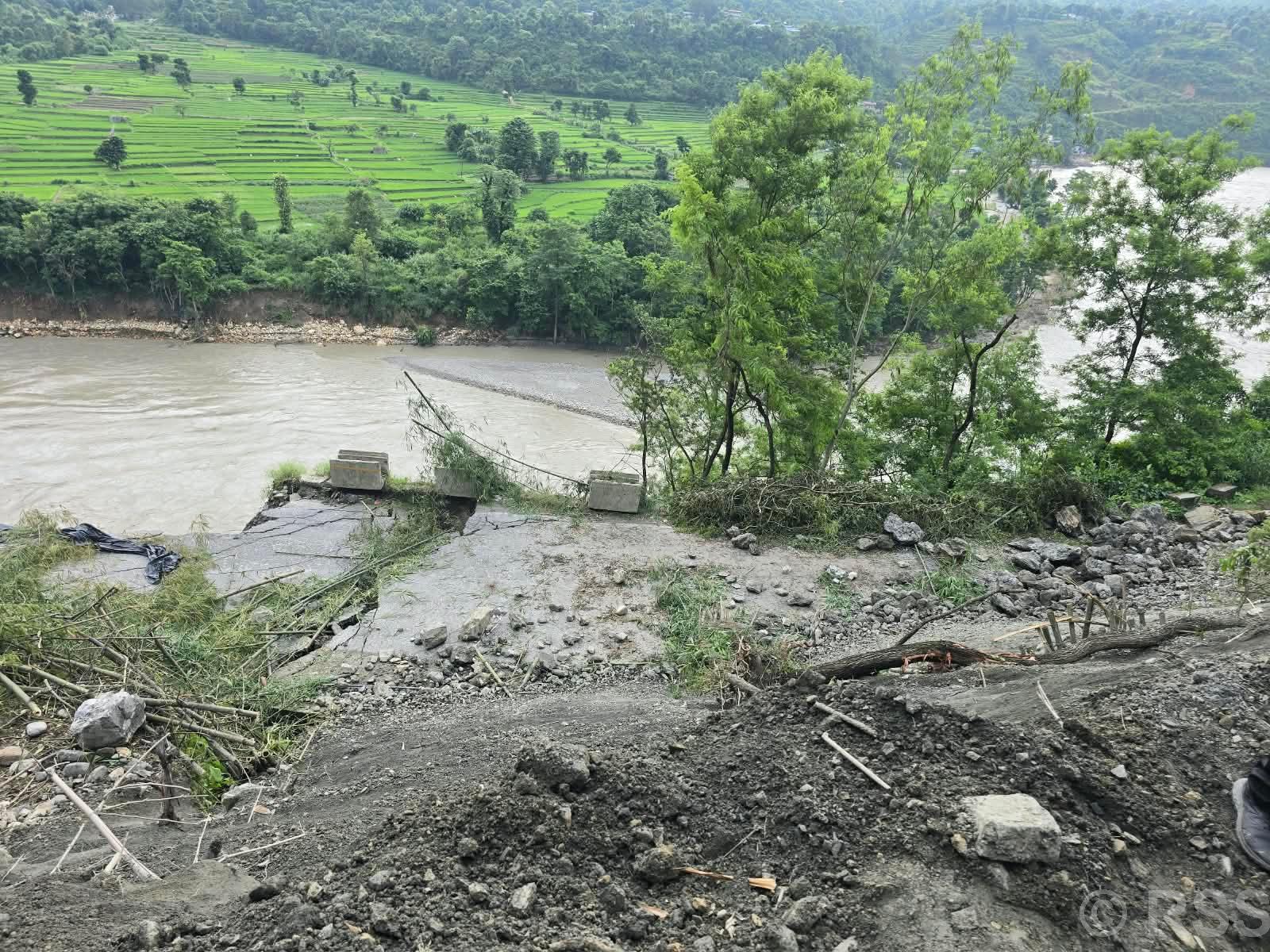
The prolonged closure of the Prithvi Highway at Krishnabhir has severely disrupted tourist bus services connecting Kathmandu with major tourism destinations including Pokhara, Chitwan and Lumbini. The highway has remained closed since August 29 after the lower section of the road was damaged by erosion linked to flooding in the Bhote Koshi River in Rasuwa.
The resulting landslide and road damage at Krishnabhir have disrupted one of Nepal’s key transport corridors during the peak tourism and travel season. Tourist buses that normally operate between Kathmandu and destinations across central and western Nepal have been unable to maintain their regular schedules. According to the Tourist Bus Association of Nepal (TBAN), buses and tourism workers have been particularly affected as vehicles remain stranded or services are suspended in Kathmandu, Pokhara, Chitwan and Lumbini.

Large Tourist Buses Unable to Use Alternative Routes
TBAN President Bhishma Prasad Neupane said the highway disruption has created major difficulties for tourist bus operators and travellers. He explained that although some smaller tourist vehicles have been able to use the alternative Chitwan–Hetauda–Pharping route occasionally, large tourist buses cannot safely and practically operate on the narrower roads because of their size and the sharp bends along the route.
The disruption has therefore affected not only tourists but also drivers, transport workers and tourism businesses that depend on regular road connectivity. With the main highway unavailable, travellers have been forced to take longer alternative routes, resulting in additional travel time, higher costs and greater difficulty during the monsoon season. The closure has also increased pressure on air services between Kathmandu and popular tourist destinations. As road travel became uncertain, more travellers began choosing flights, particularly on the Kathmandu–Pokhara and Kathmandu–Bharatpur routes.
Air Travel Demand Surges as Road Access Remains Uncertain
Yeti Airlines has increased its Kathmandu–Pokhara services in response to the rise in passenger demand. The airline had previously operated six daily flights on the route, but increased the number to 10 following the highway disruption. Yeti Airlines spokesperson Sudarshan Bartaula said passenger demand for flights to Pokhara has increased significantly since the Bhote Koshi flood and subsequent road blockage. Compared with the period before the disruption, the number of passengers travelling from Kathmandu to Pokhara by air has risen by around 50 percent.
Airlines have also reported an overall increase in airfares following the disruption, with fares rising by around 40 percent in some cases as demand for limited air capacity increased. The Kathmandu–Bharatpur route has similarly experienced a sharp increase in demand. Buddha Air, which operates flights between the two cities, has expanded its services as travellers seek an alternative to the blocked highway.
Buddha Air’s Bharatpur office chief Bhakta Bahadur Basnet said the airline previously operated around five daily flights under normal conditions. Following the deterioration of road access, services have been increased to approximately nine to 11 flights a day. Bharatpur Airport is also serving passengers from surrounding areas, including Chitwan, Nawalparasi, Gorkha, Tanahun, Lamjung and Makwanpur, further increasing demand for air travel.
New Road Track Being Constructed at Krishnabhir
Authorities are accelerating efforts to restore road connectivity at the damaged Krishnabhir section. A new temporary road track is being constructed along the affected stretch of the Malekhu–Muglin road section. Ashok Devkota, Assistant Resident Engineer for the Malekhu–Muglin road project, said construction teams are working around the clock to open the new route as quickly as possible.

Until the regular Prithvi Highway route is restored, travellers are being directed toward alternative routes through Chitwan, Hetauda and Dakshinkali. However, the condition of these roads during the monsoon has made travel more challenging, particularly for large vehicles.
The prolonged disruption has highlighted the importance of reliable road connectivity for Nepal’s tourism industry. With Pokhara, Chitwan and Lumbini among the country’s major tourism destinations, continued restrictions on the Prithvi Highway are affecting tourist mobility, transport operators, workers and businesses while simultaneously placing additional pressure on domestic aviation.