The historic walled city of Lo Manthang in Upper Mustang has come alive with the sounds of galloping horses, traditional music, communal gatherings and religious activities as the three-day Yartung festival began on August 18. One of the region’s most distinctive cultural celebrations, Yartung brings together the people of Upper Mustang after the completion of major agricultural work and provides an important occasion for communities to celebrate, reconnect and preserve traditions passed down through generations. This year’s celebration has been organized by Lo Manthang Rural Municipality in coordination with the Annapurna Conservation Area Project (ACAP), Lo Manthang, with domestic and international visitors also arriving to experience the festival.
A centuries-old celebration marking the end of summer
Yartung is deeply rooted in the Tibetan cultural and Buddhist traditions of Upper Mustang and is traditionally observed after the major agricultural work of the season has been completed, when villagers have more time to gather and celebrate. Local explanations connect the name with yar, referring to summer or the rainy season, and tung, associated with its ending or celebration. Other cultural accounts similarly describe Yartung as a festival marking summer’s end and the transition toward the harvest season. Its timing has traditionally been connected with the Tibetan lunar calendar and the August full moon period, although the exact dates can vary from year to year.
The festival is more than a horse racing competition. Historically, the celebration has provided an important social occasion for the communities of Upper Mustang to come together after the demanding period of farming and high-altitude grazing. Families gather, traditional clothing is worn, horses are prepared and decorated, and people spend time eating, drinking, singing and dancing together. Historical accounts of the festival describe its three-day structure in Lo Manthang as being connected with the king, queen and Buddhist religious community, while horse racing and communal festivities continue throughout the celebration.

The first day opens with the Mustang cultural king
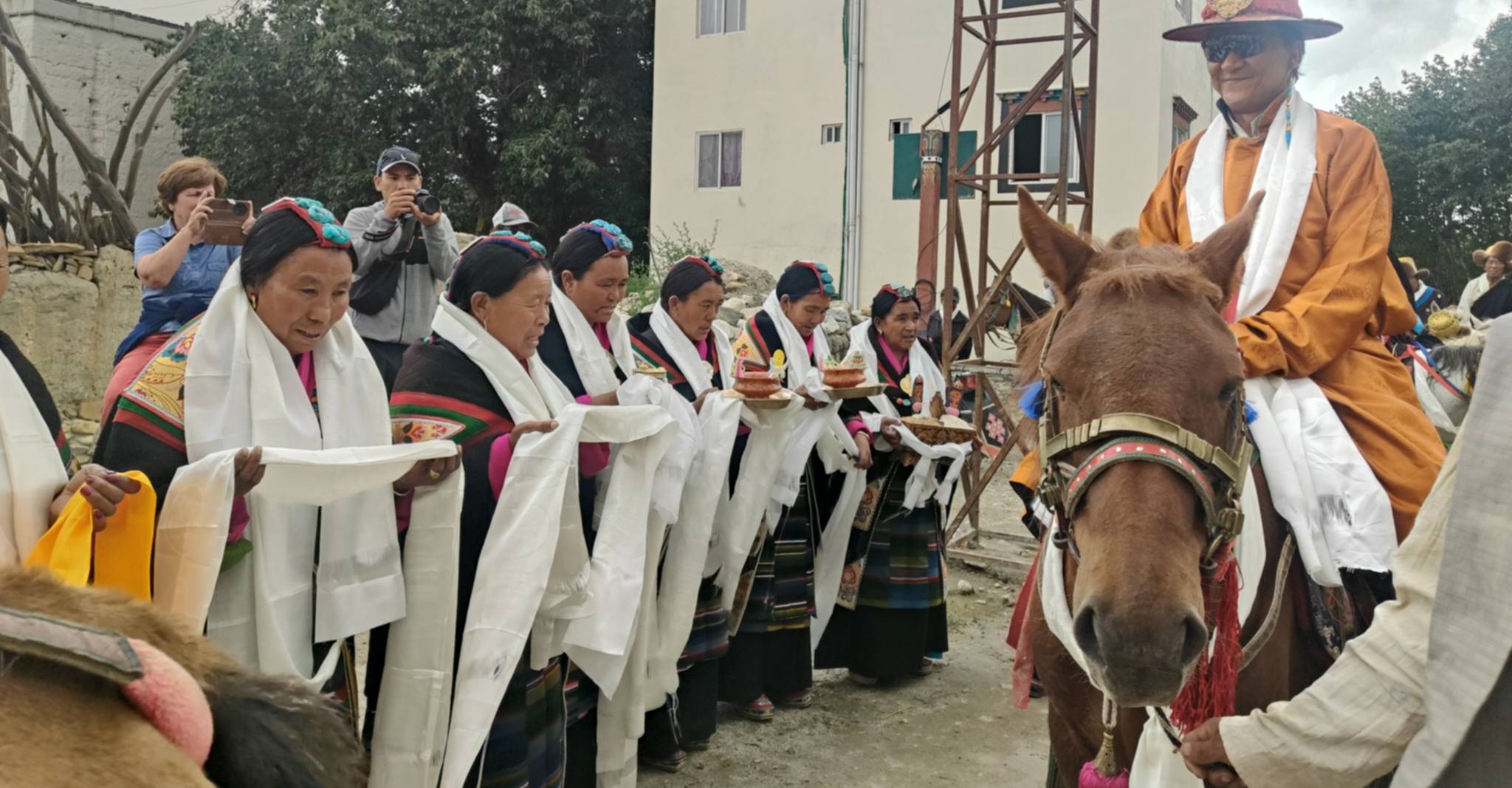
The first day of this year’s celebration in Lo Manthang began in the presence of Jigme Parwal Bista, the 26th Mustang cultural king, giving the opening day a strong connection with the region’s traditional social and cultural institutions. According to Lo Manthang 5 Ward Chairman Lakpa Wangdi Gurung, the participation of the Mustang cultural king holds particular importance on the first day. The three-day program will continue on the second day with the participation of the Mustang cultural king and queen, while the final day will feature religious activities involving lamas from monasteries in Lo Manthang.
This traditional division gives each day of Yartung a distinct character rather than treating the festival as a single uninterrupted celebration. Historical descriptions of Lo Manthang’s Yartung similarly identify the first day with the king, the second with the queen, and the final day with the monastic community. On the king’s day, people traditionally gather for communal meals, music, dancing, and horse-related activities, while the later days bring different groups of the community into the center of the celebration.
Horse racing remains the heart of Yartung
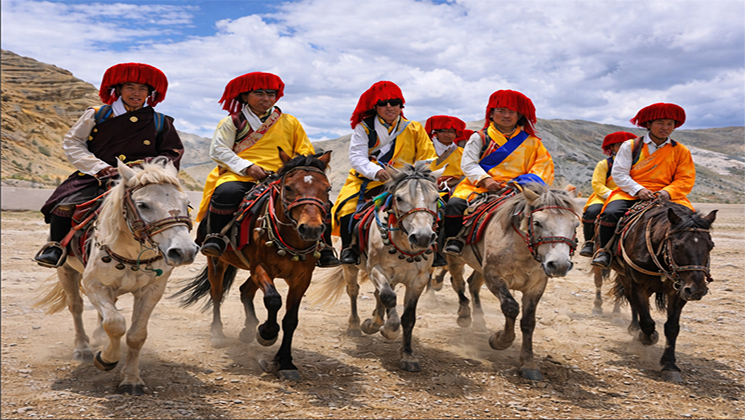
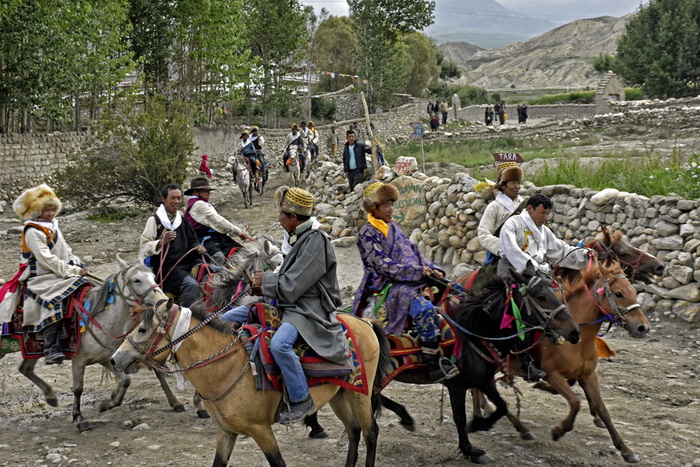
The most eagerly anticipated feature of Yartung is horse racing, a tradition that reflects the historical importance of horses in the life of Upper Mustang. On the first day of this year’s festival, a horse race was organized approximately two kilometres from Lo Manthang’s market area, drawing local spectators and visitors. Riders and horses became the centre of the celebration as traditional customs were performed along the route, demonstrating that the race is not simply a sporting competition but part of a much broader cultural ceremony.
The horse-riding tradition has survived because horses have historically been closely connected with transportation, trade, status and everyday life in Mustang. The horses used in the region are well suited to the difficult high-altitude environment, and traditional Yartung races test both the animals’ endurance and the riders’ skill. Historical accounts describe riders racing across open fields and demonstrating remarkable control of their horses, including attempts to pick up khata, or ceremonial silk scarves, from the ground while riding at speed and striking stationary targets with stones.
A striking ritual is performed along the race route
One of the most unusual traditions displayed during the first day’s horse race involved objects placed along the route by four local community groups. According to resident Bhichhiring Gurung, riders participated in a custom in which they struck and broke objects placed along the racing route, including sweet bread, an image or representation of a yak’s head, plastic mirrors and chyangra hooves, using stones. Such practices give the horse race a symbolic and ceremonial dimension and demonstrate how local customs have been incorporated into the competition over generations.
The race is therefore both a public spectacle and an expression of community identity. Traditional horse culture remains particularly important in the Mustang settlements, where residents regard horse riding as an essential part of their festivals. Gurung said that without horse riding, local celebrations would feel incomplete, underscoring the place of horses not merely as participants in a sporting event but as a defining element of the region’s cultural heritage.
The second day will bring another major horse race
The festival will continue for three days, with the second day scheduled to include another major horse-racing competition in Lo Manthang. According to the organizers, the riders finishing first, second and third will receive Rs 250,000, Rs 150,000 and Rs 100,000, respectively. The substantial prize money has added a competitive dimension to an event whose primary importance remains cultural and communal.
The second day is also associated with the participation of the Mustang cultural king and queen, according to the organizers of this year’s celebration. Traditional accounts of Yartung describe the second day as the queen’s day, when women from the community gather in traditional clothing and ornaments, participate in singing and dancing, and join the communal celebrations. Historical documentation of the festival shows that the second day has traditionally provided women with an important space within the wider celebration, while the horse-racing activities continue in the open fields.
The final day turns toward religion and the monasteries
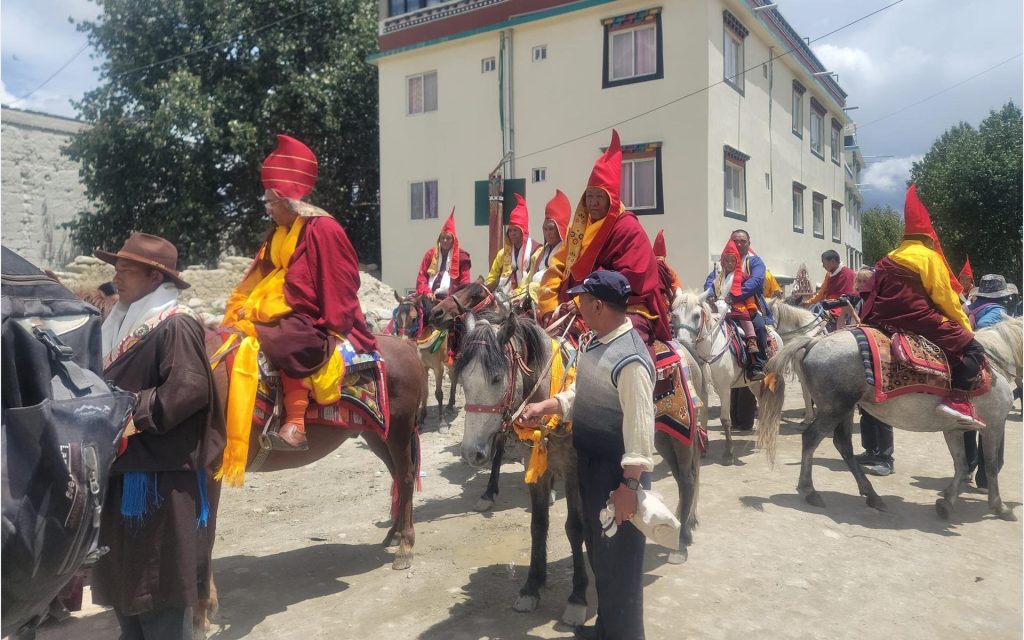
The final day of the Lo Manthang celebration will have a distinctly religious character, with lamas from different monasteries participating in religious programs. This reflects the strong connection between Yartung and the Buddhist traditions that shape the cultural life of Upper Mustang. Monastic participation gives the festival a spiritual dimension alongside its social and sporting activities, with prayers and religious observances traditionally associated with wishes for peace, prosperity and the well-being of the community.
Historical descriptions of Yartung in Lo Manthang refer to the final day as the Lama’s Yartung, when monks gather in the festival area for communal activities and religious observances. Unlike the more openly festive atmosphere associated with singing and dancing on the earlier days, the involvement of the lamas places greater emphasis on prayer and spiritual practice.
Food, chyang and communal feasting are essential parts of the festival
Yartung is also a festival of food and communal hospitality. Traditional celebrations involve families and households contributing food and grains for communal feasts, while locally produced chyang, a fermented barley drink, has historically been an important part of the gathering. A government-supported study on Mustang’s cultural heritage notes that households traditionally contributed grains to prepare food and chyang for major festivals such as Yartung, demonstrating that food preparation is not simply an individual household activity but part of collective participation in the festival.
Research on the Loba community’s agricultural and cultural practices also records Yartung feasts involving tea, chyang, butter, cheese, cakes and meat, reflecting the food traditions of the high-altitude Himalayan environment. Local festival foods may also include barley-based preparations, Tibetan-style bread, noodles, potatoes and other locally available ingredients. Butter tea and barley-based foods are particularly connected with the wider food culture of Upper Mustang, where agriculture and livestock have historically shaped household diets.
The communal meal is important because it turns the festival into a social gathering rather than merely a performance for spectators. People sit together, share food and drinks, sing traditional songs, and take part in dances and other activities. The preparation and sharing of food also reinforces relationships among families and communities, making the feast an important part of the festival’s role in maintaining social bonds. Studies of Mustang’s cultural traditions have noted that these communal feasts are closely tied to the continuation of local identity and customary practices.
Traditional dress, music and dance give the festival its identity
Yartung’s visual character comes not only from the horses but also from traditional clothing, music and dance. Participants traditionally dress in regional attire and wear ornaments associated with the Loba cultural heritage of Upper Mustang. Singing and dancing accompany the celebrations, with traditional performances providing entertainment during the communal gatherings. Historical accounts describe dances such as Shabro/Shebru, accompanied by music and community singing, as part of the festival atmosphere.
The music and dance are important because they allow cultural knowledge to be transmitted from older generations to younger members of the community. In a region where many young people increasingly leave their villages for employment and education elsewhere, festivals such as Yartung provide an opportunity for traditional practices to remain visible and actively performed. The festival is therefore not only a celebration of the past but also a living setting in which the community can teach and maintain its cultural customs.
A festival increasingly attracting tourists
The first day of this year’s Yartung festival also attracted domestic and foreign tourists to Lo Manthang, with residents reporting an increase in the presence of international visitors during the celebration. For tourists, the festival offers an opportunity to see Upper Mustang’s cultural traditions in their community setting, including horse racing, traditional dress, music, food and religious practices. The tourism appeal of Yartung is closely connected with the setting itself.
Lo Manthang is the historic walled center of Upper Mustang, an area known for its Tibetan-influenced culture, monasteries and distinctive Himalayan landscape. The festival adds a seasonal cultural experience to the destination, allowing visitors to encounter traditions that are difficult to experience outside the festival period. Tourism sources describe Yartung as a genuine community celebration rather than an event created exclusively for visitors, with tourists welcomed as observers of a tradition that remains primarily rooted in local life.
Protecting a tradition as young people leave the region
The festival has also taken on greater importance as communities face changes in their traditional way of life. According to ACAP Lo Manthang Chief Umesh Paudel, the rural municipality and ACAP have been supporting the organization and management of Yartung to help protect and promote the historic, religious and cultural festival. He noted that the increasing trend of young people leaving the region for overseas employment has made the preservation of local traditions particularly important.

This concern goes beyond Yartung itself. Research on Mustang’s cultural heritage has documented pressures on traditional festivals from changing livelihoods, declining agricultural production and climate-related difficulties. Traditional festivals have historically depended on household contributions of grains and local products, while changes in food production can make it harder for communities to maintain large communal celebrations.
More than a horse race, Yartung is a living heritage
The significance of Yartung lies in the way sport, religion, food, music, family life and community identity come together in one celebration. Its horse races provide the most dramatic public spectacle, but the festival’s deeper purpose is the gathering of people after the agricultural season, the continuation of religious and cultural practices, and the transmission of traditions to younger generations. The three-day structure gives space to the cultural king and queen, the wider community, and the Buddhist monastic tradition, creating a celebration that represents different dimensions of Upper Mustang society.
As the 2026 Yartung festival continues in Lo Manthang, the event is simultaneously serving as a cultural gathering for residents and an increasingly important heritage tourism experience for visitors. The combination of traditional horse racing, communal feasting, music and dance, ceremonial practices and monastic activities offers a rare window into the living culture of Upper Mustang. With the second day bringing another major horse racing competition and the final day turning toward religious observances, Yartung remains one of the region’s most distinctive annual expressions of Himalayan cultural heritage and community identity.