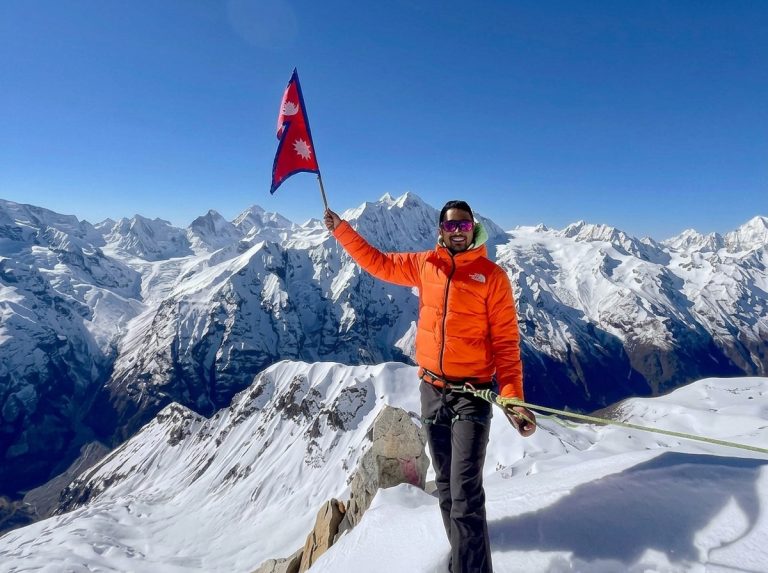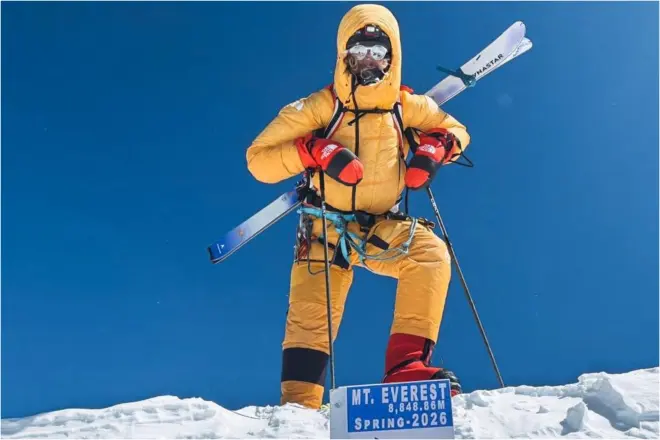
Polish mountaineer Bartek Ziemski has achieved a groundbreaking milestone in high-altitude skiing, successfully summiting and skiing down both Mount Lhotse and Mount Everest in the same season, without the use of supplemental oxygen. The achievement makes him the first person in history to ski down both giants in a single season without oxygen support, marking a rare feat in extreme alpine skiing.
Everest Ski Descent Completed After Oxygen-Free Ascent
Ziemski reached the summit of Everest on May 19 after a fully self-supported climb, carrying all his equipment from base camp without Sherpa assistance. He ascended independently, with no fixed expedition support team, and relied entirely on his own logistics and endurance throughout the climb. Despite heavy summit traffic during the peak season, he successfully transitioned at the summit and began his ski descent immediately, navigating down the world’s highest peak on skis all the way to Base Camp.

Lhotse First, Everest Second in Seven-Day Gap
Just seven days earlier, Ziemski had already summited Lhotse and completed a ski descent, setting the stage for his Everest attempt. Together, these back-to-back achievements form a rare double accomplishment in high-altitude ski mountaineering, especially without oxygen or large expedition support.
MAD Ski Project Driving Extreme Objectives
The feats are part of his long-term ambition under the “MAD Ski Project”, a personal initiative focused on skiing the world’s highest mountains in alpine style. Ziemski has now successfully skied down nine eight-thousand-meter peaks, steadily building one of the most ambitious ski mountaineering records in the world.
A Growing List of 8000-Meter Ski Descents
His high-altitude ski resume began in 2022 when he summited and skied down Broad Peak and Gasherbrum II as part of the Beskid Expedition Team.
He continued with major Himalayan summits in the following years:
- 2023: Annapurna and Dhaulagiri
- 2024: Makalu and Kangchenjunga
- 2025: Manaslu
- 2026 season: Lhotse and Everest
With these additions, only a handful of the world’s 8,000-meter peaks remain on his unfinished list, including K2, Nanga Parbat, Shishapangma, Cho Oyu, and Gasherbrum I.

Contrast with Supported Expeditions
While Ziemski’s ascent was fully self-supported, other ski descents on Everest have involved larger logistics teams. In 2025, fellow Polish skier Andrzej Bargiel also completed a ski descent of Everest under a heavily supported expedition structure organized by Seven Summit Treks, which included route preparation teams and multiple Sherpa climbers. Bargiel reached the summit after a three-day push and took two days for the ski descent, with additional technological and logistical assistance.
A New Benchmark in Alpine Ski Mountaineering
Ziemski’s latest achievement is being seen as a major milestone in the evolution of ski mountaineering, particularly for its emphasis on self-reliance, oxygen-free ascent, and minimal support style climbing. His combination of speed, endurance, and technical skiing ability places him among a small group of elite athletes pushing the limits of what is possible in the Himalayas. As the ski mountaineering world continues to evolve, his Everest-Lhotse double descent stands out as one of the most significant achievements of the modern era.