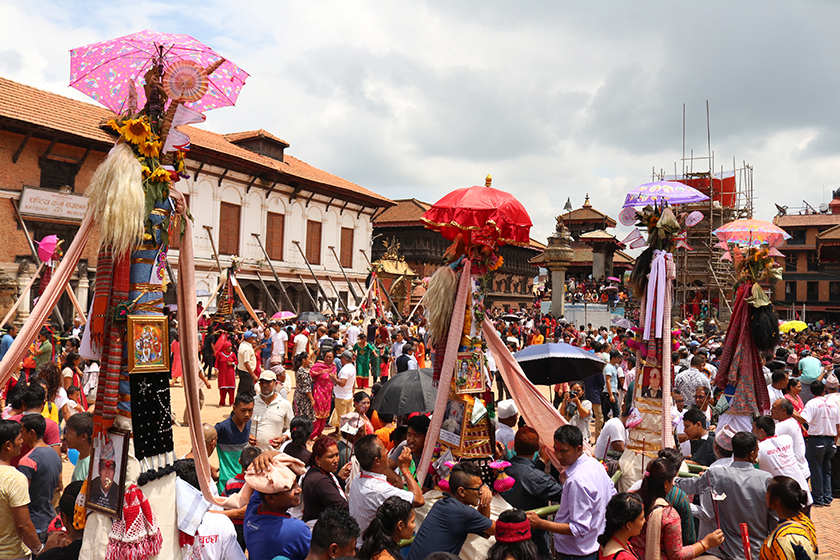
Gaijatra, locally known as Saanya or Saaparu, unfolded with vibrant processions, traditional music, symbolic cow figures, devotional rituals, satire, and street performances. Observed in Bhaktapur for eight nights and nine days, the festival brings together remembrance of deceased family members and the lively cultural traditions of the Newar community. From the morning procession of Taleju Bhawani’s Saanya to the evening procession of straw figures through the city’s historic neighborhoods, the first major day of the festival transformed Bhaktapur’s centuries-old streets into a vibrant cultural stage.
Historic Streets Turn Into A Living Cultural Stage
The first day of the celebration began in the morning with the procession of Taleju Bhawani’s Saanya, which moved through the city according to longstanding traditions honoring deceased relatives. In the evening, the Bhairavnath Jatra Cooperation Committee of Lakulachhen organized the procession of Bhaildyo, a large straw representation, together with 18 Tahaasa from the Lakulachhen neighborhood. The procession began near Pottery Square and continued through Taumadhi and other parts of the historic city before circling Bhaktapur Durbar Square. The movement of these traditional displays through the ancient streets created one of the festival’s most distinctive scenes, bringing together religious observance, community participation and cultural performance.

According to cultural expert Shree Sharan Joshi, the traditional sequence of Gaijatra is connected with the worship of Natyeshwori at Sukuldhoka by Guthi Sansthan, followed by the procession of Ghintaang Ghisi. Religious tradition holds that on the first day of Bhadra, the gateway to heaven is believed to be open, and the display of cows is therefore associated with the belief that the souls of the deceased can cross the mythical Baitarani River by holding onto a cow’s tail. Another longstanding belief says that a single step taken by a cow on this day carries spiritual merit equivalent to an Ashwamedha Yajna, reflecting the deep religious significance attached to the festival.
Every Tahaacha Tells A Story Of Loss And Remembrance
The symbolism of Gaijatra extends beyond the public procession, with families creating representations that honor relatives who have died during the year. Cultural expert Hari Sharan Amatya explained that when a child dies, a symbolic cow may be created using a decorated basket, clothing, a cow-like face, straw horns, and other handmade ornaments before being carried through the city. In cases where a pregnant woman has died, another cow-shaped figure representing the unborn child may be attached to the symbolic cow representing the mother. Children also take part in the festival by being dressed as Mahadev and Parvati and presented through the streets with traditional music and ceremonial performances. These practices allow families to publicly remember their loved ones while maintaining customs that have been passed down through generations.
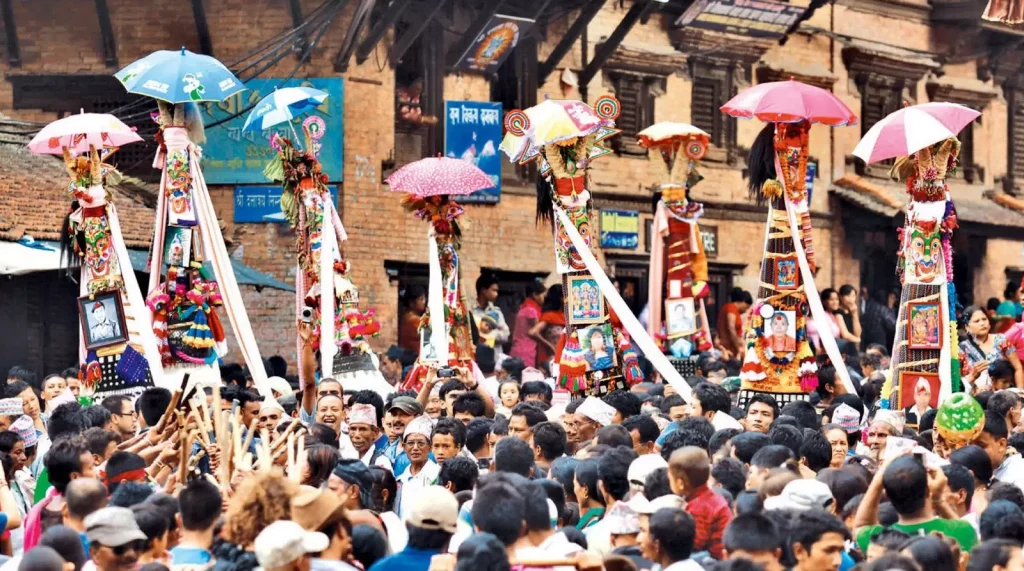
One of the most recognizable attractions of Bhaktapur’s Gaijatra is the Ghintaang Ghisi dance, a traditional performance in which participants move through the streets while rhythmically striking wooden sticks together. The dance is particularly associated with Bhaktapur and is performed alongside traditional music and other deity-related performances. Its distinctive rhythm and energetic movement draw large crowds, while the combination of dance, music, symbolic figures and processions gives Bhaktapur’s celebration a character that distinguishes it from Gaijatra observances elsewhere in the Kathmandu Valley. Participants and musicians are traditionally honored with a feast by the families involved after the festival, reinforcing the community spirit surrounding the celebration.
Eight Nights Of Dance, Satire And Cultural Expression
Gaijatra in Bhaktapur extends well beyond its principal procession. Special Tahaacha representing Bhairav and Bhadrakali are traditionally displayed during the festival, adding further religious and cultural significance to the celebrations. The festival continues from the Shrawan Shukla Purnima period through Krishna Ashtami, with different traditional dances, theatrical performances and satire presented across the city. From the day after the principal Gaijatra procession, residents continue to organize Ghintaang Ghisi dances, other traditional performances and satirical presentations during the afternoons and evenings, keeping the historic neighborhoods active throughout the festival period.
The festival’s historical development is closely associated with the Malla period. Historians and cultural scholars cited in the original report associate Gaijatra with Pratap Malla in Kathmandu, Siddhi Narasimha Malla in Lalitpur, and Jagat Prakash Malla in Bhaktapur. A popular legend connects the festival with King Pratap Malla after the death of his son left the queen deeply distressed. The tradition is said to have been encouraged so that she could see that other families in the city had also experienced loss. When this did not fully ease her grief, the king is traditionally believed to have ordered the inclusion of humor, satire, and playful performances, creating the distinctive combination of remembrance and entertainment that remains central to Gaijatra today.

Bhaktapur’s Living Heritage Strengthens Its Tourism Appeal
For Bhaktapur, Gaijatra represents far more than a religious festival. It is a living expression of Newar heritage, bringing together traditional rituals, music, dance, craftsmanship, community customs and oral traditions in the same historic spaces that define the city’s cultural landscape. During the festival, Bhaktapur’s squares and traditional neighborhoods become active cultural venues where residents do not simply preserve heritage as monuments but continue to practice and perform it as part of everyday community life. The distinctive Ghintaang Ghisi performances, Tahaacha processions, deity dances and satirical presentations make the celebration particularly attractive to those interested in experiencing Nepal’s living culture.
The festival also adds a powerful cultural dimension to Bhaktapur’s tourism identity, allowing visitors to experience the historic city at a time when its traditions are most visibly expressed in public life. Rather than being limited to temples, courtyards and heritage architecture, the experience extends into processions, performances, music and community rituals taking place throughout the old city. With its combination of remembrance, religion, music, dance, satire and Newar cultural heritage, Bhaktapur’s Gaijatra continues to demonstrate why the city remains one of Nepal’s most compelling destinations for travelers seeking an authentic cultural experience.