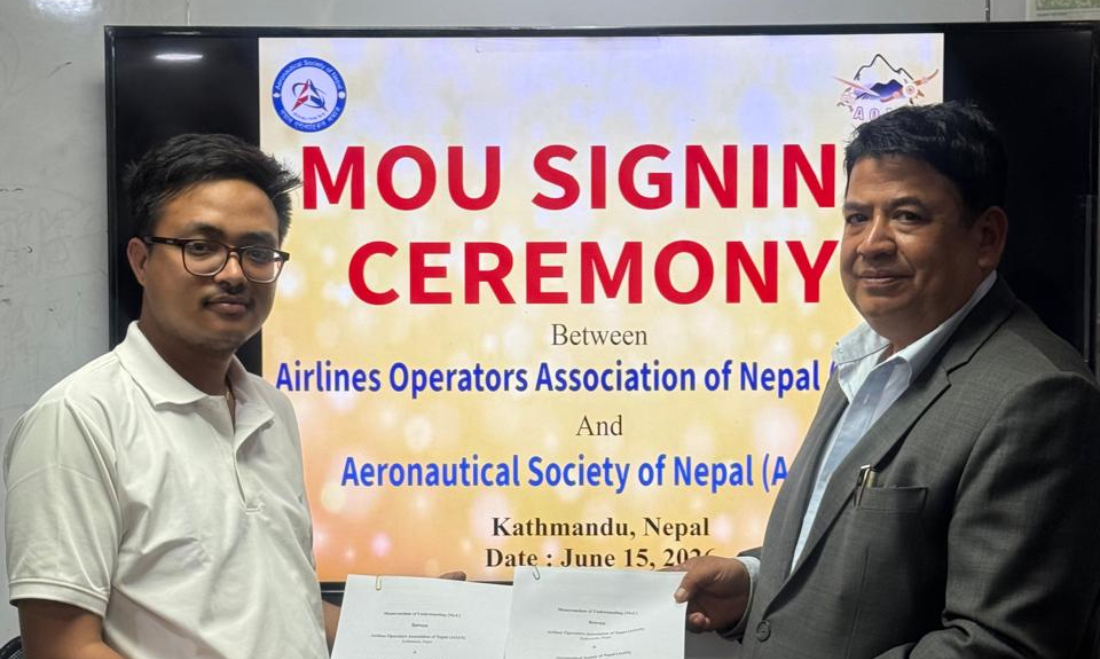
The Airlines Operators Association of Nepal (AOAN) and the Aeronautical Society of Nepal (AeSN) have formally signed a significant Memorandum of Understanding (MoU), bringing together two of Nepal’s most important aviation institutions under a shared vision for the transformation and long-term development of the country’s aviation sector. The MoU was signed at a specially organised ceremony, with AOAN President Pratap Jung Pandey signing the agreement on behalf of his organisation, marking the beginning of a new and purposeful era of structured collaboration between Nepal’s airline operators and its aeronautical research and technical community.
Two Institutions, One Shared Vision
The MoU between AOAN and AeSN represents the coming together of two organisations with complementary strengths, distinct expertise, and a shared commitment to the advancement of Nepal’s aviation industry. The Airlines Operators Association of Nepal, established in 2055 BS (1998 AD), has served for more than two decades as the principal representative body of Nepal’s aviation industry, advocating for the interests of airline operators, industry stakeholders, and the broader aviation community. Over the years, AOAN has been at the forefront of efforts to improve the operational, regulatory, and commercial environment for civil aviation in Nepal, building an institutional reputation as the authoritative collective voice of Nepal’s airline industry.
The Aeronautical Society of Nepal, established in 2075 BS (2018 AD), represents a newer but rapidly growing force in Nepal’s aviation landscape, one focused on the technical, research, and professional development dimensions of the industry. Since its founding, AeSN has made consistent and valuable contributions to aeronautical knowledge generation, technical research, and the professional development of Nepal’s aviation workforce, establishing itself as an important bridge between the academic, technical, and operational communities within the sector.
By combining AOAN’s industry leadership and operational experience with AeSN’s technical knowledge and research capabilities, the MoU creates a powerful institutional partnership that is greater than the sum of its parts, one uniquely positioned to drive meaningful and lasting progress across multiple dimensions of Nepal’s aviation development.

Responding to a Rapidly Changing Global Aviation Landscape
The signing of the MoU comes at a moment of profound and accelerating transformation in the global aviation industry. Around the world, the aviation sector is undergoing a rapid and far-reaching digital revolution, with digitalisation, automation, data-driven decision-making systems, artificial intelligence, sustainable aviation technologies, and environmental accountability emerging as the defining forces reshaping every aspect of how airlines, airports, and aviation service providers operate.
Nepal’s aviation sector, which has historically faced significant challenges in terms of safety standards, infrastructure development, regulatory capacity, and technical workforce quality, cannot afford to be left behind in this global transformation. The MoU between AOAN and AeSN is explicitly conceived as Nepal’s institutional response to this global imperative, a deliberate and structured effort to ensure that Nepal’s aviation community is prepared, equipped, and empowered to navigate the opportunities and challenges of this rapidly evolving landscape.
AOAN has stated clearly that the partnership is designed to build a common platform through which the entire Nepali aviation community can develop a shared vision, foster collective solidarity, and build the collaborative capacity needed to meet future demands and challenges with confidence and competence.
A Unified Platform for the Entire Aviation Community
One of the most significant and transformative aspects of the MoU is its ambition to create a single, unified platform that brings together every segment of Nepal’s aviation community, from airline companies and airport operators to service providers, engineers, technical personnel, researchers, academics, students, and aspiring aviation professionals. This inclusive vision of aviation community building reflects a recognition that the challenges and opportunities facing Nepal’s aviation sector are too large and too complex to be addressed by any single organisation or stakeholder group acting alone.
By connecting these diverse groups through a shared institutional framework, the AOAN-AeSN partnership aims to foster the free and productive exchange of knowledge, experience, innovation, and expertise across organisational and professional boundaries, creating the conditions for a more cohesive, dynamic, and forward-looking aviation community that can collectively drive the sector’s development in ways that isolated individual efforts cannot achieve.
Twelve Key Areas of Collaboration
The MoU between AOAN and AeSN is built on a comprehensive and ambitious framework of twelve key areas of collaboration that together address the full spectrum of Nepal’s aviation development needs. These twelve pillars of partnership reflect the breadth and seriousness of the two organisations’ shared commitment to transforming Nepal’s aviation sector and collectively cover the following priority areas:
The initiative focuses on overall capacity development and leadership promotion within the aviation sector through structured training and professional development programmes. It emphasizes skill enhancement in aviation operations, engineering, maintenance, safety management, and emerging technologies, while also strengthening collaboration to produce a skilled workforce aligned with international standards. Special attention is given to the development of students, young professionals, and future aviation leaders, along with the promotion of safety, sustainability, innovation, and research to build a strong safety culture across the industry.
It further aims to expand cooperation in digitalisation, data analytics, artificial intelligence, and other emerging technologies to modernize the aviation sector. The programme also promotes unity, coordination, and knowledge sharing among aviation stakeholders by strengthening links between industry, academic institutions, and technical communities. In addition, it encourages the organization of seminars, conferences, workshops, and technical interaction programmes, along with knowledge exchange, experience sharing, and policy dialogue involving both national and international experts.
Together, these twelve areas of collaboration constitute a holistic and integrated roadmap for the modernisation, professionalisation, and future-proofing of Nepal’s aviation industry, one that addresses human resource development, technological advancement, safety culture, research and innovation, and institutional unity in a coordinated and mutually reinforcing way.
Safety Culture and Sustainable Aviation at the Core
Among the twelve areas of collaboration outlined in the MoU, two stand out as particularly critical given the specific challenges and priorities of Nepal’s aviation context: the development of a strong safety culture and the promotion of sustainable aviation practices. Nepal’s aviation sector has historically struggled with safety challenges that have attracted international scrutiny and had significant consequences for the country’s aviation industry, including restrictions on Nepali carriers operating in certain international markets.
The explicit commitment in the MoU to building and promoting a robust safety culture across the entire aviation community represents an important institutional acknowledgement that safety improvement in Nepal’s aviation sector requires not just regulatory action but a fundamental shift in the values, attitudes, and practices of all aviation stakeholders, from airline management and pilots to engineers, ground staff, and service providers. The AOAN-AeSN partnership is committed to driving this cultural transformation through training, knowledge sharing, research, and the creation of institutional norms and expectations that place safety at the very centre of everything Nepal’s aviation community does.

Similarly, the MoU’s emphasis on sustainable aviation reflects the growing global importance of environmental responsibility in the aviation industry and Nepal’s need to align itself with international sustainability standards and expectations as it seeks to strengthen its position in the global aviation community.
Digitalisation and AI: Preparing Nepal’s Aviation for the Future
The MoU’s strong emphasis on digitalisation, data analytics, and artificial intelligence reflects a clear-eyed recognition that these technologies are not distant future possibilities but present-day realities that are already fundamentally reshaping how the world’s aviation industries operate. The AOAN-AeSN collaboration will prioritise the development of Nepal’s capacity to adopt, adapt, and leverage these transformative technologies, ensuring that Nepal’s airlines, airports, and aviation service providers are not left behind as the global industry moves rapidly toward AI-driven operations, predictive maintenance, data-based safety management, and digital passenger services.
A Call to the Entire Aviation Community
In announcing the MoU, AOAN has issued a broad and open invitation to all stakeholders across Nepal’s aviation sector to join and actively participate in this shared mission of building a unified, competitive, safe, and future-ready aviation industry. The association has emphasised that the transformation envisioned through this partnership is a collective endeavour that requires the engagement, commitment, and contribution of every member of Nepal’s aviation community, from established industry leaders to young students taking their first steps toward aviation careers.
This inclusive call to action reflects AOAN’s conviction that Nepal’s aviation sector can only achieve its full potential through genuine unity, shared purpose, and collective effort, values that lie at the very heart of the MoU signed with AeSN and that will guide the partnership’s work in the years ahead.