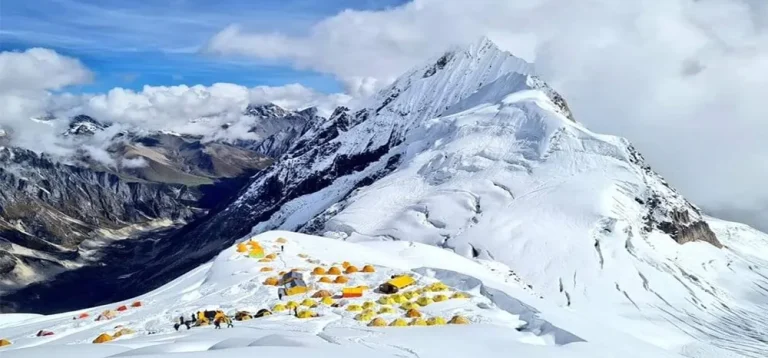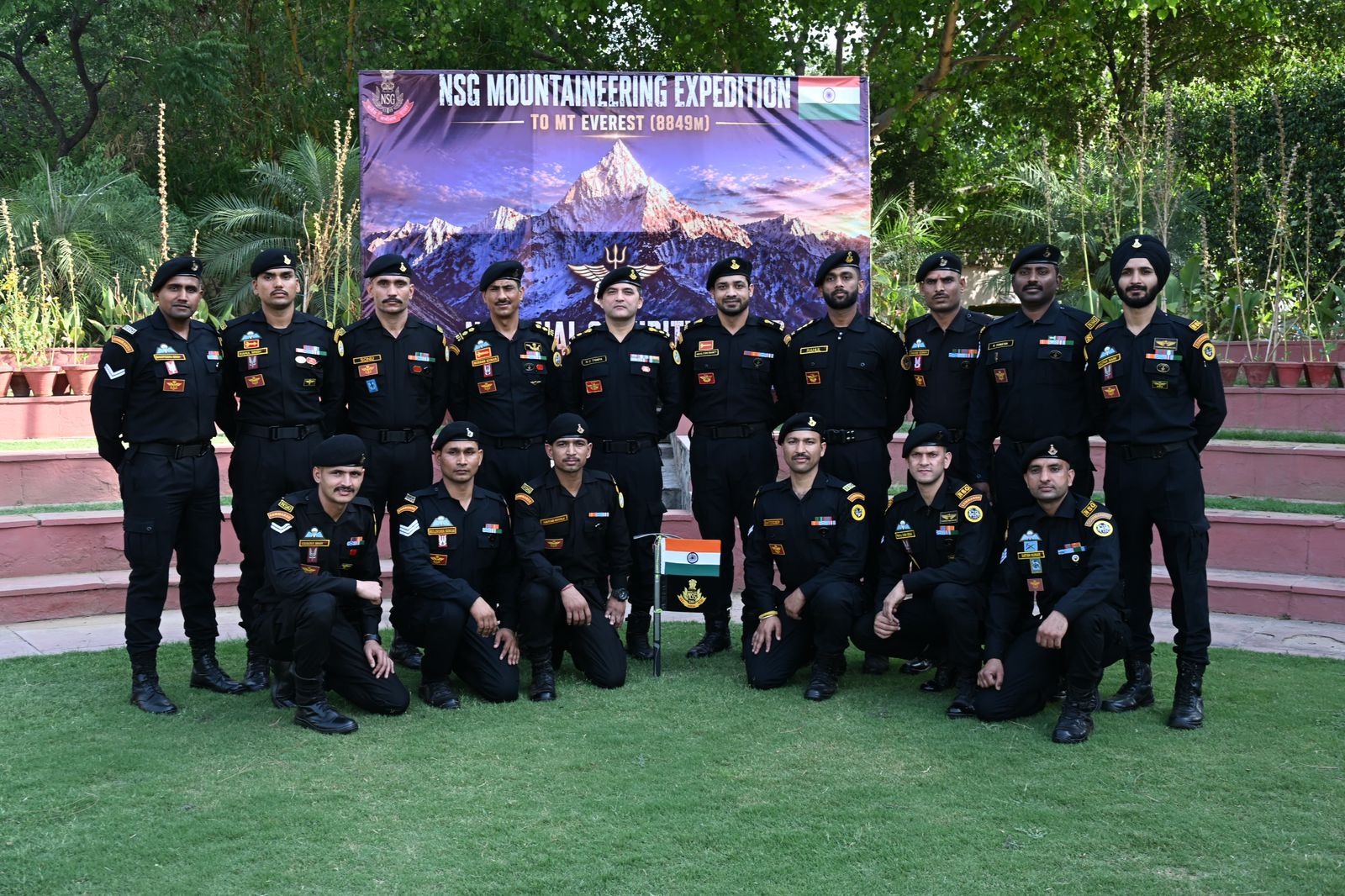
A team of ten commandos from India’s National Security Guard (NSG), popularly known as the “Black Cats,” successfully summited Mount Everest on May 23 at 3:26 AM, completing a full expedition from Kathmandu in just 20 days.
The mission, titled the NSG Everest Expedition 2026, showcased exceptional endurance, discipline, and coordination by India’s elite counter-terrorism force, established in 1984 for rapid response and special operations.

Team Composition and Leadership
The 16-member expedition team consisted of 10 Indian climbers and 6 Nepali Sherpa guides. The team operated under the command of Lt. Col. Ram Chandra Thapa, with Major Akhilesh Bhatt serving as climbing leader and Mingma Thindu Sherpa as Sirdar.
The expedition was organized and professionally coordinated by Seven Summit Treks, with Director Chhang Dawa Sherpa overseeing logistics and field management throughout the mission.
List of Summiteers
The successful Indian summiteers included Major Akhilesh Bhatt (Climbing Leader), Bavinder Singh, Bhoopendra Singh, Pankaj Singh Dosad, Rahul Singh, Ravinder Singh, Satish Kumar, Sonu, Sulinder Singh, and Suresh Kumar.
The Nepali Sherpa support team comprised Mingma Thindu Sherpa, Danuru Sherpa, Lakpa Temba Sherpa, Ngima Dorchi Sherpa, Ming Dorchi Sherpa, Pemba Sherpa, Lakpa Tendu Sherpa, Furtenji Sherpa, Phurtenjen Sherpa, Dawa Rinje Sherpa, Chhangwa Sherpa, Lakpa Tasi Sherpa, Chhiring Sherpa, Pastemba Sherpa, Nima Tashi Sherpa, and Dawa Rinjin Sherpa.
Rapid Ascent and Operational Efficiency
The expedition is being praised for its unusually fast turnaround, completing the full Kathmandu-to-summit-and-return cycle in just 20 days. Experts note that such a timeline reflects strong physical preparation, precise acclimatization planning, and highly efficient logistical support.
The NSG team reached the summit in a coordinated push, marking one of the fastest structured institutional Everest expeditions in recent years.
Additional Activities and Environmental Efforts
Beyond the climb, the team also conducted a medical camp at Everest Base Camp and participated in mountain clean-up initiatives, reinforcing environmental responsibility in the fragile Himalayan ecosystem.
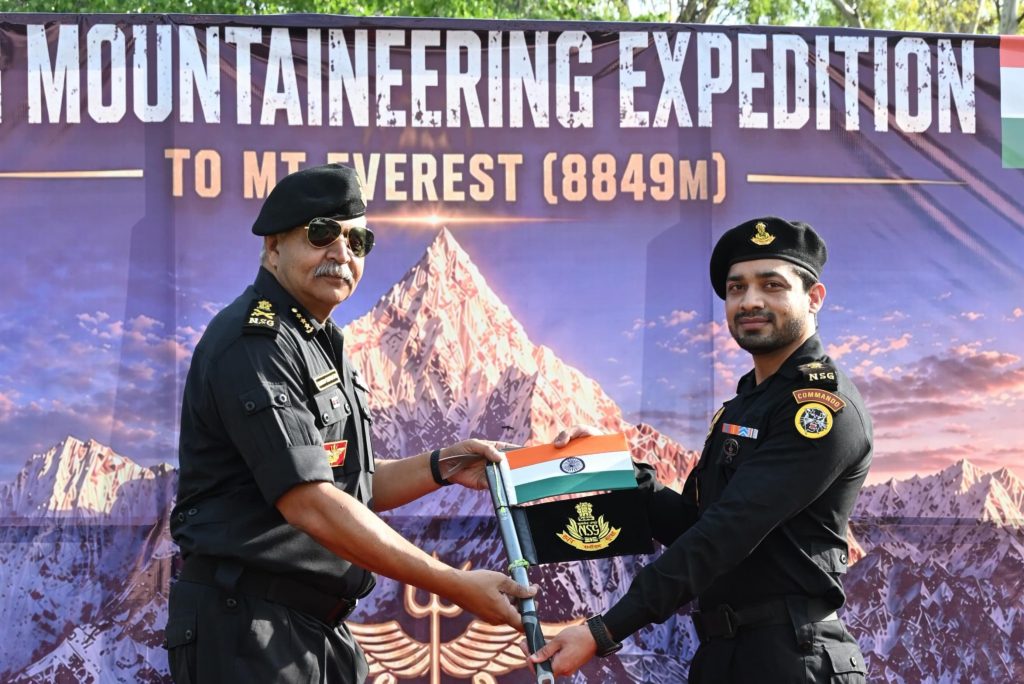
The expedition was formally flagged off by NSG Director General Shri Brighu Srinivasan, IPS, highlighting institutional support for adventure and endurance training.

Symbol of Friendship and Endurance
Officials stated that the mission reflects the NSG’s ethos of “Sarvatra Sarvottam Suraksha,” demonstrating physical and mental resilience aligned with its elite operational mandate.
The successful ascent also stands as a symbol of cooperation and friendship between Nepal and India, with strong collaboration between Indian climbers and Nepali Sherpa guides in one of the world’s most extreme environments.