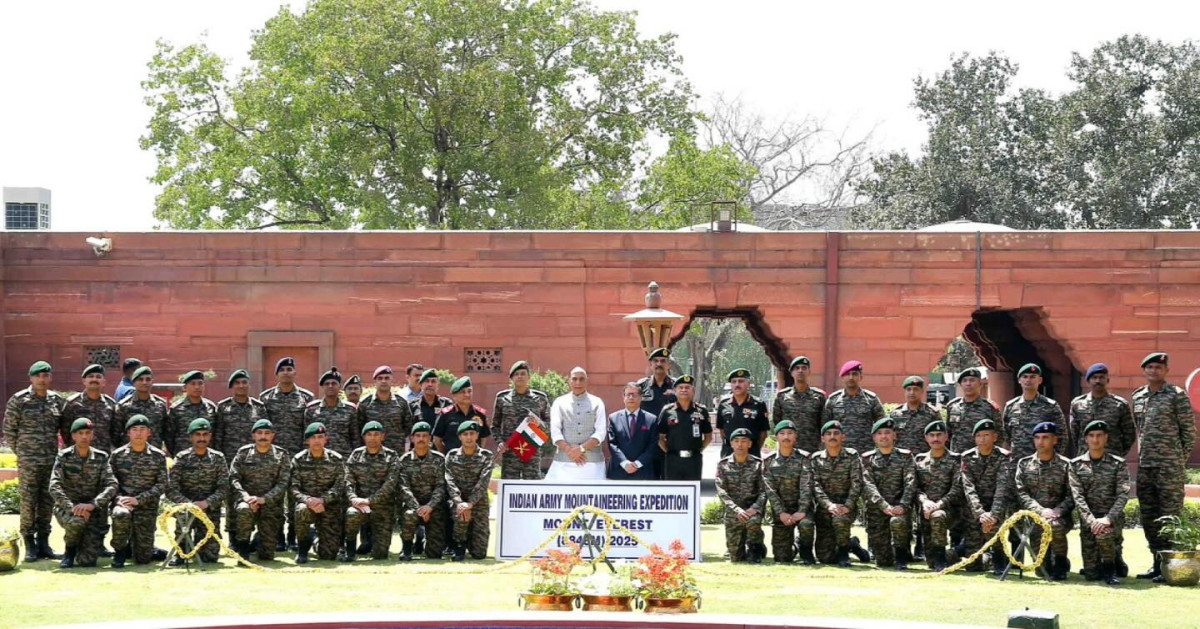
The Indian Army’s Army Adventure Wing (AAW) has created mountaineering history by achieving the largest single-day summit of Mount Everest by a single organisation. During the Spring 2025 climbing season, a total of 49 climbers and Sherpa guides successfully reached the summit of the world’s highest peak on May 27, setting a new world record certified by the Official World Record. The feat stands as a remarkable demonstration of coordination, endurance, and high-altitude expertise.
Historic Feat During Silver Jubilee Everest Expedition
The record was achieved as part of the Indian Army’s Silver Jubilee Everest Expedition, marking 25 years since the Army’s first successful Everest mission. The summit push included 22 Indian Army climbers supported by 27 experienced high-altitude Sherpa guides. All members reached the 8,848.86-metre summit on the same day, making it the largest coordinated ascent of Everest ever completed by a single organisation within 24 hours.

This unprecedented achievement highlights not only the physical capability of the climbers but also the logistical precision required to manage such a large team on the mountain during a narrow and weather-dependent summit window.
Role of Seven Summit Treks in Logistics and Operations
The expedition was operated and logistically supported by Seven Summit Treks, a Nepal-based expedition company renowned for managing large-scale Himalayan expeditions. The company was responsible for comprehensive logistical arrangements throughout the season, including Sherpa coordination, oxygen supply, route support, camp management and base camp operations.
Seven Summit Treks played a crucial role in ensuring smooth movement between camps, maintaining safety standards, and supporting climbers during acclimatisation rotations and the final summit push.
Leadership and Expert Coordination
The AAW expedition was led by Lieutenant Colonel Manoj Joshi and followed the traditional South Col route under favourable weather conditions. Weeks of structured acclimatisation and preparation enabled the team to take advantage of a stable summit window.
Overall expedition leadership was overseen by Chhang Dawa Sherpa, who previously led the historic first winter ascent of K2 in 2021. Operational coordination and ground handling were managed by Mingma Sherpa, Nepal’s first mountaineer to summit all 14 peaks above 8,000 metres.

Veteran climber Kami Rita Sherpa, the world record holder for the most Everest ascents with 31 summits, served as the main sirdar (lead guide). He led high-altitude operations alongside a team of certified mountain guides and experienced Sherpa climbers, overseeing route fixing support, oxygen logistics, and camp management during the critical summit phase.
Largest Single-Day Summit Achieved Through Precision Planning
According to Seven Summit Treks, the success of the record-setting ascent was the result of meticulous planning, phased acclimatisation schedules, and precise timing of climber movements across various camps. Such coordination was essential to maintain safety while managing a large group in extreme conditions.
Mountaineering experts noted that handling a team of this size on Everest demands exceptional discipline, experienced leadership, and seamless communication. The challenge was further heightened by variable weather patterns and growing concerns over crowd management during the peak climbing season.
Indian Army Climbers Who Reached the Summit
The Indian Army climbers who successfully summited Mount Everest are:
Lt. Col. Bhanoo Pathak, Mahak Mehta, Anirudh Yadav, Krishna Bahadur Kuwar, Tashi Stanba, Indra Singh Adhikari, Sunil Singh, Arjun Thapa Magar, Shankar Nath Goswami, Sunil Budhalakoti, Kundan Singh, Tundup Namgail, Raghuveer Singh, Urgain Padma, Deepak Singh, Rigzen Nurboo, Tsewang Motup, Balwant Singh, Bhuvan Ale Magar, Pradeep Singh, Dharmendra Singh, and Kiran Bahadur PC. They were supported by 27 Sherpa guides who formed an integral part of the historic summit push.

Significance for Mountaineering and Regional Cooperation
The successful expedition holds deep symbolic value as it commemorates the Indian Army’s 25-year legacy in Everest mountaineering. The mission concluded without major incidents, underscoring the importance of structured expedition management, professional Sherpa support, and disciplined teamwork at extreme altitudes.
The record-setting climb has also been hailed as a strong example of Nepal–India cooperation in the Himalayas, highlighting the indispensable role of Nepali Sherpas alongside the training, resilience, and commitment of Indian Army climbers in achieving extraordinary high-altitude success.