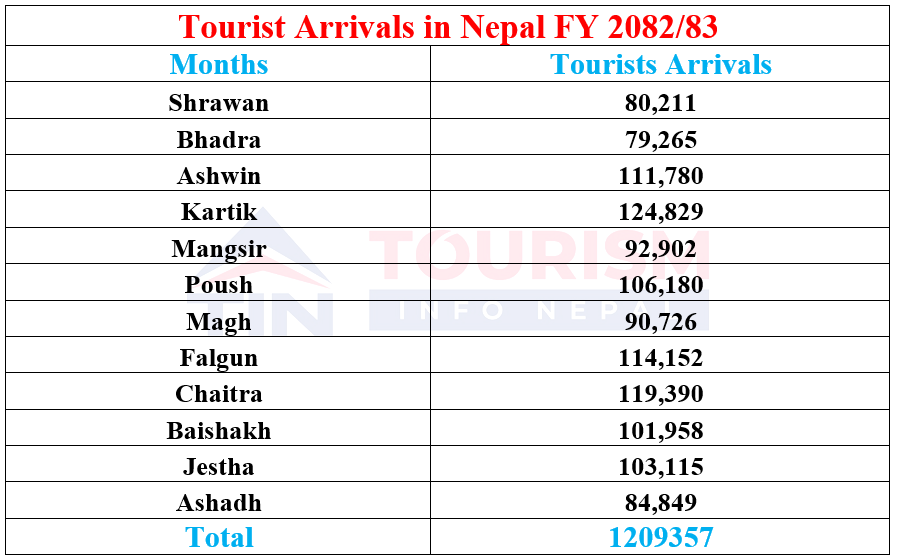
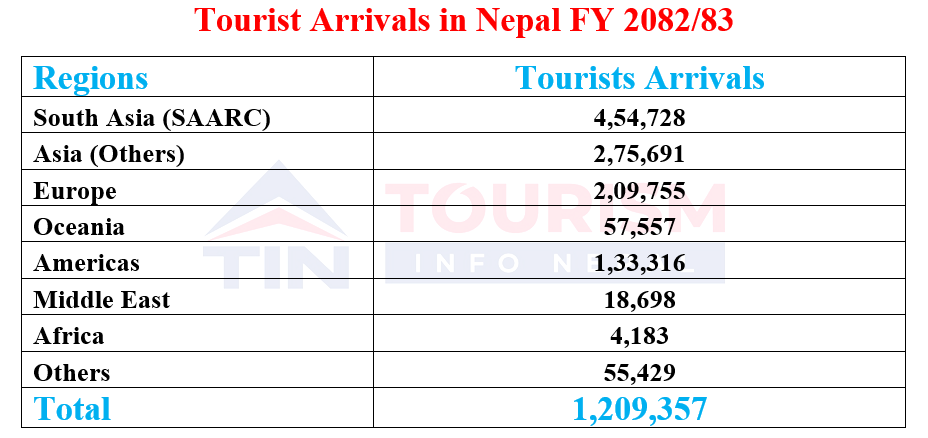
Nepal welcomed 1,209,357 international tourists during the fiscal year 2082/83, with India remaining the country’s largest source market, according to data released by the Nepal Tourism Board (NTB). The latest figures indicate continued growth in Nepal’s international tourism sector, supported by strong arrivals from neighbouring countries, major long-haul markets and intensified promotional campaigns in key destinations.
According to the NTB’s international tourist arrival statistics, India contributed the largest number of visitors during the fiscal year, with 311,531 Indian tourists travelling to Nepal. India accounted for approximately 25.76 percent of total international arrivals, maintaining its position as Nepal’s most important source market. The United States ranked second with 111,325 visitors, while China emerged as the third-largest source market with 109,892 tourists.
The strong performance of these three markets highlights the importance of both neighbouring and long-haul destinations to Nepal’s tourism industry. India and China remain particularly significant because of their geographical proximity, large populations and growing interest in Nepal’s cultural, spiritual, adventure and leisure tourism products. Meanwhile, the United States continues to be one of Nepal’s strongest long-haul markets, contributing a substantial share of international visitors.
Bangladesh, UK and Australia among major source markets
Following India, the United States and China, Bangladesh emerged as another important source market, sending 58,163 visitors to Nepal during the fiscal year. The United Kingdom contributed 56,649 tourists, while Australia accounted for 53,195 arrivals. Other notable source markets included Sri Lanka, which contributed 43,211 visitors, followed by Bhutan with 36,289, Myanmar with 30,737, Germany with 29,296, Thailand with 27,201, Japan with 25,762 and Malaysia with 25,640 visitors.
The arrival figures show that Nepal continues to attract tourists from a broad range of international markets. While neighbouring countries remain central to the country’s tourism performance, traditional European and North American markets, along with destinations in the Asia-Pacific region, continue to provide a stable base for the industry.
October recorded the highest monthly tourist arrivals
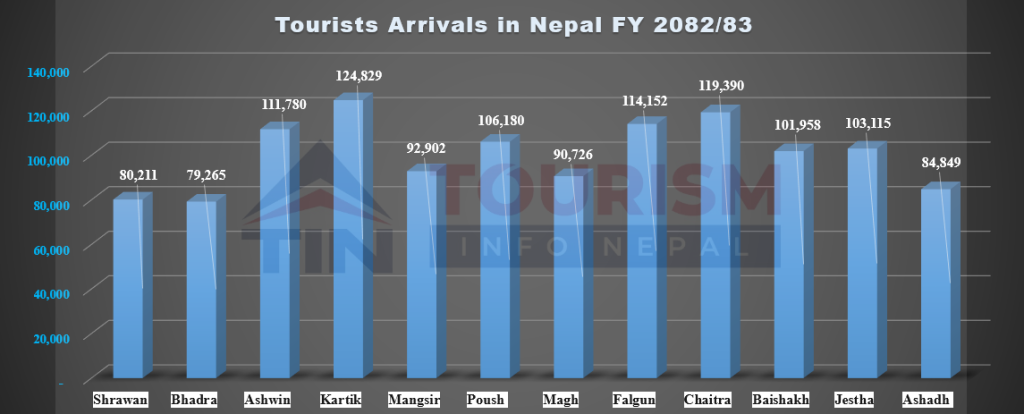
The monthly arrival figures show that the highest number of international tourists visited Nepal in Kartik, corresponding roughly to October–November, when 124,829 foreign tourists arrived in the country. The period coincides with Nepal’s peak autumn tourism season, which is traditionally one of the most popular times of the year for trekking, mountaineering, cultural tourism and nature-based travel.
The second-highest monthly arrival figure was recorded in Chaitra, corresponding roughly to March–April, when Nepal welcomed 119,390 international visitors. This was followed by Falgun, corresponding roughly to February–March, with 114,152 arrivals, and Ashwin, corresponding roughly to September–October, with 111,780 visitors.
The strong performance during these months reflects the continued importance of its two major tourism seasons. The autumn season is traditionally associated with favourable weather and clear mountain views, while the spring season attracts trekkers, mountaineers and visitors interested in Nepal’s natural and cultural attractions.
NTB intensifies tourism promotion in India and China
The Nepal Tourism Board has intensified promotional activities in India and China, identified as two of Nepal’s closest and most important source markets. During fiscal year 2082/83, the NTB organised more than 12 promotional programmes in various Indian cities, including Pune, Hyderabad, Chennai, Mumbai and New Delhi.
The programmes were aimed at strengthening Nepal’s presence in the Indian tourism market and promoting the country’s diverse tourism products. India is an especially important market for Nepal because of its proximity, extensive land connectivity, growing air links and strong cultural, religious and historical ties.
The NTB also expanded its promotional activities in international markets, conducting more than 40 tourism promotion programmes globally during the fiscal year. These initiatives were designed to increase Nepal’s visibility, strengthen relationships with international tourism stakeholders and attract more visitors from both established and emerging markets.
Border tourism promotion boosts arrivals from India
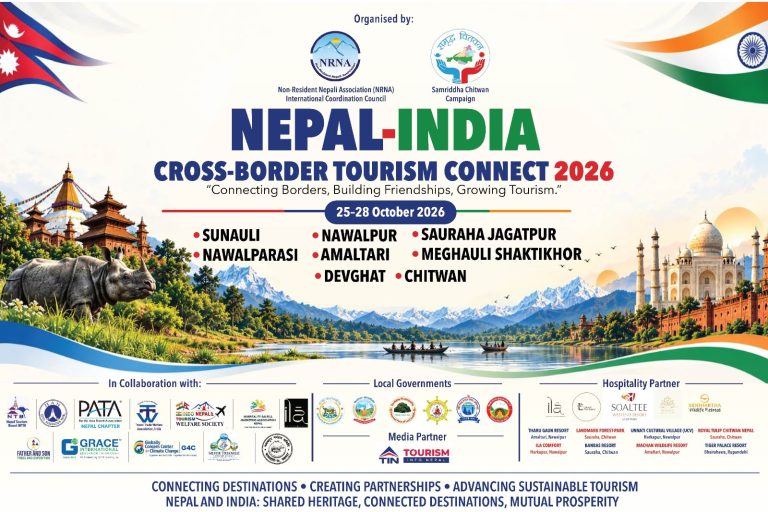
During the final three months of fiscal year 2082/83, tourism promotion activities were also intensified in its southern border areas. A series of cross-border tourism marts, fairs and promotional events were organised across the Tarai region, stretching from Jhapa in eastern Nepal to Kanchanpur in the west.
The initiatives were designed to protect and promote investments made in tourism infrastructure in the border regions while improving tourism cooperation and connectivity with neighbouring Indian markets. According to the NTB, the activities contributed to a notable increase in the number of tourists entering Nepal through border points.
The growth in border arrivals highlights the importance of land-based tourism, particularly from India. While international air connectivity remains a major driver of Nepal’s tourism sector, overland arrivals from neighbouring countries continue to provide a significant opportunity for expanding tourist numbers and supporting tourism businesses outside the major urban centres.
Tourism moves from recovery towards sustainable growth
NTB Officiating Chief Executive Officer Hikmat Singh Ayer attributed the positive growth in international tourist arrivals to intensified international promotion, improved air connectivity and cooperation with the private sector.
Ayer said the tourist arrival figures for fiscal year 2082/83 clearly indicate that Nepal’s tourism industry is moving beyond the post-pandemic recovery phase and towards sustainable growth. He said the NTB would continue to strengthen targeted promotion in major source markets as well as in new markets with high growth potential.
According to Ayer, the objective is to establish Nepal as an attractive year-round destination by promoting a broader range of tourism products and reaching travellers beyond the traditional peak seasons. He said the NTB would continue working to ensure that Nepal’s tourism growth is supported by stronger market diversification and more effective promotional strategies.

China offers significant growth potential
Ayer also highlighted the significant potential of the Chinese tourism market. Although China has already emerged as one of Nepal’s three largest source markets, he said there remains considerable room to increase arrivals through more targeted promotional activities and stronger business-to-business connections.
He stressed the need to make sales missions in China more effective and to strengthen Nepal’s presence in other high-potential markets such as the United States, Australia and Bangladesh. According to him, regular international sales missions will be important for developing stronger relationships with travel companies, tour operators and other tourism stakeholders.
The NTB is planning to expand such programmes through cooperation with the private sector under the budget for fiscal year 2083/84. The objective is to make tourism promotion more result-oriented and convert promotional activities into higher visitor arrivals, longer stays and increased tourism spending.
Wellness Tourism Year 2027 expected to create new opportunities
The government has declared 2027 as the Year of Wellness Tourism, a move expected to create new opportunities for diversifying Nepal’s tourism industry. The initiative is aimed at promoting Nepal’s potential in wellness, health, spiritual and holistic tourism while attracting visitors seeking longer and more meaningful travel experiences.
According to the NTB, the wellness tourism campaign will form part of broader efforts to develop new tourism products and attract higher-spending visitors. The Board also plans to focus on increasing the average length of stay of international tourists and expanding Nepal’s presence in emerging markets.
The tourism authority said it would continue strengthening promotional activities in traditional markets while simultaneously exploring new international destinations with strong growth potential. The strategy will focus on attracting quality tourism, encouraging longer stays and promoting tourism products beyond the country’s traditional trekking and mountaineering image.
Nepal targets stronger tourism growth in the coming fiscal year
With more than 1.2 million international tourist arrivals recorded during fiscal year 2082/83, Nepal’s tourism industry is entering the next phase of growth with renewed optimism. The combination of strong arrivals from India, the United States and China, rising interest from Asian markets, increased international promotion and improved air connectivity has created a positive foundation for further expansion.
The NTB has said its future strategy will focus on attracting higher-spending tourists, increasing visitor length of stay and developing Nepal as a year-round destination. Alongside established markets, the country will increasingly target emerging and high-potential markets through international sales missions, business partnerships and targeted promotional campaigns.
The figures also highlight the growing importance of cooperation between the government and the private sector. As Nepal seeks to strengthen its position in the global tourism market, coordinated efforts in promotion, infrastructure, air connectivity, service quality and tourism product development will remain essential.
The latest arrival data suggest that Nepal’s tourism industry is no longer focused solely on recovering from the pandemic-era decline. Instead, the country is now attempting to build a more diversified, competitive and sustainable tourism sector capable of attracting visitors throughout the year and generating greater economic benefits for communities and businesses across the country.