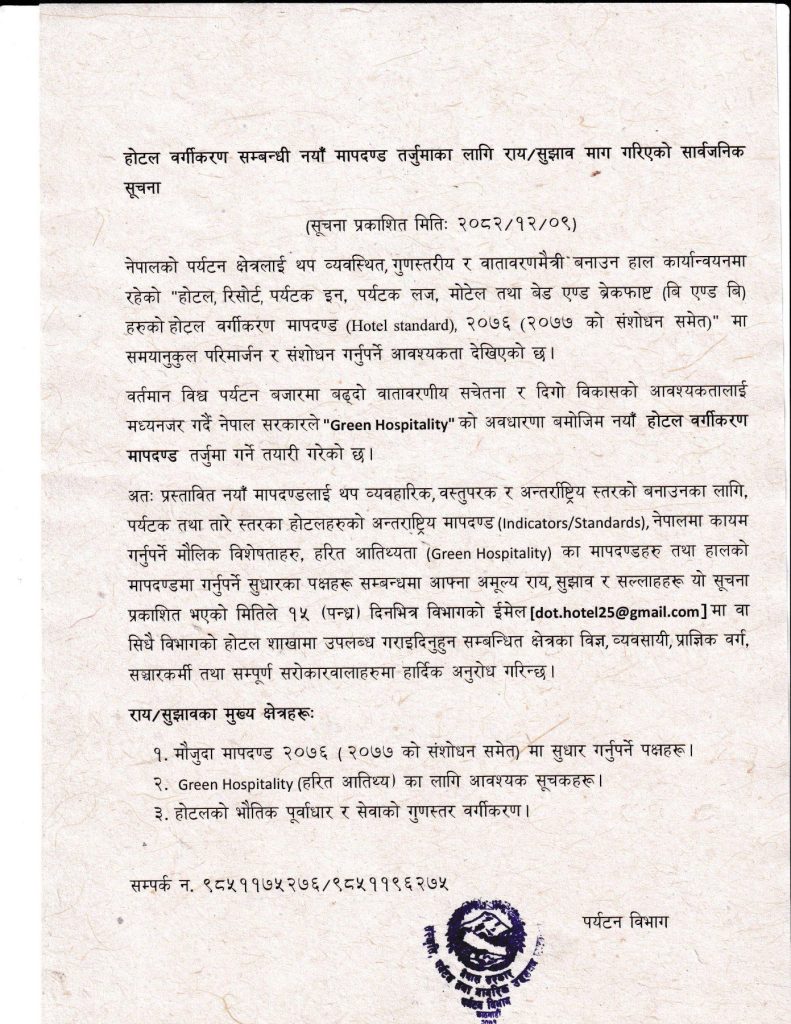
The Ministry of Culture, Tourism and Civil Aviation (MoCTCA), Nepal, has issued a public notice seeking suggestions and recommendations from experts, stakeholders, and the general public regarding the formulation of new hotel classification standards. The move aims to modernize and enhance the country’s hospitality sector by making it more organized, quality-driven, and environmentally sustainable.
Background: Need for Revised Standards
Currently, Nepal implements the “Hotel, Resort, Tourist Inn, Tourist Lodge, Motel, and Bed & Breakfast (B&B) Classification Standards, 2076 (Amended 2077).” However, with evolving trends in the global tourism market and increased emphasis on environmental awareness, the government recognizes the need to revise these standards. The proposed revisions are intended to align Nepal’s hospitality sector with international benchmarks while addressing local context and priorities.

The Ministry is particularly emphasizing the concept of “Green Hospitality,” reflecting a growing global commitment to eco-friendly practices and sustainable tourism. By incorporating environmental sustainability, energy efficiency, and responsible resource management into hotel operations, Nepal aims to position itself as a forward-looking and environmentally conscious tourism destination.
Invitation for Feedback from Stakeholders
In this context, Ministry of Culture, Tourism and Civil Aviation (MoCTCA) has invited experts, industry professionals, academics, media personnel, and other concerned stakeholders to provide their valuable suggestions, insights, and recommendations within 15 days from the date of the notice. Contributions can be submitted via email at [email protected] or directly at the Ministry’s Hotel Division.
The Ministry of Culture, Tourism and Civil Aviation (MoCTCA) has outlined specific areas where feedback is particularly sought:
- Improvements to Current Standards: Identifying gaps, limitations, or outdated practices in the 2076 standards (including 2077 amendments) that require modification.
- Green Hospitality Indicators: Suggestions for indicators and parameters to incorporate sustainable and environmentally responsible practices into hotel classification.
- Physical Infrastructure and Service Quality: Inputs on classifying hotels based on facilities, services, guest experience, and operational excellence.
Aligning Nepal with International Practices
The initiative reflects Nepal’s commitment to aligning its hospitality sector with global standards and best practices. International tourism increasingly values sustainability, comfort, safety, and quality services. Revising the classification framework allows Nepal to standardize hotel operations, improve service quality, and enhance visitor experiences while promoting environmentally responsible tourism.
Experts say that adopting Green Hospitality standards could encourage hotels to minimize energy consumption, manage water efficiently, implement waste reduction strategies, and adopt eco-friendly construction and operational practices. Such measures are expected to improve Nepal’s reputation as a sustainable tourism destination and attract a growing segment of environmentally conscious travelers.
Stakeholder Participation Encouraged
The Ministry emphasizes that public participation is critical for making the new standards practical, transparent, and adaptable to local conditions. Suggestions from hoteliers, industry associations, tourism professionals, environmental specialists, and academics will help ensure that the revised classification system balances international benchmarks with Nepal-specific requirements.
Officials note that this collaborative approach also ensures that the standards are inclusive and implementable, providing clear guidelines for small, medium, and large hotels across the country. By doing so, Nepal can improve competitiveness in the global tourism market while enhancing safety, comfort, and sustainability for visitors.

Impact on Nepal’s Tourism Sector
The proposed revision is expected to strengthen Nepal’s tourism sector by:
- Ensuring quality consistency across hotels and lodges.
- Promoting eco-friendly and sustainable practices through Green Hospitality standards.
- Facilitating better marketing and branding for hotels compliant with international benchmarks.
- Encouraging hotels to invest in infrastructure and service improvements.
- Enhancing visitor confidence and satisfaction, particularly among environmentally conscious and international tourists.
The Ministry’s initiative represents a critical step toward modernizing Nepal’s tourism and hospitality sector while fostering sustainable development. Stakeholders are urged to actively participate in the consultation process to contribute to the formulation of a robust and globally competitive hotel classification framework.