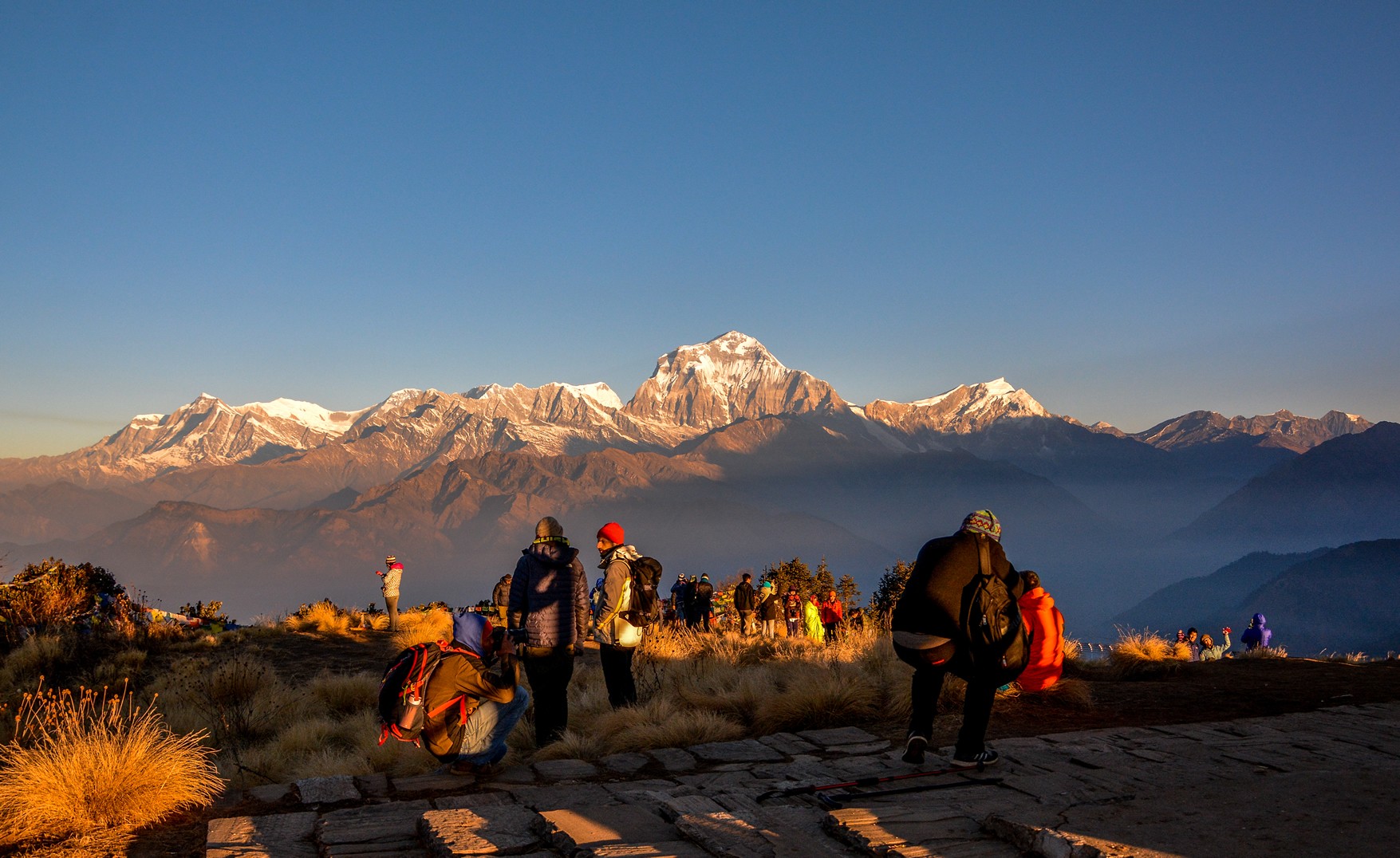
Poon Hill, located in Ghorepani of Annapurna Rural Municipality–6, has become one of Nepal’s most popular short trekking destinations, attracting both domestic and international tourists. Known for its breathtaking panoramic views of Dhaulagiri, Annapurna, Machhapuchhre, Nilgiri, and Gurja Himal, the hilltop offers some of the most stunning sunrise and sunset views in the Himalayas.
The best time to visit Poon Hill is during autumn and spring, specifically in the months of October, November, March, April, and May, when skies are clear and mountain views are at their finest. According to data from the Tourist Police Post in Ghorepani, around 30,000 tourists visit the area annually.

Tourist Numbers Affected by Weather and Political Uncertainty
Local entrepreneur Sudip Purja Pun, who manages tea stalls and the entrance fee collection contract, reported that tourist arrivals this season have been lower than expected. “Due to unfavorable weather and the political situation, the number of visitors has declined compared to previous years,” he said.
In previous autumn seasons, Ghorepani would welcome nearly 400 visitors daily, many of whom hike for about 40 minutes uphill from the village to Poon Hill before dawn to witness the spectacular sunrise over the Himalayas.
Currently, Ghorepani has 23 hotels offering modern facilities with a combined capacity to accommodate over 1,000 guests per night, making it one of the most well-prepared mountain villages in the Annapurna region.
Multiple Trekking Routes Connect Ghorepani–Poon Hill
Trekkers can reach Ghorepani–Poon Hill through several scenic routes. Popular trails include:
- Birethanti–Ulleri–Ghorepani and Nayapul–Ghandruk–Ghorepani from Kaski district,
- Nagi–Mohare–Phulbari–Ghorepani and Tatopani–Ghar–Shikh–Ghorepani from Myagdi district.
Additionally, travelers can access Ghorepani via road through Pokharebagar, Ghar, and Shikh, the administrative center of Annapurna Rural Municipality. According to Ward Chairperson Ram Bahadur Khadka of Annapurna–6, both federal and provincial governments are collaborating to upgrade the Pokharebagar–Ghorepani road while also expanding the Nayapul–Ghorepani route from Kaski. “We are investing part of the revenue from Poon Hill contracts into improving local tourism infrastructure,” he said. “Our goal is to attract both international trekkers who enjoy hiking and domestic visitors who prefer vehicle access.”
Revenue from Poon Hill Tourism Continues to Rise
Poon Hill has also become a significant source of local revenue. In the fiscal year 2082/83 (2025/26), the Annapurna Rural Municipality earned around NPR 4.6 million (Rs 46 lakh) from entrance fees and tea stall operations at Poon Hill.
According to Information Officer Bhagwati Khadka, the municipality awarded a contract worth Rs 4.59 million to Hotel Shikhar Pvt. Ltd., which had the highest bid and deposited the amount in advance. As per the rules, the contractor received a 10% discount for full upfront payment. Last year, the total income from the site was Rs 4 million, marking steady growth in tourism revenue.

At an altitude of 3,210 meters above sea level, Poon Hill charges an entry fee of Rs 150 for foreign tourists and Rs 50 for Nepali visitors. The collected revenue is used to maintain the trails, improve local facilities, and promote sustainable tourism in the area.
Sustainable Growth and Future Prospects
As infrastructure improves and promotion increases, Poon Hill continues to attract nature enthusiasts, photographers, and trekkers seeking a short yet rewarding Himalayan experience. With its easy accessibility, rich cultural surroundings, and spectacular mountain scenery, Poon Hill stands as a shining example of community-led tourism success in Nepal’s Annapurna region.