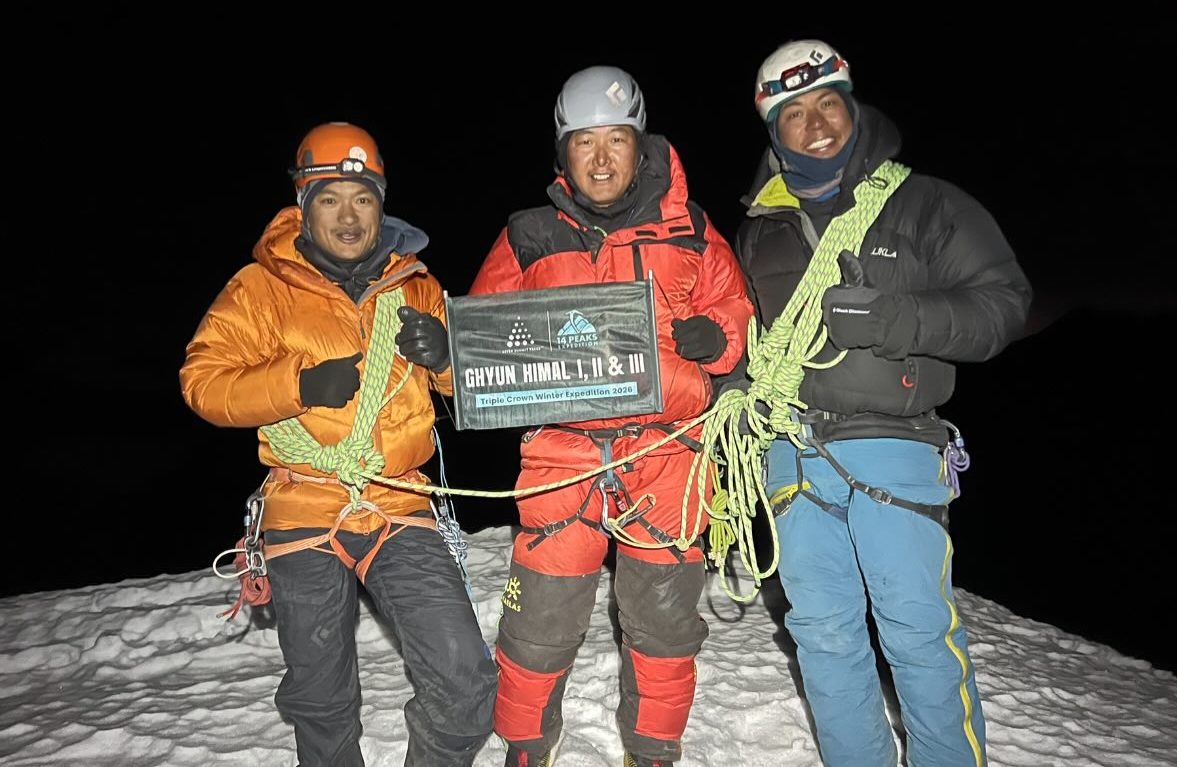
An all-Nepali team of elite mountaineering guides has etched a new chapter in Nepal’s climbing history by completing the first-ever winter ascent of three previously unclimbed peaks in the remote Ghyun Himal range of Upper Mustang. The historic summits of Ghyun I (6,099m), Ghyun II (6,029m), and Ghyun III (6,027m) were achieved on January 12, 2026, marking the world’s first winter ascents of all three virgin peaks. The landmark expedition was jointly organised by Seven Summit Treks (SST) and 14 Peaks Expedition, two of Nepal’s leading adventure companies, further underlining the growing leadership of Nepali climbers in global mountaineering.
The pioneering team was led by IFMGA guide Pasang Kaji (PK) Sherpa and included aspirant guides Prem Magar and Bikram Karki, with Chhewang Sherpa serving as support climber. Entirely Nepali in composition, the team opened Nepal’s 2026 adventure calendar with what has been hailed as one of the most significant winter mountaineering achievements in recent years. SST described the ascent as a proud moment for the country, celebrating both the technical success of the climb and the symbolic importance of Nepali guides leading complex exploratory expeditions in the Himalaya.

A Bold Route into Untouched Terrain
According to expedition leader PK Sherpa, the team had initially planned to approach the mountains by opening a new trail from Ghar Gumba and establishing a conventional base camp. However, the rugged and unstable nature of the terrain forced a strategic change of plan.
Instead of following the original route, the climbers diverted westward, crossed the challenging Kekepla Pass, and skipped the traditional base camp setup altogether. They established a high camp at an altitude of 5,665 metres, directly positioning themselves for an ambitious summit push in extreme winter conditions.
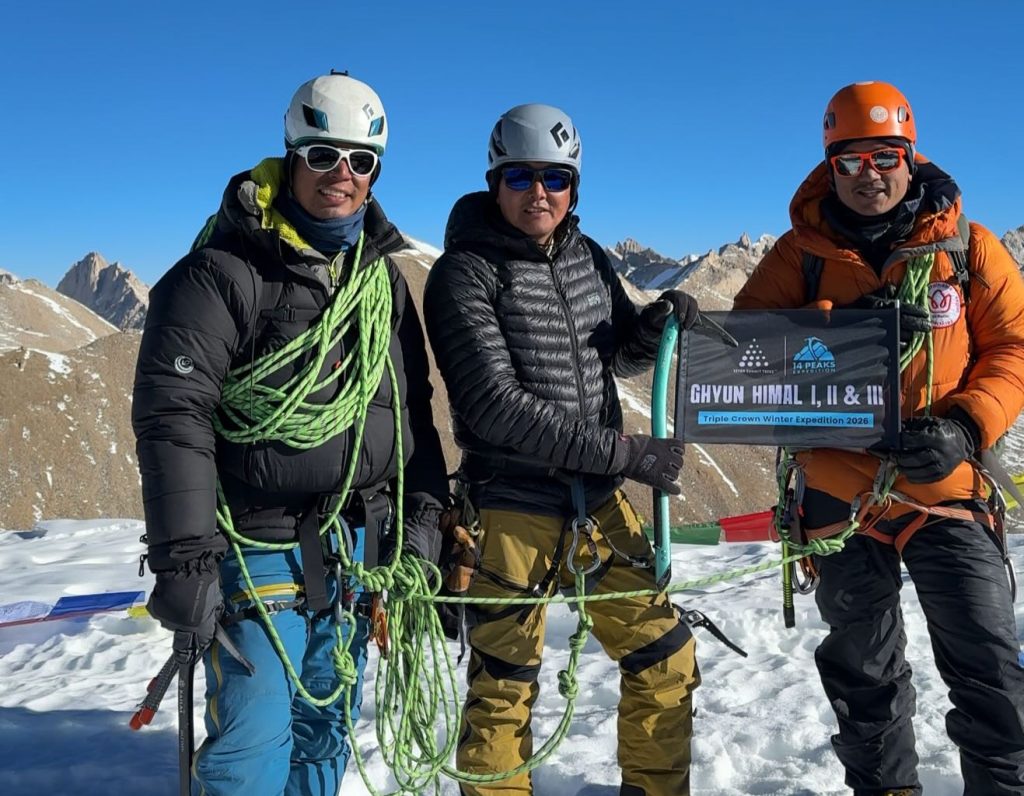
From the high camp, the team advanced along the northern scree slopes beneath the cirque of the Ghyun massif. The chosen route was technically demanding and required careful navigation across loose, unstable boulders with very little snow cover, a rare but particularly hazardous condition for winter climbing. The lack of consolidated snow increased the risk of rock movement, demanding constant vigilance, rope work, and professional coordination from all members of the team.
The final summit push began at approximately 2:00 am on January 12, following a narrow northern gully that eventually connected to the south ridge. Despite the cold and the exposed terrain, the climbers maintained a steady pace, drawing on their extensive experience and technical skills to safely negotiate the difficult sections.

Three Summits in a Single Day
The team first reached the summit of Ghyun I at 5:40 am, becoming the first people in the world to stand atop the 6,099-metre peak during winter. From there, they undertook a demanding traverse to the northwest col, leading them to the summit of Ghyun III, which they reached at 9:20 am. Without pause, the climbers then descended via the west col and made their final ascent of the day to Ghyun II, reaching its 6,029-metre summit at 12:45 pm. The team safely descended to high camp via the southeast face, completing an extraordinary triple-summit achievement within a single winter day.
Seven Summit Treks hailed the expedition as a major milestone for Nepali-led winter mountaineering, stating that the ascent not only opens a new chapter of exploration in Upper Mustang but also reinforces Nepal’s position as a global leader in Himalayan adventure. The success demonstrates the technical maturity, leadership, and exploratory spirit of Nepali guides who are increasingly spearheading complex expeditions in the world’s most challenging mountain environments.
With the first winter ascents of Ghyun I, II, and III now recorded, the remote Ghyun Himal range has been firmly placed on the international mountaineering map, and Nepal’s 2026 climbing season has begun with a historic triumph led entirely by Nepali hands.