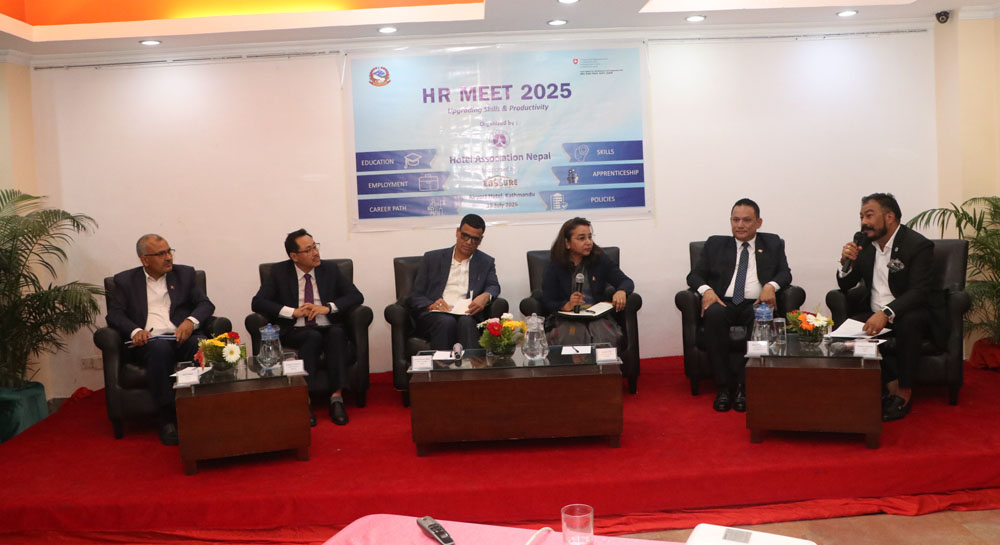
Experts from both government and private sectors have emphasized the urgent need for strong cooperation to develop skilled and competent human resources in Nepal’s hospitality industry. The call was made during the “Human Resource Conference” organized today by the Hotel Association Nepal (HAN) in collaboration with the government’s Ensure Project (INSURE).
Lack of Skilled Manpower Hindering Productive Growth
Speakers at the conference highlighted that without skilled human capital, the productivity of the hospitality and tourism sector cannot be enhanced. The hospitality industry, being one of Nepal’s major economic drivers, is facing a critical shortage of trained professionals, a situation that experts say must be urgently addressed through collaborative efforts.
Role of Curriculum and Private Sector Support
Mahesh Bhattarai, Member Secretary of the Council for Technical Education and Vocational Training (CTEVT), stressed the need for timely and relevant curriculum development. “The current curriculum must evolve in line with industry demands,” Bhattarai said, adding that private sector engagement is crucial to designing and implementing effective training programs.
Skills Gap in the Labor Market
Suresh Kumar Joshi, Undersecretary at the Ministry of Education, Science and Technology, pointed out a growing skills gap in the national labor market. He said that although there is a large workforce available, a lack of appropriate skills is hampering their employability, especially in technical and service-oriented industries like hospitality.
Echoing this sentiment, Dambar Sunuwar, Undersecretary at the Ministry of Labor, Employment, and Social Security, emphasized the urgent need to connect education and skill development programs directly with labor market demands.
Legal and Policy Frameworks Discussed
Gandhi Pandit, legal advisor to the Hotel Association Nepal, delivered a comprehensive presentation on the existing laws, policies, and industrial relations affecting the hospitality sector. He addressed several procedural and legal challenges that hinder smooth operations in the industry and recommended reforms to facilitate a more business-friendly environment.
Ravindra Bahadur Singh, the lead of the Ensure Project, presented insights on the role and effectiveness of industrial trainees in enhancing hospitality skills. He highlighted the project’s contribution to training and internships, which are aimed at preparing youth for real-world challenges in hotel management and service delivery.
Nepal’s Hotels Struggling Despite Low Occupancy
Speaking at the event, HAN President Binayak Shah shed light on the irony of the current situation. “Even though only about one-third of hotels in the country are operating at full capacity, there is still a serious shortage of skilled manpower,” he said. Shah stressed that the conference was organized to bring this issue to the forefront and to initiate actionable dialogue.
Rising Number of Star Hotels and Foreign Tourists
The conference also addressed the growing number of star hotels and the rising inflow of tourists, particularly from India and China. As Nepal positions itself as a premier travel destination, the need for quality service delivery has become more pressing than ever. Panelists discussed how existing policies and the lure of foreign employment have contributed to the local labor shortage in the hospitality sector.
Panel Discussions on Curriculum and Internships
Moderated by HAN Treasurer Yubaraj Shrestha, a group discussion was held featuring several key stakeholders. Among the participants were Sangeeta Ojha, Executive Director of the Nepal Academy of Tourism and Hotel Management (NATHM); Binod Badal, Director at CTEVT; and Khem Paudel, HR Director representing the private sector.
The panel extensively debated issues such as the lack of industry-relevant curriculum, the role of foreign employment and internships, and the necessity of updating training programs in line with international standards. Discussions also focused on how to retain talent within the country through competitive salaries and clear career paths.
Formation of Hospitality HR Club Announced
A major takeaway from the conference was the announcement of the formation of a new “Hospitality HR Club,” composed of human resource managers from across the hospitality sector. The club aims to foster collaboration, share best practices, and work in an integrated manner to drive growth and excellence in the industry.
Looking Forward
The Human Resource Conference concluded with a consensus that addressing the human capital crisis in Nepal’s hospitality sector requires an inclusive, collaborative approach involving policymakers, educators, training institutes, and industry stakeholders.
As Nepal continues to grow as a travel and tourism destination, a skilled and dynamic workforce will be critical in delivering high-quality service and maintaining international standards. The event has set a positive tone for future collaboration and policy reform aimed at bridging the skills gap and boosting employment and productivity in one of the country’s most vital industries.