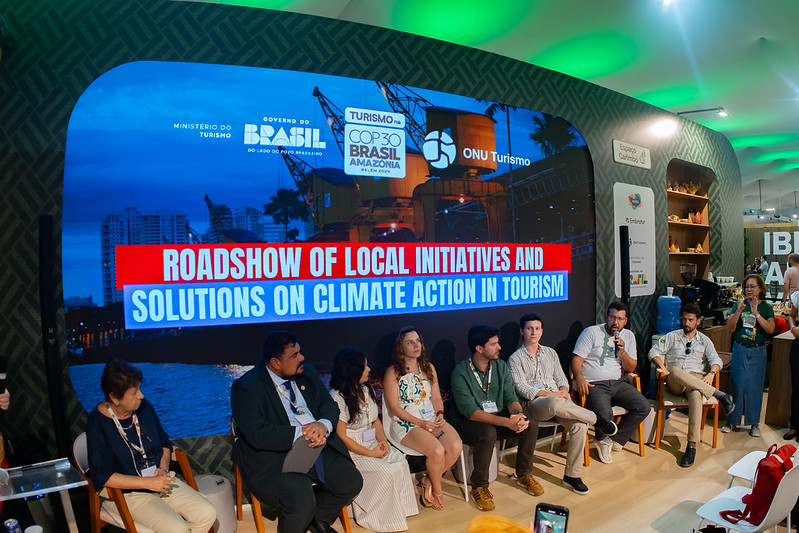
UN Tourism has announced significant progress in aligning the global tourism sector with climate action following two high-level Tourism Thematic Days held on November 19–20 during COP30. The sessions, convened jointly with Brazil’s Ministry of Tourism, brought together global leaders, climate experts, and tourism institutions to accelerate the sector’s transition toward sustainable, low-carbon development.
Strengthened Governance Through Global Coordination
A central focus of the twin thematic days was governance. UN Tourism emphasized that stronger coordination is essential for guiding tourism’s Net Zero pathway. The events highlighted the expanded role of the Interinstitutional Working Group on Tourism and Climate Action, a platform that integrates governments, private sector bodies and international partners to create unified climate-action frameworks for tourism.
UN Tourism Executive Director Zoritsa Urosevic underscored the urgency of accelerating climate action across the entire sector. She noted, “Faster progress in decarbonization, adaptation and regeneration, supported by stronger investment, is essential if tourism is to achieve a just and effective Net Zero transition.”

Plan for Accelerated Solutions Introduced at COP30
One of the most notable achievements was the introduction of a Plan for Accelerated Solutions (PAS) under the UNFCCC High-Level Climate Champions. This new mechanism is designed to streamline and harmonize global approaches for measuring, mitigating and adapting to climate impacts within tourism.
The PAS focuses on creating common standards for monitoring emissions, protecting natural ecosystems, and embedding resilience strategies. It places special emphasis on forests, oceans and biodiversity, ecosystems that are deeply intertwined with tourism and particularly vulnerable to climate change.
The plan also supports the development of a Global Partnership for Enhanced Climate Action in Tourism, building on the COP29 climate declaration, which has already been endorsed by 70 governments.
Accelerating Implementation of the Glasgow Declaration
The thematic sessions also examined the pace of implementation of the Glasgow Declaration on Climate Action in Tourism, which calls for halving emissions by 2030 and achieving Net Zero by 2050.
Discussions highlighted the need for improved climate-risk monitoring tools, standard reporting guidelines, and stronger investment flows into low-carbon tourism businesses. Delegates agreed that without consistent global action, the tourism sector will face mounting risks from extreme weather events, biodiversity loss and socio-economic disruptions.
Adaptation Becomes a Central Pillar of Tourism Planning
Adaptation featured prominently in COP30’s tourism discussions, reflecting growing urgency as climate impacts intensify worldwide. Experts explored ways to integrate climate-risk data into local tourism planning, especially in vulnerable destinations like small islands, coastal regions and mountain ecosystems.
Key themes included:
- Community-led adaptation, empowering local residents to shape resilience strategies.
- Nature-based solutions, such as reforestation, watershed conservation and coral restoration.
- Circularity in plastics, water and food, supporting resource efficiency and reducing pollution.
- Opportunities in alternative fuels, reforestation and blue carbon projects.
- Blended-finance models aimed at expanding access to low-carbon technologies for tourism businesses.
UN Tourism and Brazil’s Ministry of Tourism jointly announced a call for inputs on advancing regenerative tourism approaches, which prioritize ecosystem health and community well-being over short-term economic gains.
Global Engagement Expands Through Virtual Sessions
Complementing the in-person dialogues, global virtual sessions were hosted in collaboration with Travalyst and The Travel Foundation, inviting wider international participation from industry representatives, local governments and sustainability experts. The sessions broadened the reach of the Tourism Thematic Days, enabling stakeholders worldwide to contribute to climate-action discussions.

A special signing ceremony welcomed new signatories to the Glasgow Declaration, including Rio’s iconic Christ the Redeemer Sanctuary, signaling growing commitment from cultural and heritage institutions.
Tourism’s Role in Global Climate Solutions Strengthened
UN Tourism stated that the outcomes of COP30 reinforce tourism’s evolving role as an active contributor to global climate solutions, rather than a passive observer. With strengthened governance, enhanced monitoring frameworks, and renewed adaptation commitments, the sector is now more firmly embedded in the international climate agenda.
According to UN Tourism, the momentum generated in Brazil marks an important step toward transforming tourism into a resilient, low-carbon and regenerative sector capable of supporting communities and ecosystems worldwide.