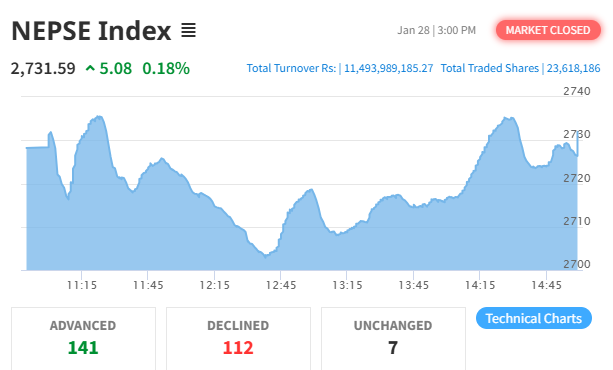
The Nepal Stock Exchange (NEPSE) Index recorded a modest gain today, rising by 5.08 points (0.18%) to close at 2,731.59. This recovery follows a sharp 42.58 point loss in the previous trading session, reflecting renewed investor confidence amid mixed market conditions.
The benchmark index opened at 2,728.22, reaching an intraday high of 2,735.55 and a low of 2,702.56. A total of 23,618,186 shares were traded across 334 companies, involving 121,992 transactions. The market capitalization stood at Rs. 45.86 Kharba, with a float market capitalization of Rs. 15.62 Kharba, indicating healthy liquidity in the market.

Sector-Wise Performance
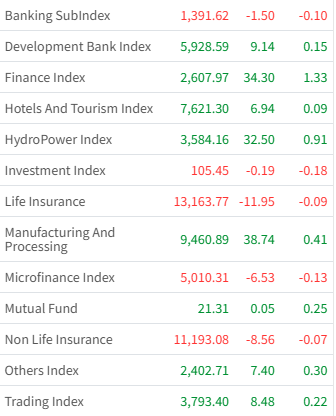
Among sectoral indices, the Finance Index recorded the highest gain, rising 1.33%, driven by strong performance from major commercial banks and financial institutions. In contrast, the Investment Index faced the steepest decline of 0.18%, reflecting cautious trading in non-banking investment companies.
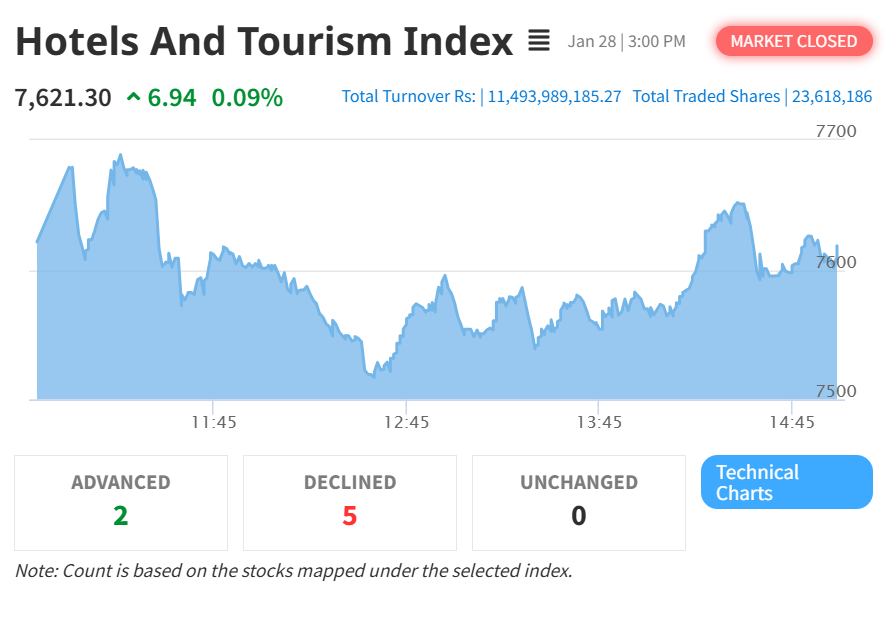
The Hotels and Tourism Index also showed a slight recovery, gaining 6.94 points (0.09%) to settle at 7,621.30, after experiencing a significant 140.69 point loss in the previous session. The index opened at 7,621.45, reached an intraday high of 7,688.70, and touched a low of 7,511.18, highlighting volatility in the tourism and hospitality sector amid ongoing market uncertainties.

Market Outlook
Today’s trading indicates a cautious optimism among investors, with selective buying in the finance and hospitality sectors contributing to the NEPSE gain. Analysts suggest that market participants remain attentive to sectoral performances and macroeconomic developments, which continue to influence trading behavior.
Despite today’s modest recovery, volatility remains a key feature of the Nepali stock market, with sectoral disparities highlighting areas of strength and weakness. Investors are advised to monitor market trends closely while making informed investment decisions. The NEPSE Index’s slight rebound today demonstrates a tentative stabilization after consecutive sessions of losses, signaling gradual market resilience and sustained investor interest in key sectors.