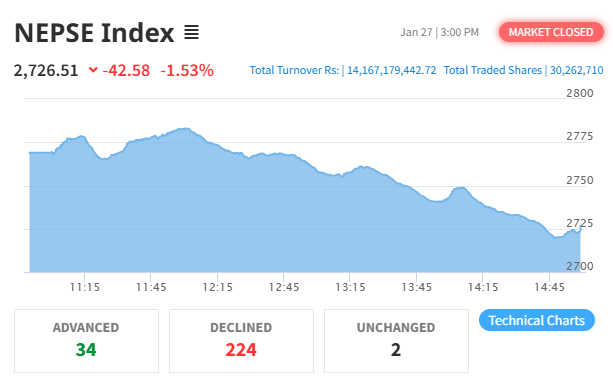
The Nepal Stock Exchange (NEPSE) Index declined sharply on Wednesday, shedding 42.58 points (1.53 percent) to close at 2,726.51, reversing gains made in the previous trading session. The market had gained 3.07 points a day earlier, but renewed selling pressure pushed the benchmark index firmly into negative territory.

Market Opens Lower, Volatility Seen Throughout the Session
The benchmark index opened the day at 2,768.97, but soon slipped as selling pressure dominated most sectors. During the session, NEPSE touched an intraday high of 2,782.96 before sliding to a low of 2,718.85, reflecting heightened volatility and cautious investor sentiment.
Market participants appeared to adopt a wait-and-see approach, leading to profit booking in several sectors following recent fluctuations.
Turnover Crosses Rs. 14 Arba
Despite the decline in the index, trading activity remained strong. Total daily turnover reached Rs. 14.16 Arba, indicating sustained participation from investors. A total of 30,262,710 shares were traded across 333 listed companies through 142,476 transactions.
The overall market capitalization stood at Rs. 45.77 Kharba, while the float market capitalization was recorded at Rs. 15.58 Kharba, highlighting the market’s continued depth despite the downturn.
Hotels and Tourism Index Ends in the Red
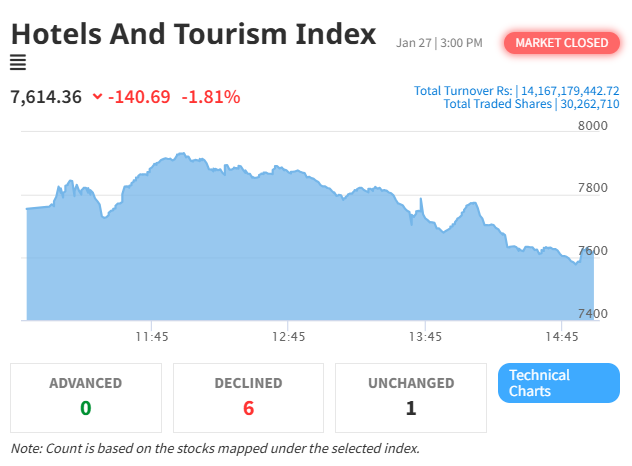
The Hotels and Tourism Index also witnessed a significant decline, falling by 140.69 points (1.81 percent) to settle at 7,614.36. The sector had gained 127.68 points in the previous session, but failed to maintain momentum amid broader market weakness.
The sectoral index opened at 7,755.05, reached an intraday high of 7,932.70, and dropped to a low of 7,570.19 during the trading hours. Selling pressure in hotel and tourism-related stocks contributed to the sector’s downward movement.
Investor Sentiment Remains Cautious
Market analysts attributed the decline to profit-taking and cautious investor sentiment, particularly after recent market movements. Investors appeared hesitant ahead of upcoming economic indicators and corporate disclosures, leading to selective selling across sectors.
Experts note that while short-term volatility continues, the sustained trading volume suggests that investor interest in the market remains intact. They advise investors to remain cautious and focus on fundamentally strong stocks amid ongoing market fluctuations.

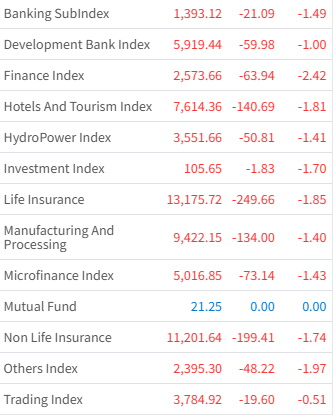
With the benchmark index closing lower, market watchers expect continued volatility in the near term, driven by investor sentiment, liquidity conditions, and sector-specific developments. The performance of key sectors such as banking, hydropower, and tourism will likely play a crucial role in determining the market’s next direction.