Nepal has received two cultural antiquities repatriated from the United States following their recovery by American authorities, marking another important milestone in the country’s ongoing efforts to reclaim sacred artefacts that were illegally trafficked out of the country decades ago. The recovery of these two pieces adds to a growing list of successful repatriations that have brought stolen Nepali heritage items back home in recent years, reflecting strengthened international cooperation around cultural property restitution.
A Formal Handover Ceremony in New York
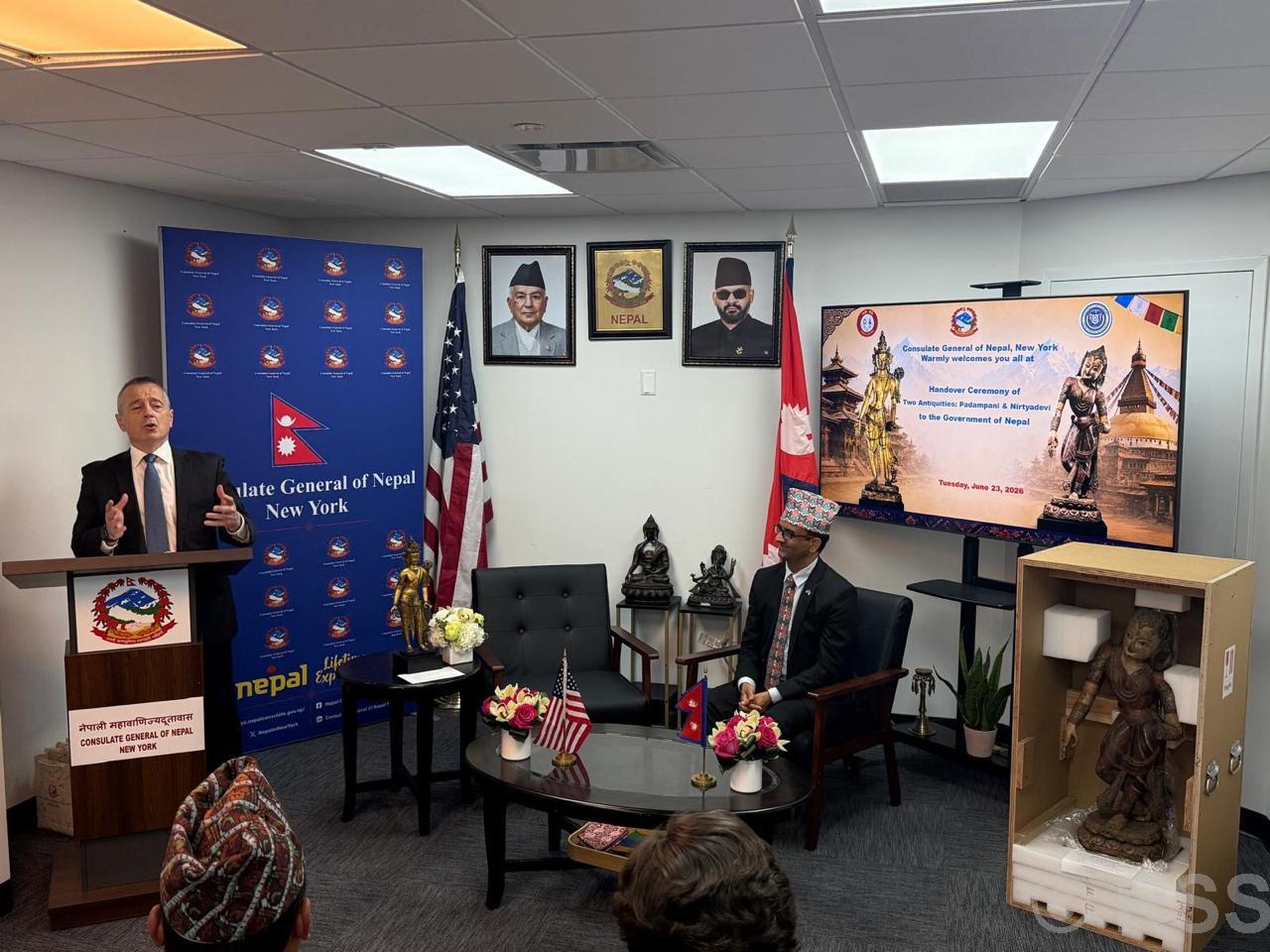
At a special handover ceremony held at the Consulate General of Nepal in New York recently, the New York County District Attorney’s Office formally transferred ownership of two significant historical artefacts to the government of Nepal: a 13th-century bronze statue of Padma Pani and a 16th-century wooden statue of Nrityadevi, the Goddess of Dance. Both pieces represent important examples of Nepal’s rich tradition of religious and artistic craftsmanship, spanning several centuries of the country’s cultural history.

The transfer was formalised through the signing of the Minutes of Concurrence by Consul General of Nepal in New York, Dadhiram Bhandari, and Colonel Matthew Bogdanos, Chief of the Antiquities Trafficking Unit of the Manhattan District Attorney’s Office, according to the Consulate General of Nepal in New York. The involvement of a dedicated antiquities trafficking unit within the Manhattan DA’s office underscores the increasingly institutionalised nature of efforts within the United States to investigate and address the illicit trade in cultural artefacts originating from countries like Nepal.
The Padma Pani Statue’s Journey
During the ceremony, Consul General Bhandari provided details on the origins and trafficking history of each artefact. The Padma Pani statue, he explained, originally belonged to Tham-Bahil, also known as Vikramashila Mahavihara or Bhagwan Bahal, located in Kathmandu. The statue is believed to have been smuggled into the United States at an unknown date sometime between 1971 and 1987, a timeframe that places its disappearance within a period when the illicit trafficking of South Asian religious artefacts was notably widespread and often went largely unchecked by international authorities.
The Nrityadevi Statue’s Path from Patan to the Met
Similarly, the Nrityadevi statue, originally housed at I-Baha Bahi in Patan, Lalitpur, was reportedly smuggled out of Nepal between 1969 and 1983. In a particularly notable detail regarding its subsequent history, Bhandari revealed that the statue was later seized from the Metropolitan Museum of Art in New York, one of the world’s most prestigious and prominent art institutions. The statue’s presence within such a major museum collection highlights a broader and increasingly scrutinised pattern in which significant cultural institutions have, in some cases, unknowingly or insufficiently diligently acquired artefacts with problematic provenance, often originating from looting or illegal export decades earlier.
A Coordinated Recovery Effort
The artefacts were recovered through coordinated efforts involving the New York County District Attorney’s Office, US Homeland Security Investigations, and partner institutions. This multi-agency collaboration reflects the complex investigative work typically required to trace the provenance of trafficked antiquities, identify their rightful countries of origin, and navigate the often lengthy legal processes required to secure their formal return.
Returning Home: Next Steps for the Artefacts
The antiquities are scheduled to arrive in Nepal on June 25, marking the final stage of their long journey back to their country of origin after decades spent illegally abroad. Upon arrival, the statues will be handed over to the Department of Archaeology for conservation and eventual restoration to their original sites, Tham-Bahil in Kathmandu for the Padma Pani statue, and I-Baha Bahi in Patan, Lalitpur, for the Nrityadevi statue.

A Continuing Pattern of Cultural Restitution
This latest repatriation forms part of a broader and increasingly active pattern of cultural heritage recovery efforts between Nepal and the United States in recent years. As American authorities, museums, and law enforcement agencies have come under growing pressure to address the provenance of antiquities within their collections, a steady stream of Nepali artefacts, many taken from temples and religious sites during periods of weak heritage protection enforcement in the late 20th century, has gradually been identified, investigated, and returned to Nepal.
For Nepal’s Department of Archaeology and the broader cultural heritage community, each successful repatriation represents not only the physical return of an irreplaceable artefact but also a symbolic restoration of historical and religious continuity for the communities and institutions from which these pieces were originally taken, many of which continue to actively practise the religious traditions these statues were originally created to serve.