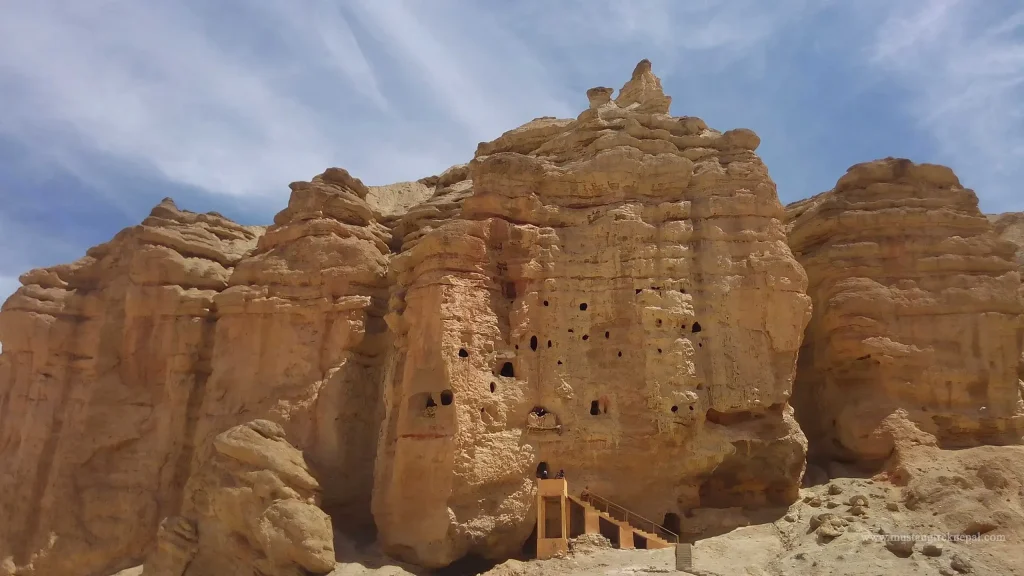
Mustang, a Himalayan district renowned for its religious and natural attractions, is home to dozens of human-made caves as well as several naturally formed sites. Among them, Chhongsi Cave, located in Syangboche village of Lo-Ghekar Damodar Kunda Rural Municipality–2 in Upper Mustang, is gaining recognition as an important destination for religious tourism.
A Naturally Formed Sacred Chhongsi Cave
Chhongsi Cave, also known locally as Chiwsi or Chhongsi Ramjhon, lies amid a high mountain landscape. The cave is believed to have formed naturally from a rock resembling a conch shell. It is situated about three kilometers below the Jomsom–Korala road. The cave holds deep religious significance among local communities and Buddhist devotees. According to local belief, visiting and worshipping at the sacred site brings spiritual liberation and gives pilgrims a sense of heavenly peace.

Connection with Guru Padmasambhava
Chhongsi Cave is closely associated with Guru Padmasambhava (Rinpoche), one of the most revered figures in Tibetan Buddhism. Local historical accounts state that Padmasambhava meditated inside the cave during his journey toward Tibet in the eighth century. A footprint believed to belong to Guru Padmasambhava can also be seen on a rock inside the cave, adding to its religious and cultural importance. A lama associated with the cave said the site is not merely a natural cave but an important spiritual destination connected with Padmasambhava and several Buddhist traditions.
Religious Symbols and Sacred Chambers
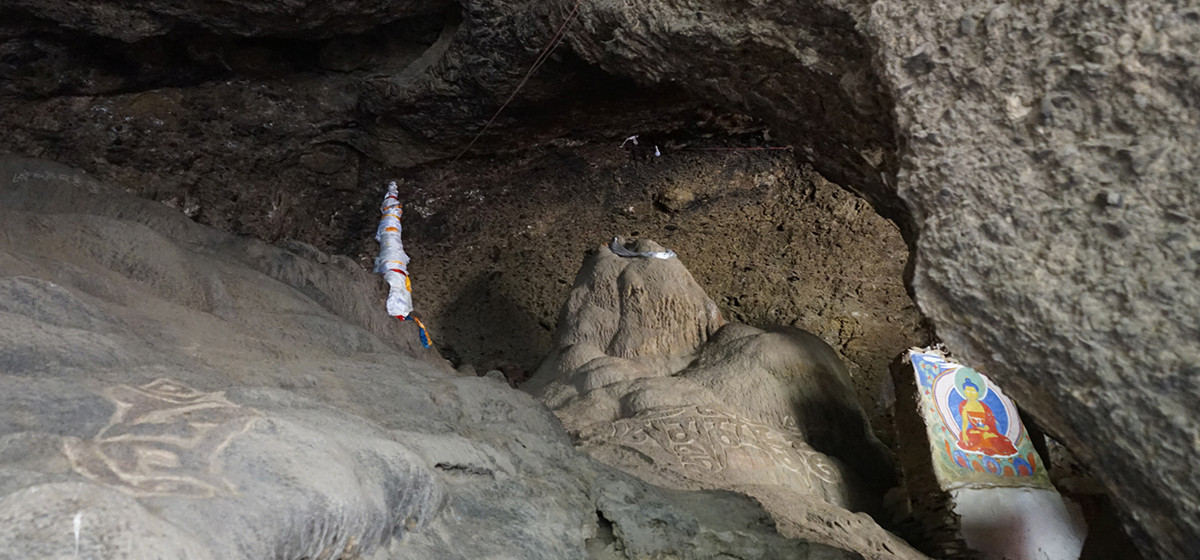
The cave contains several religious features and naturally formed rock structures that devotees consider sacred. The western section houses representations associated with Green Tara and White Tara, while the cave itself is divided into three sections. According to Baragung Muktichhetra Rural Municipality Chairperson Ringzin Namgel Gurung, four forms of Buddha are found inside the cave and are traditionally worshipped as manifestations of Avalokiteshvara.
The cave also contains two separate rocky mounds. One is worshipped as Mount Kailash, while the other is regarded as the Deity of Longevity, locally known as Thegum. Although Mount Kailash itself lies in Tibet, the rocky formation inside Chhongsi Cave is traditionally considered a symbolic part of the sacred mountain.
A Place Filled with Religious Legends
The second section of the cave contains a rocky chamber believed to be the dwelling place of deities associated with Guru Padmasambhava. A designated area is used for worship and religious rituals. Visitors can also find sacred sites associated with Mahakala and the Naga deity, along with a place traditionally believed to measure one’s good and bad deeds. One large rock inside the cave is particularly associated with local religious belief. Devotees believe that people who can embrace the rock with both arms have fulfilled their duty of serving their parents, while those unable to do so are believed to have fallen short of that responsibility.
Sacred Water and Pilgrimage Traditions
Religious texts also refer to a sacred site in the upper section of the cave associated with birds and Garuda. Only a limited number of devotees are believed to have visited this part. The cave also contains more than half a dozen small openings in the rocks where sacred water can be collected. Visitors use a ladle-like tool to draw water from the holes. Local belief holds that drinking the sacred water can help cure stomach-related ailments, including gastritis.

Improved Road Access Boosting Visitors
The growing accessibility of Chhongsi Cave is expected to further support religious tourism in the area. A rough road has now been extended from Syangboche toward the cave, making the journey considerably easier for both pilgrims and tourists. Lo-Ghekar Damodar Kunda Rural Municipality Chairperson Lopsang Chhomphel Bista said visitors previously had to walk for around three hours from Samar to reach the cave. With the recent road extension from Syangboche, the site can now be reached in approximately 15 minutes by vehicle.
Rising Tourism Potential
According to Baragung Muktichhetra Rural Municipality Chairperson Ringzin Namgel Gurung, the cave was previously visited mainly by religious devotees, particularly when there was no road access. In recent years, however, an increasing number of domestic and international tourists have also begun visiting the site. With its natural formations, Buddhist heritage, religious legends, and improving road connectivity, Chhongsi Cave has strong potential to develop into a prominent religious and cultural tourism destination in Upper Mustang.