
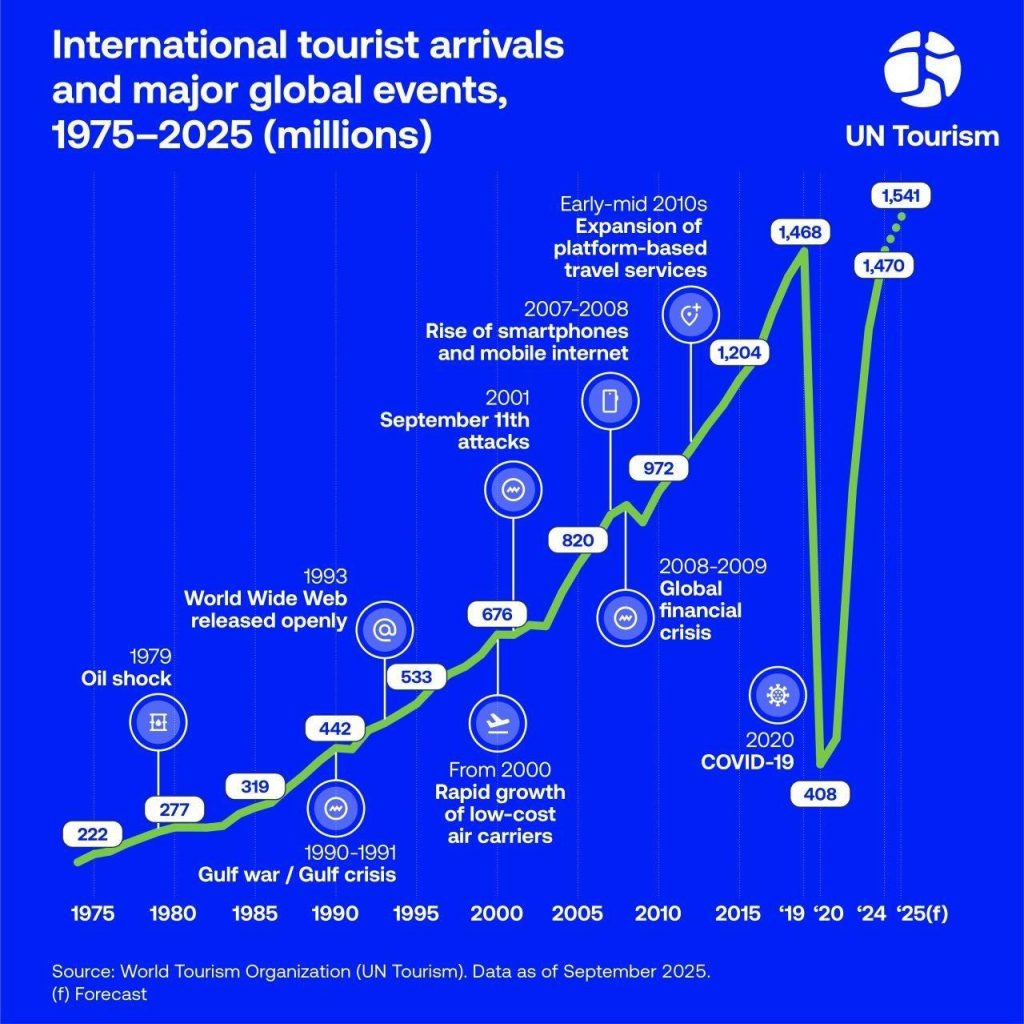
Global tourism has reached a historic milestone, with international tourist arrivals increasing from 222 million in 1975 to a provisional 1.544 billion in 2025, marking an almost seven-fold expansion over five decades. The growth reflects the transformation of international travel into a major global economic sector, supported by improved connectivity, technological progress, more accessible travel options and the emergence of new tourism destinations.
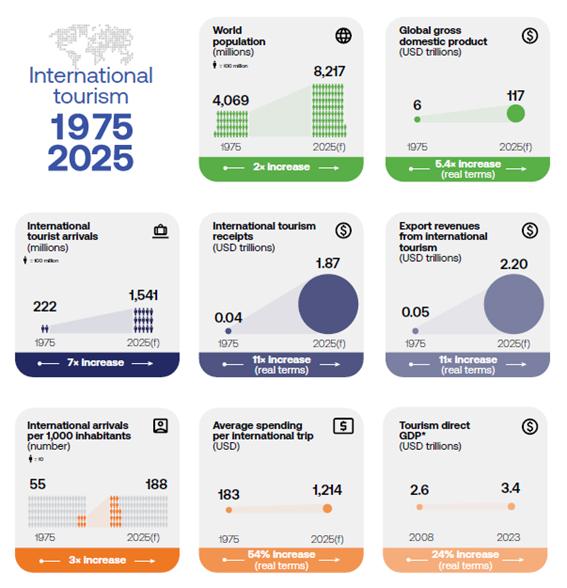
According to the World Tourism Report published by UN Tourism, international tourism receipts also increased substantially during the same period, reaching an estimated USD 1.88 trillion in 2025. This represents an eleven-fold increase in real terms compared with USD 41 billion in 1975, after adjusting for inflation and exchange-rate fluctuations. The figures highlight how tourism has evolved beyond a leisure activity into an important contributor to economic development, international exchange and destination growth. The year 2025 also marked 50 years since the establishment of the World Tourism Organization, now known as UN Tourism, which has played a central role in international tourism cooperation and policy development.
International Tourism Records Nearly Seven-Fold Growth in Five Decades
The expansion of international tourism over the past 50 years has been remarkable. In 1975, the world recorded approximately 222 million international tourist arrivals. By 2025, the number had climbed to around 1.544 billion, representing a nearly seven-fold increase despite population growth, economic fluctuations and several major global crises. Tourism revenue experienced an even stronger expansion. International tourism receipts, which represent spending by international visitors in destinations, increased from approximately USD 41 billion in 1975 to an estimated USD 1.88 trillion in 2025. UN Tourism calculates this as an eleven-fold increase in real terms, demonstrating the sector’s growing economic importance.
When international tourism receipts are combined with passenger transport fares, total export revenues from international tourism reached an estimated USD 2.2 trillion in 2025. This broader measure demonstrates the contribution of tourism-related travel to international trade and economic activity. The growth has also been reflected in the wider economy. UN Tourism’s report estimates that tourism’s direct contribution to global gross domestic product reached USD 3.4 trillion in 2023, compared with USD 2.6 trillion in 2008, representing a 24% increase in real terms over the period. The report also identifies tourism as an important source of employment, business opportunities and economic diversification.
Technology, Connectivity and Global Events Shape Tourism Growth
Several developments have contributed to the expansion of international tourism since the 1970s. Improvements in air transport, increased flight connectivity, more efficient aircraft, the growth of low-cost airlines and easier travel arrangements have made international journeys more accessible to a wider population. The development of digital technology has also transformed the way people plan and experience travel. Online travel agencies, digital booking platforms, mobile applications and wider access to travel information have made it easier for visitors to compare destinations, arrange accommodation and book transport. These changes have helped tourism businesses reach international markets and enabled lesser-known destinations to attract visitors.
However, international tourism has also faced periods of uncertainty. The second oil shock of 1979–1980 slowed tourism growth as rising fuel prices and economic pressures affected international travel. The sector subsequently recovered, with global arrivals surpassing 300 million by the mid-1980s. The Gulf Crisis in 1991 caused another temporary slowdown, but international tourism expanded strongly during the following decade. By the end of the 1990s, global arrivals had exceeded 600 million. The early 2000s brought further challenges, including the September 11 attacks, the Iraq conflict and the SARS outbreak. Despite these disruptions, international travel recovered, and arrivals surpassed 900 million by 2007.
The global financial crisis of 2009 caused another decline, but tourism returned to growth by 2011, crossing the one-billion-arrival mark. During the following years, natural disasters, political tensions and health emergencies affected individual destinations and regions, while worldwide tourism continued to expand. International arrivals reached nearly 1.5 billion in 2019. The COVID-19 pandemic, however, became the most severe crisis in the sector’s recent history.
International tourist arrivals fell by 72% in 2020 as border closures, travel restrictions and health concerns brought much of international travel to a halt. Recovery began in 2021 and accelerated as vaccination programmes expanded and countries gradually eased travel restrictions. By 2023, arrivals had recovered to around 89% of their 2019 level, and international tourism returned to pre-pandemic volumes in 2024.
Asia and the Pacific Emerge as Major Tourism Regions
The geographical distribution of international tourism has changed significantly over the past five decades. In 1975, Europe and the Americas together accounted for approximately 92% of international tourist arrivals. By 2025, their combined share had declined to around 66%, reflecting the growing importance of other regions in the global tourism market. Asia and the Pacific recorded one of the most significant transformations. The region received just over 10 million international tourist arrivals in 1975, representing approximately 5% of the global market. UN Tourism’s original 2025 forecast placed arrivals at around 350 million, while its subsequent January 2026 provisional reporting recorded approximately 331 million.
The Middle East also expanded its position in international tourism, growing from around 3.5 million arrivals in 1975 to nearly 100 million in the 2025 forecast. Africa’s share increased from approximately 2% to 5%, while the Middle East’s share rose from around 2% to 6%. Europe continued to maintain its position as the world’s largest tourism destination region. Its international arrivals increased from approximately 154 million in 1975 to 785 million in the original 2025 forecast.
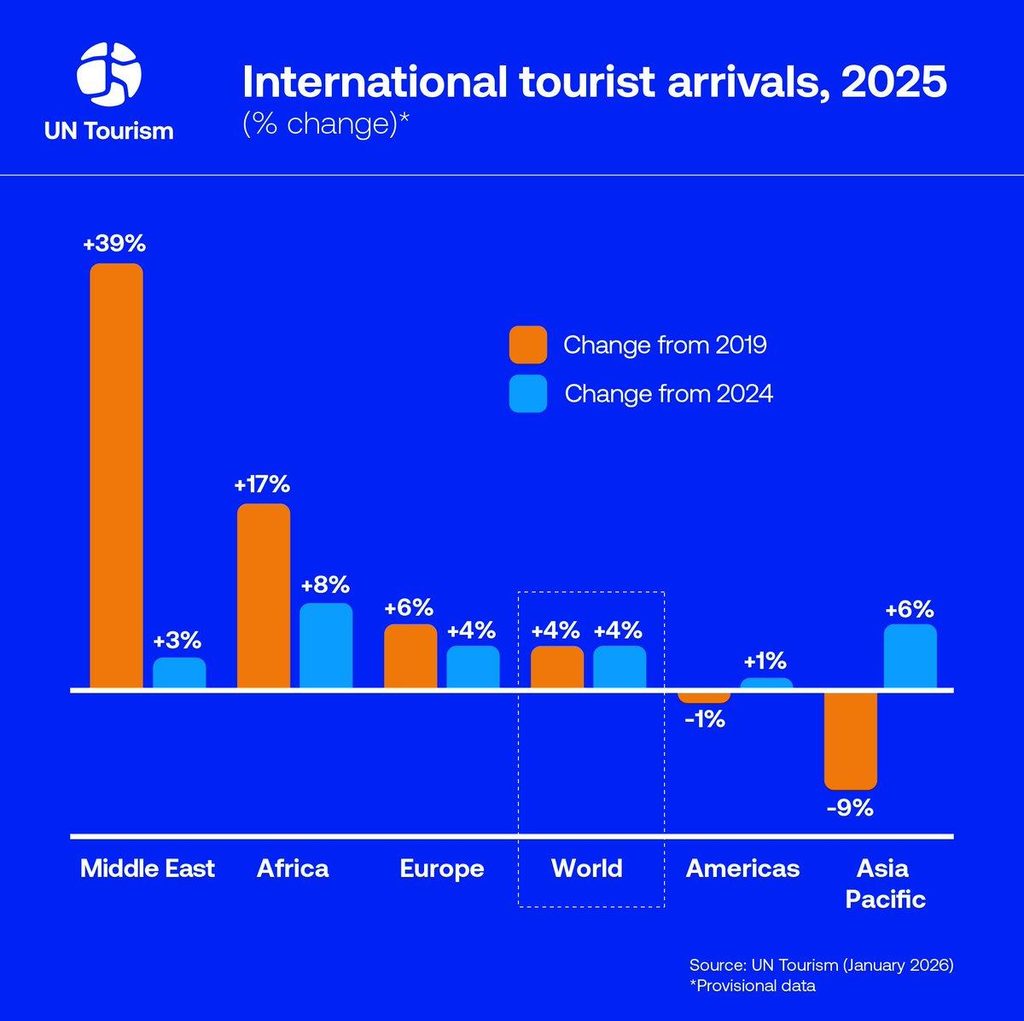
Although the region’s share of global arrivals declined from 69% to around 51%, its visitor volume increased substantially. The latest provisional regional figures published by UN Tourism in January 2026 recorded 793 million international arrivals in Europe, 331 million in Asia and the Pacific, 218 million in the Americas, 100 million in the Middle East and 81 million in Africa. These figures demonstrate the increasingly broad distribution of international travel across the world’s regions.
Emerging Destinations Expand the Global Tourism Landscape
The expansion of international tourism has also created opportunities for a wider range of destinations. The concentration of international arrivals among the world’s ten most visited destinations has declined over time, indicating that travellers are increasingly exploring countries and regions beyond traditional tourism centres. According to UN Tourism, the world’s top ten destinations accounted for 61% of international tourist arrivals in 1980. By 2024, their combined share had fallen to 40%. France, the United States and Spain continued to rank among the leading destinations, while several other countries strengthened their international tourism positions.
China entered the top ten in 1990 and climbed to fourth place by 2013. Japan entered the top ten in 2024, while Türkiye also advanced to fourth place that year. Italy maintained a position among the leading destinations, accounting for approximately 4% of global arrivals in 2024, while Mexico and Germany each held shares of around 3%. The post-pandemic period also brought changes to destination rankings. Uzbekistan, Albania, Colombia and Saudi Arabia recorded some of the largest upward movements between 2019 and 2024, highlighting the growing international visibility of destinations across different regions.

The diversification of tourism markets and destinations is an important development for countries seeking to strengthen their tourism industries. Improved air connectivity, destination promotion, investment in tourism infrastructure, travel facilitation and the development of new tourism products can help countries attract visitors and participate more actively in the international travel market. The expansion of global tourism over the past 50 years demonstrates the sector’s capacity for growth and recovery.
From 222 million international arrivals in 1975 to a provisional 1.544 billion in 2025, tourism has become a major force in global economic activity, connecting destinations, businesses and communities across the world. As international travel continues to evolve, the growing diversity of markets and destinations offers further opportunities for tourism development.