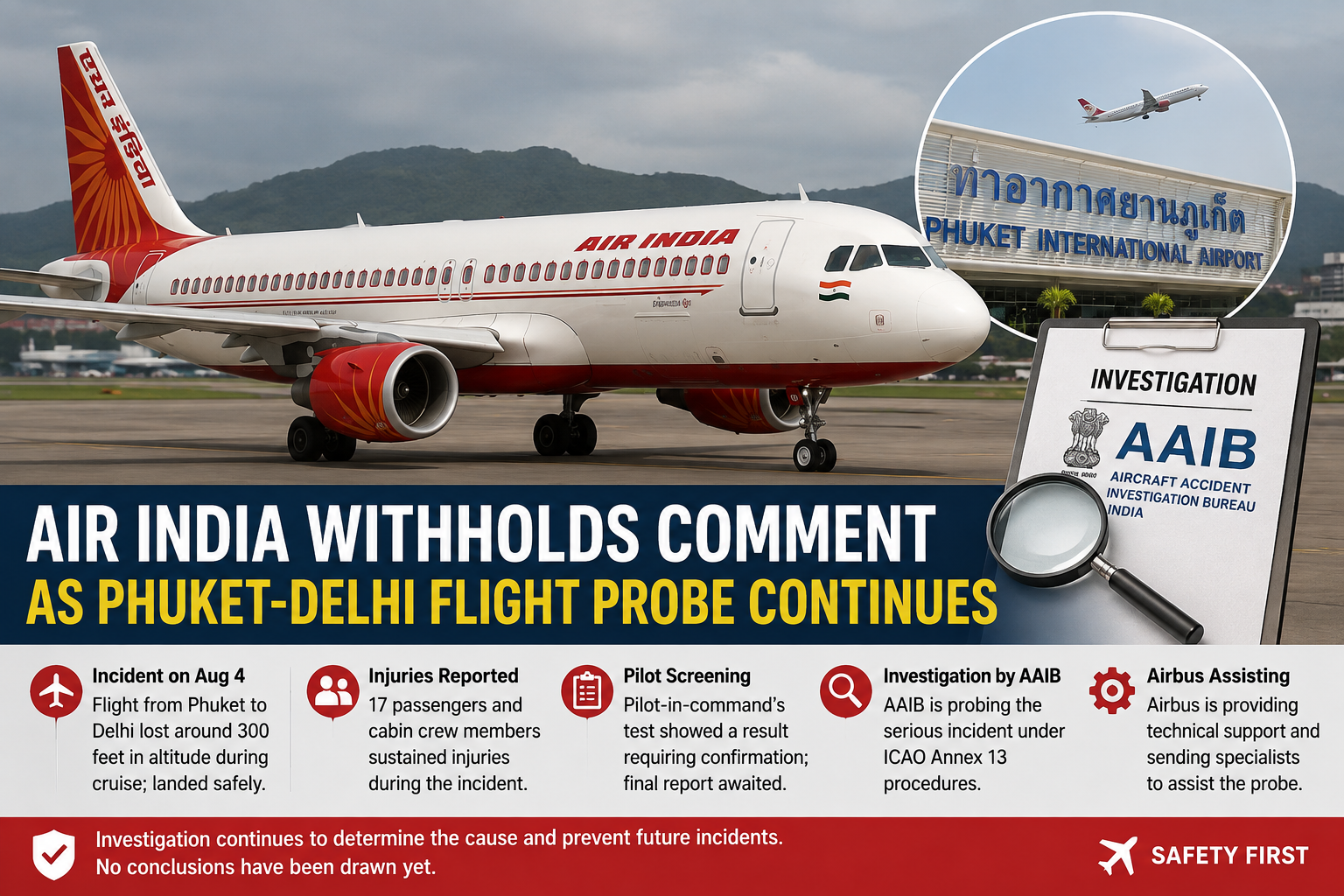
Air India has said it will not comment on findings or observations related to the investigation into a serious incident involving its Phuket-Delhi flight, as India’s Aircraft Accident Investigation Bureau (AAIB) continues its inquiry under the provisions of Annex 13 of the International Civil Aviation Organization (ICAO).
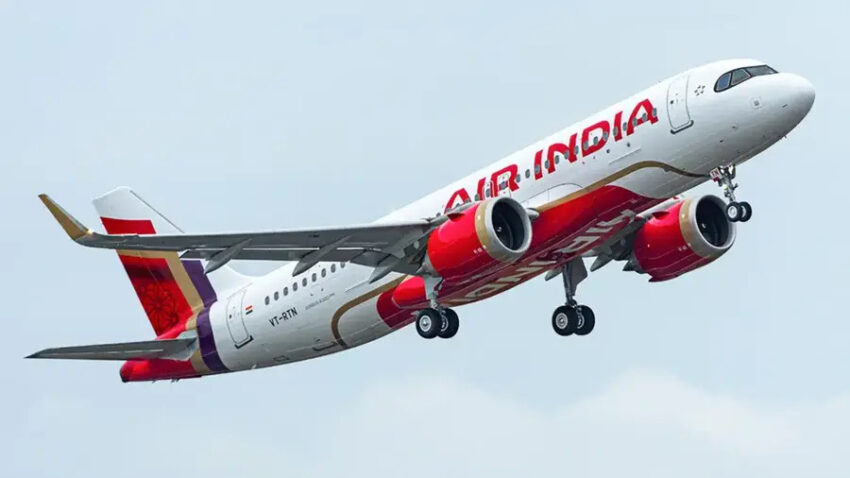
Air India said it remains committed to providing full cooperation and all necessary assistance to the authorities conducting the investigation. The incident, which occurred on August 4, involved an Air India Airbus A320 operating from Phuket, Thailand, to New Delhi. The aircraft experienced a sudden loss of approximately 300 feet in altitude while cruising before stabilising and continuing safely to Delhi. The occurrence was later classified as a “Serious Incident” by India’s Ministry of Civil Aviation.
Air India Says Investigation Is Still Ongoing
Air India has maintained that it is not in a position to comment on possible findings while the official investigation remains underway. Air India said the AAIB is conducting the inquiry in accordance with ICAO Annex 13 and that it will continue to cooperate with the relevant authorities throughout the process. The approach is in line with international aviation investigation procedures, under which investigators are responsible for establishing the facts and identifying factors that may have contributed to an accident or serious incident.

Airbus Provides Technical Assistance
Aircraft manufacturer Airbus is also supporting the investigation by providing technical assistance to the relevant authorities. Airbus said it is working with the investigating agencies and supporting the airline as the inquiry progresses. The manufacturer is also sending specialists to assist with the technical aspects of the investigation. The involvement of Air India manufacturer is expected to assist investigators in examining the aircraft’s systems, technical records, and other relevant data.
Several Passengers and Crew Members Injured
The sudden altitude change resulted in injuries to passengers and members of the cabin crew. Recent reports have put the number of injured people at 17, although details have varied in early reporting. The aircraft was carrying more than 130 passengers along with its crew when the incident occurred. Despite the sudden altitude loss, the aircraft stabilised and subsequently landed safely at Delhi airport. There were no reports of a crash or loss of life.
Pilot Screening Result Sent for Confirmation
Following the incident, both pilots underwent the prescribed psychoactive-substance screening as part of standard aviation procedures. According to India’s Ministry of Civil Aviation, the initial screening of the pilot-in-command produced a result requiring confirmatory testing.
The relevant sample was subsequently sent to a designated laboratory, with the final result still awaited. Pending completion of the investigation and the prescribed testing process, both flight crew members have been removed from the operating roster by India’s Directorate General of Civil Aviation (DGCA). Authorities have said that any further action will depend on the findings of the investigation and the final laboratory result.
Technical Issues Also Being Examined
The investigation is examining the circumstances surrounding the aircraft’s sudden altitude loss. Recent reports have indicated that investigators are looking into possible technical issues involving the Airbus A320, including reported hydraulic-system problems and an autopilot disconnect. However, these reports are not yet official final findings, and the AAIB investigation remains ongoing. Investigators are expected to examine aircraft data, operational procedures, technical records and other available evidence before determining what caused or contributed to the occurrence.
What ICAO Annex 13 Means
ICAO Annex 13 establishes international standards and procedures for investigating aircraft accidents and serious incidents. The primary purpose of such investigations is to prevent similar accidents and incidents in the future, rather than to assign blame or determine legal liability. Investigators examine the circumstances of an occurrence, identify contributing factors and, where appropriate, issue safety recommendations. The process can involve the authorities of different countries, aircraft manufacturers, airlines and other technical organisations.

Importance for International Travel and Tourism
The Phuket-Delhi route connects two major tourism markets in Asia, making aviation safety a key concern for the broader travel and tourism industry. Air connectivity plays a central role in international tourism, allowing visitors to travel between major destinations efficiently.
Phuket is one of Thailand’s leading international leisure destinations, while Delhi serves as a major aviation gateway for India and the wider South Asian region. Incidents such as this highlight the importance of strong aviation safety standards, effective investigation mechanisms and international cooperation in maintaining passenger confidence in air travel. For the tourism sector, safe and reliable air connectivity is an essential part of the overall visitor experience, particularly on international routes linking major tourist destinations.
Investigation Remains Underway
The AAIB investigation remains ongoing, and authorities have yet to release conclusions about the cause of the incident. Air India and Airbus continue to cooperate with the investigating authorities, while technical and operational information is being assessed. Until the investigation is completed, officials and Air India have stressed that no definitive conclusions should be drawn from preliminary observations or unconfirmed reports.