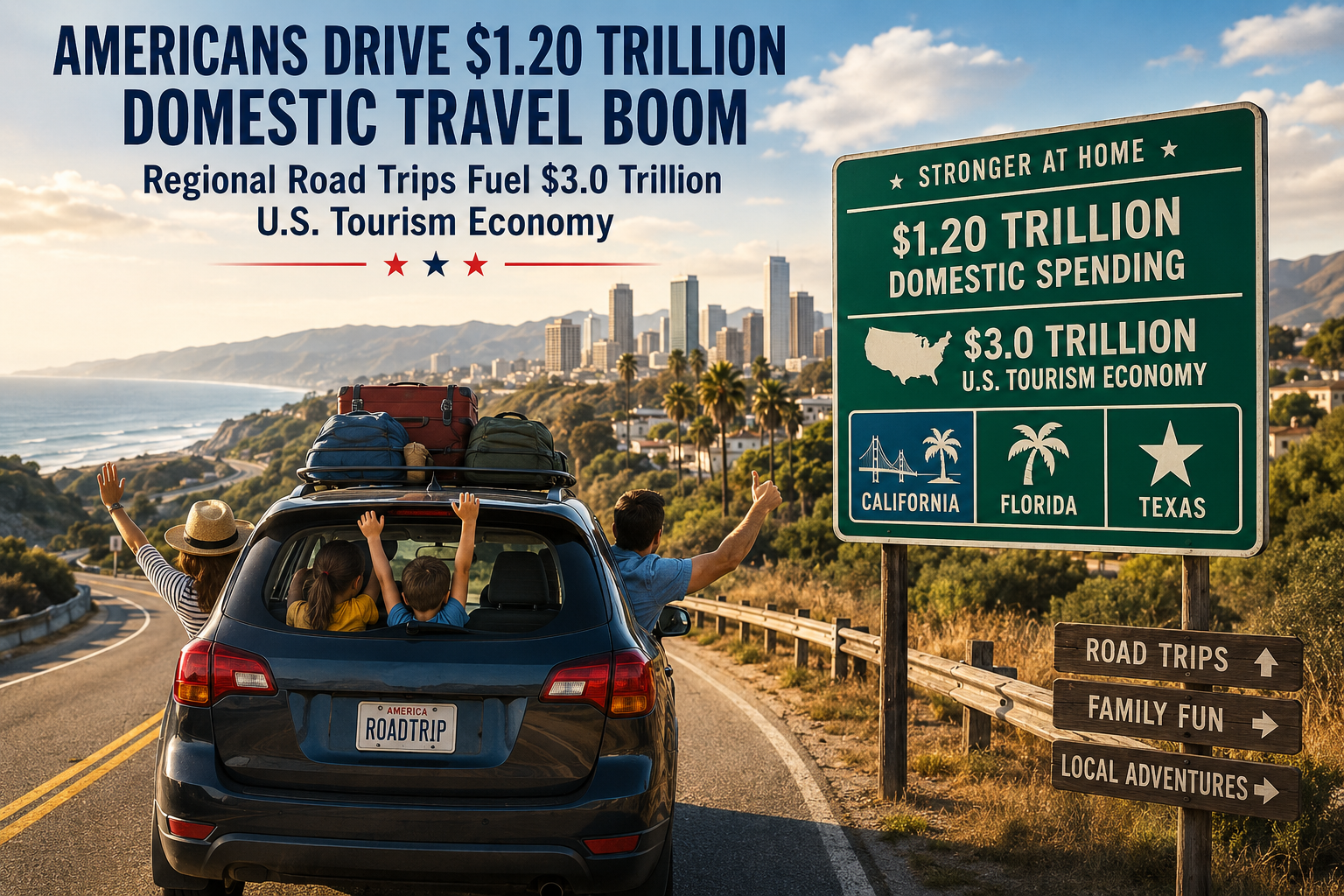
Faced with persistent disruptions across international aviation and rising costs that have made overseas travel increasingly uncertain, American travellers have made a decisive and measurable shift toward exploring their own backyard. Regional road trips, local getaways, and drive-market vacations have surged in popularity, and the economic impact of that behavioural change is now reflected in hard numbers. Domestic travel spending in the United States has reached a landmark $1.20 trillion, serving as the single most powerful anchor of the country’s broader $3.0 trillion tourism economy in 2026.
The $1.20 Trillion Milestone in America
According to data from the National Travel and Tourism Office (NTTO) and the U.S. Travel Association, the scale of domestic leisure travel alone is projected to reach $909 billion this year, with business and group travel contributing an additional $319 billion. International inbound spending, by contrast, stands at a comparatively modest $178 billion, nearly 18% below pre-pandemic, inflation-adjusted levels.

The figures paint a clear picture: it is the American traveller, not the overseas visitor, who is carrying the country’s tourism economy on their shoulders. Middle-class families in particular have adapted to inflationary pressures by opting for shorter-duration trips and accessible regional destinations, favouring the predictability and affordability of domestic travel over the volatility and expense of international alternatives.
California, Florida, and Texas Lead the Charge
At the state level, three destinations have emerged as the dominant engines of domestic tourism growth, each capitalising on distinct traveller segments and economic strengths. California continues to hold the top position for overall travel revenues, driven by a combination of premium leisure spending and technology-sector corporate travel. Its coastal cities, national parks, and world-class hospitality infrastructure make it a perennial draw for travellers across income brackets.
Florida is benefiting enormously from family resort demand and the surge in regional drive-market visitors. As Americans increasingly opt for accessible, road-trip-friendly destinations, Florida’s theme parks, coastal resorts, and warm-weather appeal have positioned it as one of the most visited states in the country, helping to offset the slower return of international visitors to its shores.
Texas is capitalising on two powerful and fast-growing segments. Corporate group travel, forecast to reach $118 billion nationally, is disproportionately benefiting convention cities such as Houston and Dallas. Simultaneously, Texas has emerged as a major hub for youth sports tourism, a market now valued at an estimated $40 billion, drawing families from across the country for tournaments, competitions, and sporting events throughout the year.
The International Visitor Gap
Despite the strength of domestic spending, a significant structural challenge persists. The recovery of international inbound tourism to the United States remains sluggish and uneven. Total international visitor spending is expected to reach $178 billion in 2026, a figure that sounds substantial in isolation but represents a meaningful shortfall relative to historical benchmarks when adjusted for inflation. Experts do not anticipate a full recovery of international visitor volumes to pre-pandemic levels until at least 2029.
Several factors are contributing to this delayed recovery. Visa processing delays continue to deter potential visitors from key source markets. Unfavourable currency exchange rates have reduced the purchasing power of travellers from Europe, Asia, and Latin America. And broader global macroeconomic headwinds, including elevated inflation and geopolitical uncertainty, have dampened international travel appetite across multiple regions.
Practical Realities for Domestic Travellers
The surge in internal travel has reshaped the booking landscape in meaningful ways for American holiday-makers. Popular domestic destinations are experiencing sustained, year-round demand that has fundamentally changed the availability and pricing of accommodation and experiences. Cities such as Miami, Austin, and southern California’s coastal towns are regularly operating near peak capacity, and last-minute deals at premium properties have become increasingly rare.
Travel advisors are urging prospective visitors to plan and book significantly further in advance than they may have done in previous years. They also recommend exploring emerging regional destinations, state parks, and secondary cities as alternatives to saturated hotspots, options that often deliver comparable experiences at considerably lower cost and with far less congestion.

The Road to International Recovery
Industry analysts monitoring the domestic travel boom are careful to note that while internal spending is successfully cushioning the broader tourism economy, long-term health requires a meaningful recovery in international arrivals. On that front, there is cautious optimism. Major global sporting events scheduled to take place on American soil, most notably the upcoming FIFA World Cup, are expected to deliver a significant injection of international visitors and spending. Organisers anticipate well over one million global attendees, providing targeted relief to hospitality operators in host cities who have been most affected by the prolonged absence of overseas tour groups and international leisure travellers.
The Bigger Picture
The United States tourism sector currently supports approximately 15 million jobs, contributing around 2.4% of national GDP. The resilience of that contribution, maintained through a period of significant international headwinds, is a testament to the depth and diversity of America’s domestic travel market. From weekend road trips to multi-state family vacations, the everyday choices of American travellers have collectively constructed an economic buffer that has protected livelihoods, sustained businesses, and kept one of the world’s largest tourism economies firmly on its feet.