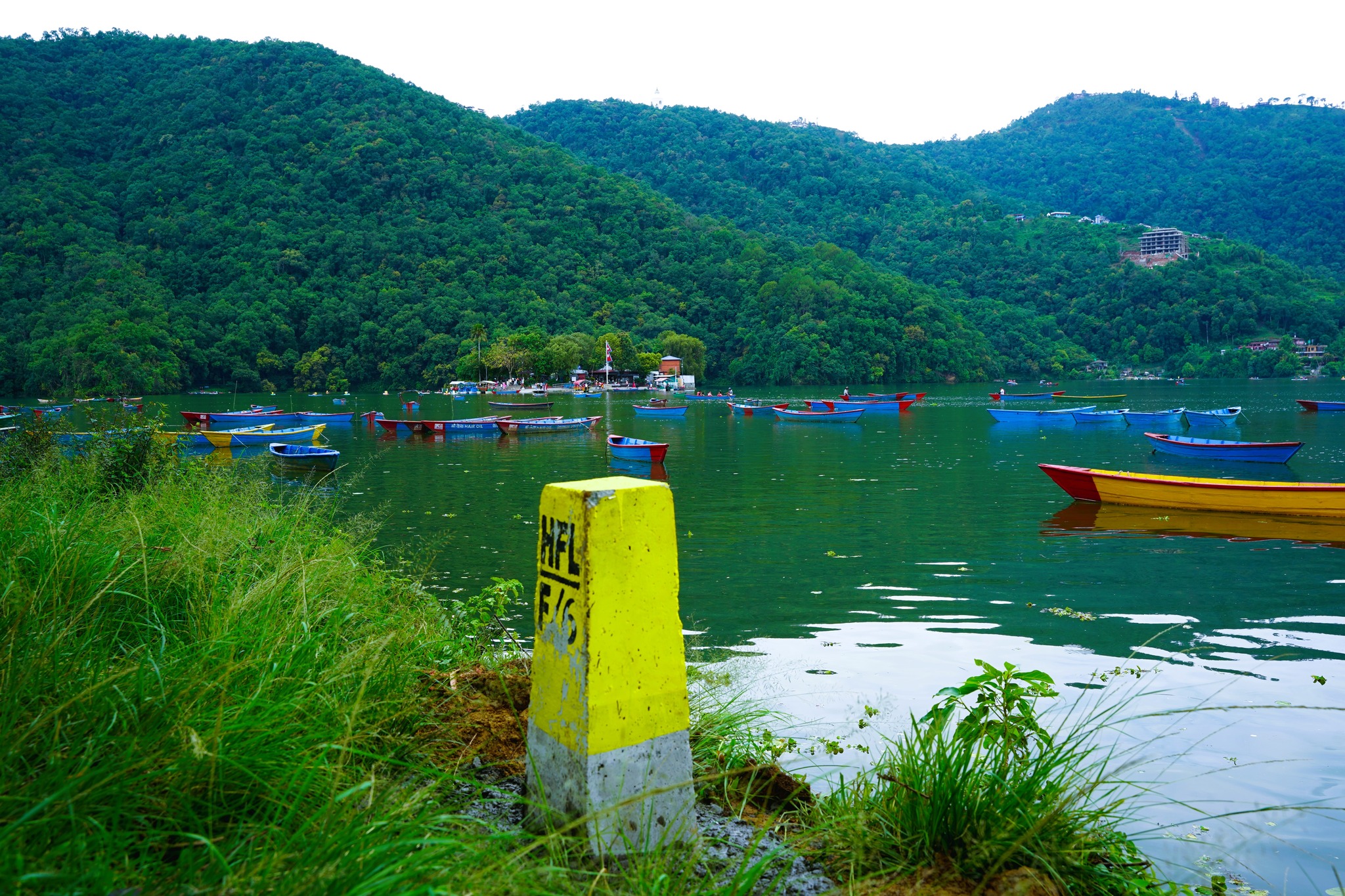
The much-anticipated demarcation project of Pokhara’s iconic Fewa Lake has achieved a significant milestone. As part of a coordinated initiative by Pokhara Metropolitan City, the Gandaki Province, and the Government of Nepal, the work of installing boundary pillars along the shores of the lake has been successfully completed. The initiative follows a directive issued by the Supreme Court to preserve and protect the ecological and cultural sanctity of the lake, one of Nepal’s most treasured natural heritages.
Boundary Demarcation Begins Following Court Order
The demarcation project officially began on Jestha 17, 2082 (early June 2025), in response to a Supreme Court ruling issued on Ashadh 4, 2080, mandating the removal of all structures, both permanent and temporary, within a 65-meter radius from the lake’s high-water mark. The court directive ordered the Nepal Government, Gandaki Province, and Pokhara Metropolitan City to enforce the removal of encroachments and restore the Fewa Lake perimeter to its original ecological boundary.
To implement the court’s mandate, a technical sub-committee formed by the Fewa Lake Conservation Coordination Committee carried out a detailed survey using advanced tools like drone mapping and Differential GPS (DGPS) technology. Based on this scientific survey, the team demarcated the lake’s legal boundaries and identified precise locations to install the boundary markers.
Over a Thousand Pillars Installed Around Fewa’s Shore
According to Pokhara Mayor Dhanraj Acharya, a total of 1,055 boundary pillars (or poles) have now been installed along the shores of Fewa Lake, primarily in the Talghar area. These poles mark the designated 65-meter buffer zone from the lake’s waterline, a zone that the court has declared off-limits for construction and human encroachment.
“This marks a historic step in our efforts to protect and preserve Fewa Lake,” said Mayor Acharya. “The successful completion of this first phase demonstrates our firm commitment to environmental conservation and the rule of law. With the installation of these pillars, the lake now has clear physical boundaries for the first time in its history.”
In areas where it was not possible to physically install poles, such as steep slopes or densely vegetated regions, alternative methods such as visual markers and signposts have been used to denote the lake’s boundaries.
Second Phase: Classification of Land Parcels to Begin
Now that the first phase of pillar installation is complete, Pokhara Metropolitan City is preparing to launch the second phase of the conservation campaign. This involves categorizing land parcels that fall within the 65-meter boundary zone. Mayor Acharya noted that the upcoming phase will determine which plots of land are eligible for compensation and which will be invalidated due to illegal occupation or encroachment.
“The next step is to conduct a land classification process,” Acharya said. “This will help us determine which families or owners are entitled to government compensation for relocation and which structures must be removed without any compensation due to unlawful construction.”
This land classification process is expected to play a crucial role in managing future resettlement, compensation claims, and legal disputes that may arise as the authorities move forward with evictions and restoration efforts.
Compensation and Clearance in the Third Phase
In the third and final phase of the conservation plan, the metropolitan city will recommend compensation for eligible landowners. Only after the compensation process is completed will authorities proceed to clear the encroached areas, thereby restoring the lake’s green buffer zone as envisioned in the court’s order.
This step is seen as essential to ensure that the rights of legally residing individuals are respected, while also facilitating the long-term goal of restoring Fewa Lake’s natural state. Authorities are keen to emphasize that no forced evacuations will take place without due process and financial redress.
Use of Modern Technology for Accurate Surveying
One of the hallmarks of this project has been the use of cutting-edge technology. For the first time, high-precision DGPS mapping and drone surveys were deployed to assess the lake’s exact geographical and hydrological boundaries. These technologies provided a detailed, evidence-based foundation for the technical team to demarcate the lake with scientific accuracy.
According to recent studies, the total area of Fewa Lake has been determined to be approximately 6.343 square kilometers, equivalent to around 12,468 ropanis of land. This figure will now serve as the official record for further conservation and development planning.
Environmental and Cultural Significance of the Project
The installation of the pillars is not just an administrative act but a symbol of Pokhara’s commitment to protecting its natural and cultural heritage. Fewa Lake is not only a major tourist attraction but also a source of spiritual, environmental, and economic value for the people of the region.
“This project will help preserve Pokhara’s identity as a city of lakes and natural beauty,” Mayor Acharya stated. “By clearly demarcating the lake and restoring its buffer zone, we are protecting biodiversity, preventing overdevelopment, and maintaining the ecological balance that the lake provides.”
The demarcation is also expected to enhance tourism, as clean and ecologically preserved environments attract both domestic and international visitors. Local conservationists believe that a clearly marked and legally protected Fewa Lake will reduce haphazard urban expansion and help maintain the lake’s water quality and natural appeal for future generations.
A Legal and Environmental Landmark
The completion of the first phase of this project marks a historic moment in Nepal’s environmental conservation efforts. It also sets a legal precedent for how natural heritage sites across the country can be protected through coordinated efforts between the judiciary, central and provincial governments, and local authorities.
As the city moves into the second and third phases, Pokhara stands at the forefront of a broader national dialogue about sustainable urban planning, ecological justice, and public accountability in natural resource management. The ongoing commitment to restoring and conserving Fewa Lake sends a powerful message that Nepal is ready to prioritize long-term environmental sustainability over short-term developmental pressures.