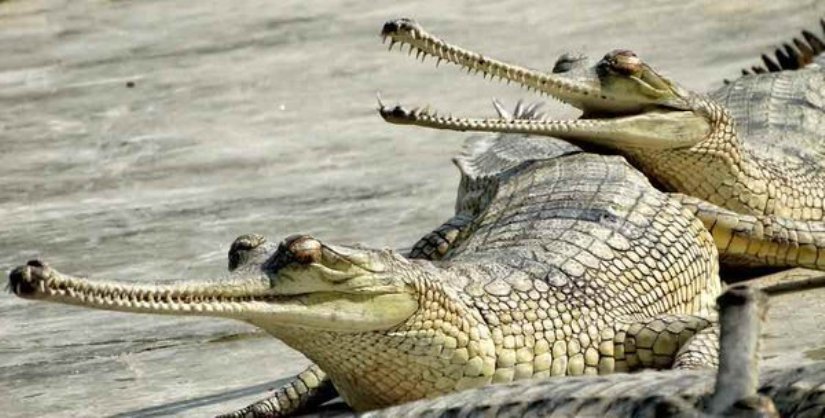
A comprehensive gharial crocodile count and monitoring operation has officially begun in Nepal’s Rapti and Narayani rivers, aimed at assessing the status of one of the world’s most endangered reptile species. According to the Chitwan National Park (CNP), the initiative commenced on Sunday and will continue from Mangsir 21 to 28.
Annual Monitoring to Assess Released Gharials
CNP Information Officer Abinash Thapa Magar stated that the annual monitoring is crucial for understanding the condition of crocodiles that are released into the wild every year. “Every year, gharials raised in our breeding center are released into the rivers. The count and monitoring help us understand their survival and current status,” he explained.

The gharial breeding center under Chitwan National Park has been raising the species in a controlled environment for decades. Once they reach a viable age, the crocodiles are systematically released into their natural habitats across various river systems of the country. This year’s count aims to determine the existing population of released gharials and evaluate their adaptation in the wild.
Survey Areas Across Rapti and Narayani Rivers
Thapa Magar detailed the specific areas selected for the monitoring exercise. In the Rapti River, the survey will cover stretches from Lothar to Golaghat and further downstream to Triveni. Similarly, in the Narayani River, the count will extend from Gajipur to the confluence point where the Narayani meets the Rapti River.
These regions are critical habitats for crocodiles due to suitable water flow, prey availability, and nesting conditions. However, they are also vulnerable to increasing human activities, making population assessment essential for future conservation planning.
Technical Team, Army Personnel, and Local Community Engaged
An eight-member team has been deployed for the gharial count, consisting of CNP’s technical staff, personnel from the Nepal Army, and individuals from the local Bote community, who possess extensive traditional knowledge of river ecosystems. Thapa Magar explained that the process may take longer than expected due to the need to thoroughly inspect river bends, sandbanks, and other natural formations where crocodiles are typically spotted.
The integration of community participation, especially from the Bote people, has helped enrich the accuracy of monitoring efforts, as they are familiar with local aquatic species and river dynamics.
Over 2,105 Gharials Released Since 1995
Nepal has been continuously releasing captive-reared gharials into the wild as part of long-term conservation efforts. According to CNP, 2,105 gharials have been released into various rivers of the country since 1995. In the previous fiscal year alone, 133 crocodiles were released, while 15 have been released so far in the current fiscal year.
However, not all released gharials survive. Many are swept away by strong river currents, while others fall victim to habitat disruption. As a result, the population has not increased in expected numbers despite decades of conservation attempts.
352 Gharials Recorded in Last Year’s Count
During last year’s survey, a total of 352 gharials were recorded across the two rivers, 206 in the Rapti River and 146 in the Narayani River. Although these figures indicate the presence of a stable population, conservationists emphasize that gharials remain in a critically endangered state. Historically, gharials were found across Pakistan, Bangladesh, Bhutan, Myanmar, India, and Nepal. Today, their presence has shrunk dramatically, and they remain only in Nepal and India.
Sharp Decline in Global Population
In the 1940s, the global crocodile population was estimated at around 10,000. By the 1970s, it had plunged to just 2 percent of that figure, raising alarm among conservationists worldwide. Since then, breeding centers and reintroduction programs have been launched, but the species continues to face numerous threats.

Human Activities Threatening Gharial Habitats
Thapa Magar warned that increasing human encroachment has significantly degraded the natural habitats of crocodiles. Riverbed extraction, pollution, fishing activities, and rising human movement along rivers have contributed to shrinking habitats and increased mortality.
Conservationists stress that without stronger enforcement of river protection laws and increased awareness among local communities, the gharial population may continue to struggle despite ongoing conservation efforts.