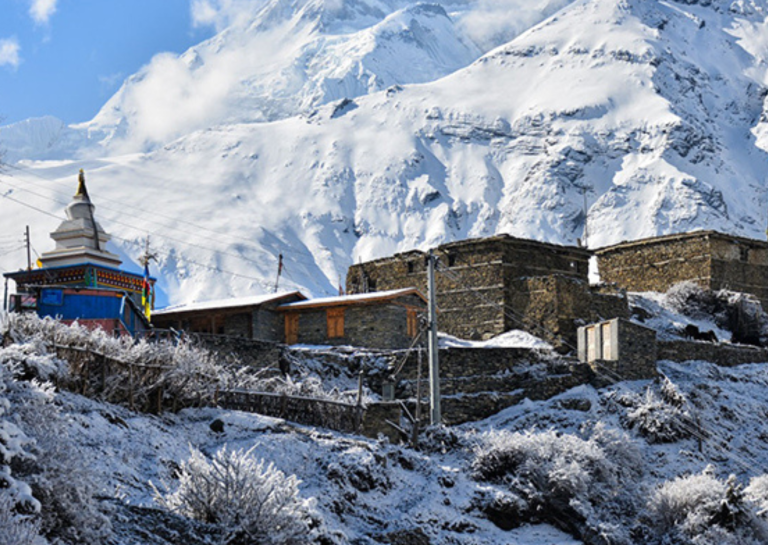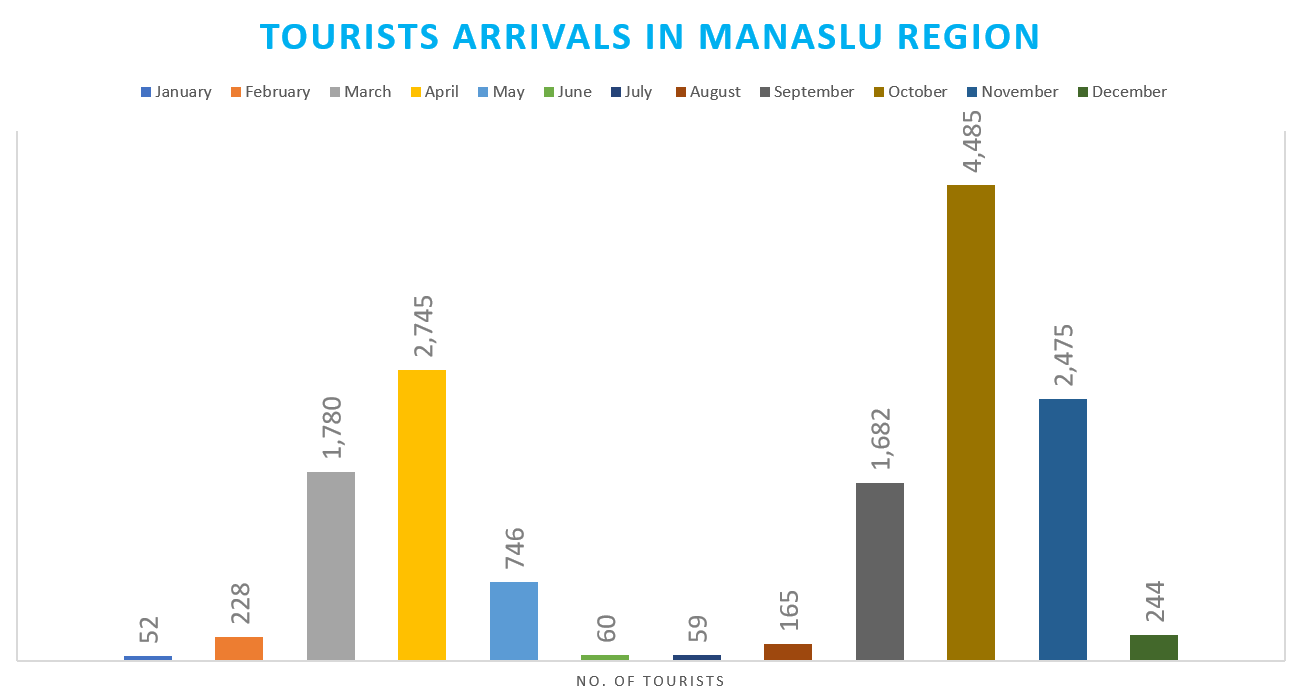
The Manaslu region of Gorkha has recorded a remarkable growth in tourism in 2025, welcoming nearly 15,000 foreign visitors despite facing challenges such as off-season floods, landslides, heavy snowfall, and global travel uncertainties including the Gen-Z youth movement. According to records maintained by the Manaslu Conservation Area Project (MCAP), a total of 14,980 tourists entered the Manaslu Conservation Area throughout 2025, marking a significant increase compared to 12,800 foreign tourists in 2024.
Out of the total visitors in 2025, 14,738 were international tourists from countries outside the SAARC region, 344 were from SAARC nations, and 240 were domestic Nepali travelers. MCAP officials state that this steady rise in tourist inflow reflects the growing global interest in Manaslu as a premium trekking and adventure destination, particularly known for its pristine trails, cultural villages, dramatic Himalayan scenery, and less-crowded trekking experience compared to other mainstream routes.

Online Permit System Drives Efficient Tourist Management
MCAP Chief Santosh Sherchan informed that the introduction of an online permit system has significantly streamlined tourist management in the region. In 2025 alone, 14,721 tourists obtained their entry permits online, while an additional 17 visitors acquired permits directly from MCAP checkposts in Jagat and Samagaun. The digital system has improved transparency, data accuracy, and ease of access for travelers planning to explore the Manaslu region.
The online system also plays a key role in ensuring visitor safety, monitoring travel flows, and supporting conservation planning. MCAP has been gradually modernizing its visitor monitoring mechanism to align with sustainable tourism practices, ensuring that tourism growth does not compromise the fragile mountain ecosystem.
Over NPR 38.5 Million Collected in Entry Fees
Tourism activities in Manaslu have also significantly contributed to conservation financing. In 2025, MCAP collected a total of NPR 38.586 million as conservation area entry fees. Of this, NPR 344,000 was collected from SAARC tourists and NPR 48,000 from Nepali visitors, while the remainder came from tourists from other international markets.
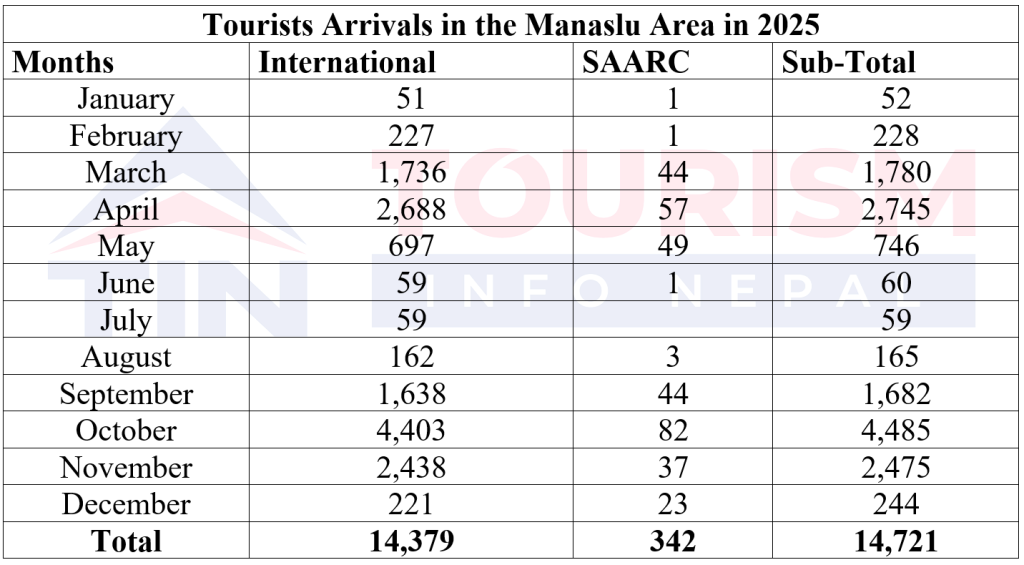
As per the existing regulations, SAARC nationals are required to pay NPR 1,000 per person, while tourists from other countries pay NPR 3,000 per person as entry fees. Nepali visitors are charged a nominal NPR 100 per person. Tourists are required to pay their entry fees at designated counters in Bhrikutimandap, Kathmandu, and Damside, Pokhara. However, those who fail to obtain permits at these counters must pay double the entry fee at the checkposts in Jagat and Samagaun.
In a significant policy shift, MCAP has started recording data of domestic tourists from 2025 onwards, marking an important step toward comprehensive tourism statistics and better planning for infrastructure development.
Consistent Long-Term Growth in Visitor Numbers
MCAP data shows a consistent upward trend in tourist arrivals over the years. During the fiscal year 2080/81, Manaslu welcomed 9,782 tourists, while 7,705 tourists visited in 2079/80, and only 2,284 in 2078/79. The lowest tourist arrival was recorded in 2077/78 with just 194 visitors, largely due to the pandemic. Earlier years recorded 5,338 tourists in 2076/77 and 7,655 in 2075/76, demonstrating a steady long-term recovery and growth trajectory.
MCAP Chief Sherchan emphasized that proper utilization of available resources, improved infrastructure, and effective destination marketing could position Manaslu as one of Nepal’s most prominent trekking destinations within a few years. He noted that with better trail management, eco-lodging development, digital monitoring, and promotion of local culture, Manaslu has strong potential to rival other leading trekking routes such as Annapurna and Everest.

A Rising Star in Nepal’s Mountain Tourism
Tourism entrepreneurs and conservation experts believe that Manaslu’s increasing popularity is driven by its pristine natural environment, restricted-area trekking status, rich Tibetan-influenced culture, and quieter trails, which appeal to adventure seekers and cultural travelers alike. With growing international exposure, the Manaslu Circuit Trek is now increasingly being recognized as a must-visit destination for trekkers seeking both wilderness and authenticity.
With continued investment in sustainable tourism practices, Manaslu is poised to become a major pillar of Nepal’s mountain tourism economy, contributing to local livelihoods, conservation funding, and Nepal’s global tourism image in the years to come.