Nepal Rastra Bank (NRB), the country’s central bank, has announced the official foreign exchange rates for today. According to the central bank, the rates were determined to guide commercial banks and foreign exchange dealers in conducting currency-related transactions. These rates reflect the latest value of major international currencies against the Nepali rupee.
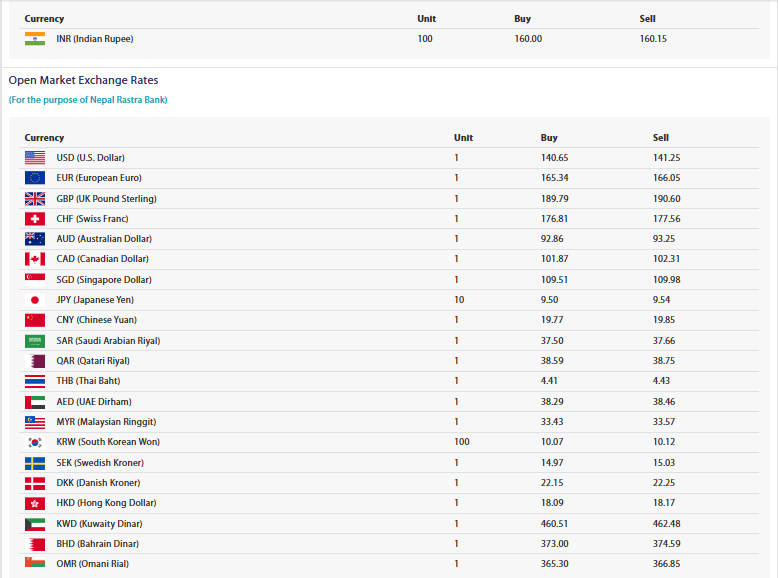
The announcement shows the U.S. dollar continues to remain one of the most closely watched currencies. NRB has fixed the buying rate of one U.S. dollar at NPR 140.65 and the selling rate at NPR 141.25. This slight difference between buying and selling rates is part of the bank’s mechanism to maintain stability and manage foreign exchange flows effectively.

European and British Currencies
The euro and pound sterling, two of the strongest global currencies, have also been updated in today’s list. One euro is valued at NPR 165.34 for buying and NPR 166.05 for selling. Similarly, one British pound sterling has been set at NPR 189.79 for buying and NPR 190.60 for selling.
Switzerland’s official currency, the Swiss franc, has also been included, with a buying rate of NPR 176.81 and a selling rate of NPR 177.56. These European currencies play an important role in Nepal’s remittance inflows, trade settlements, and tourism transactions.
Dollar Bloc Currencies: Australia, Canada, and Singapore
Among the dollar bloc countries, the Australian dollar has been fixed at NPR 92.86 for buying and NPR 93.25 for selling. The Canadian dollar stands at NPR 101.87 for buying and NPR 102.31 for selling. Similarly, the Singapore dollar has been valued at NPR 109.51 for buying and NPR 109.98 for selling.
These currencies are important given Nepal’s growing trade relationships and the increasing number of Nepali workers residing in Australia, Canada, and Singapore, who send back remittances in these denominations.
Asian Currencies: Yen, Yuan, and Riyals
Asian currencies also form a significant part of the exchange table. The Japanese yen, calculated in units of 10, has been fixed at NPR 9.50 for buying and NPR 9.54 for selling. The Chinese yuan, which is gaining increasing importance due to growing cross-border trade, has been set at NPR 19.77 for buying and NPR 19.85 for selling.
From the Gulf region, where millions of Nepalis work, the Saudi Arabian riyal has been fixed at NPR 37.50 for buying and NPR 37.66 for selling. The Qatari riyal has been set at NPR 38.59 for buying and NPR 38.75 for selling. These rates are particularly relevant for remittance-dependent households, as workers in Saudi Arabia, Qatar, and other Gulf countries send back billions annually in foreign currency.
Other Regional Currencies
According to NRB, the Thai baht is valued at NPR 4.41 for buying and NPR 4.43 for selling. The UAE dirham has been set at NPR 38.29 for buying and NPR 38.46 for selling. The Malaysian ringgit is fixed at NPR 33.43 for buying and NPR 33.57 for selling.
For South Korea, 100 South Korean won is valued at NPR 10.07 for buying and NPR 10.12 for selling. Meanwhile, the Swedish krona has been set at NPR 14.97 for buying and NPR 15.03 for selling, while the Danish krone is valued at NPR 22.15 for buying and NPR 22.25 for selling.
Premium Currencies: Dinar and Omani Rial
Some of the world’s most valuable currencies have also been included in today’s announcement. The Hong Kong dollar is fixed at NPR 18.09 for buying and NPR 18.17 for selling. The Kuwaiti dinar, which remains one of the strongest currencies globally, has been set at NPR 460.51 for buying and NPR 462.48 for selling.
The Bahraini dinar has been valued at NPR 373.00 for buying and NPR 374.59 for selling. Similarly, the Omani rial stands at NPR 365.30 for buying and NPR 366.85 for selling. These currencies are especially relevant for Nepali migrant workers in the Middle East, whose remittances form the backbone of Nepal’s economy.
Indian Rupee Exchange Rate
Given Nepal’s deep economic ties with India, the exchange rate of the Indian rupee remains highly significant. NRB has fixed INR 100 at NPR 160 for buying and NPR 160.15 for selling. The near-parity exchange rate reflects the pegged system Nepal maintains with the Indian rupee, ensuring monetary stability in cross-border trade and financial transactions.
Exchange Rate Flexibility and Public Information
Nepal Rastra Bank has clarified that today’s rates may be subject to revision if necessary, depending on fluctuations in international markets. The central bank also stated that the exchange rates determined by commercial banks might vary slightly from the official rates, though they are required to remain within the parameters set by NRB.
For public transparency, updated foreign exchange rates are regularly published on the central bank’s official website. This ensures that businesses, financial institutions, and individuals have easy access to the latest figures for conducting international transactions.

The daily announcement of foreign exchange rates by Nepal Rastra Bank highlights the importance of currency management in a country heavily reliant on imports and remittances. Today’s rates show the Nepali rupee maintaining relative stability against major global currencies, with slight fluctuations in line with international trends.
For businesses engaged in trade, families dependent on remittances, and travelers dealing with foreign exchange, these official rates serve as a critical benchmark. By adjusting rates daily, the central bank aims to strike a balance between stability, competitiveness, and fairness in Nepal’s foreign exchange market.