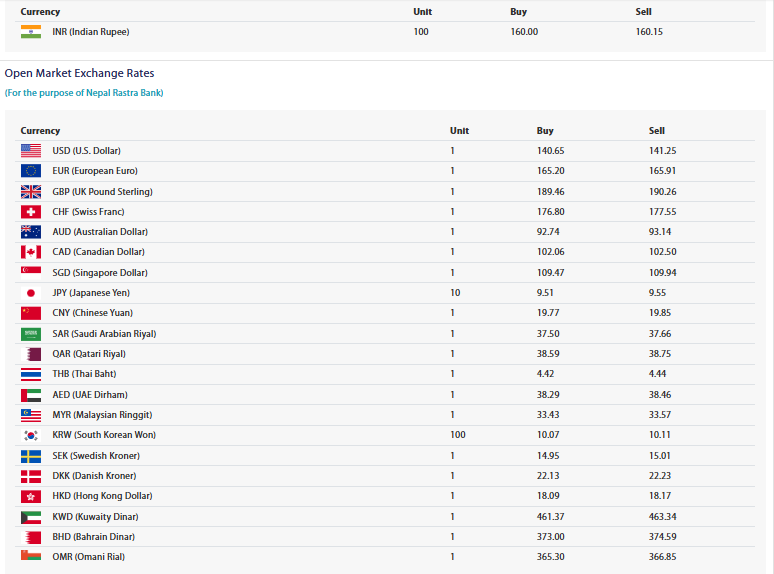
Nepal Rastra Bank (NRB), the country’s central bank, has published the official foreign exchange rates for today. According to the announcement, the buying rate of one U.S. dollar has been set at Rs. 140.65 while the selling rate stands at Rs. 141.25.
The daily exchange rate determination by NRB is crucial for international trade, remittance inflows, tourism-related transactions, and the financial sector. Businesses, travelers, importers, exporters, and Nepalis working abroad closely monitor these rates to plan their financial activities.
Major Currencies: Dollar, Euro, and Pound
In addition to the U.S. dollar, the Euro and British Pound remain key currencies for Nepal’s economy due to trade relations and tourism. For today, the buying rate of one Euro has been set at Rs. 165.20 and the selling rate at Rs. 165.91. Similarly, the British Pound Sterling is trading at a buying rate of Rs. 189.46 and a selling rate of Rs. 190.26. The Swiss Franc also features prominently in today’s update, with the buying rate fixed at Rs. 176.80 and the selling rate at Rs. 177.55.

Dollar Bloc Currencies
Among other key currencies, the Australian dollar is being exchanged at Rs. 92.74 for buying and Rs. 93.14 for selling. The Canadian dollar stands at Rs. 102.06 for buying and Rs. 102.50 for selling. Similarly, the Singapore dollar is at Rs. 109.47 (buying) and Rs. 109.94 (selling). These currencies are important for Nepal as the country has growing trade, educational, and labor market ties with Australia, Canada, and Singapore.
Asian Currencies: Yen, Yuan, and Riyals
For Asian currencies, the Japanese Yen (per 10 units) has been fixed at Rs. 9.51 for buying and Rs. 9.55 for selling. The Chinese Yuan stands at Rs. 19.77 for buying and Rs. 19.85 for selling. In terms of Gulf currencies, the Saudi Arabian Riyal is at Rs. 37.50 (buying) and Rs. 37.66 (selling), while the Qatari Riyal has been fixed at Rs. 38.59 (buying) and Rs. 38.75 (selling). These currencies are significant due to the large number of Nepali migrant workers in the Middle East, where remittances are sent home in bulk.
Other Asian and Regional Currencies
The Thai Baht is being exchanged at Rs. 4.42 (buying) and Rs. 4.44 (selling). The UAE Dirham is valued at Rs. 38.29 for buying and Rs. 38.46 for selling. Similarly, the Malaysian Ringgit is at Rs. 33.43 (buying) and Rs. 33.57 (selling).
The South Korean Won (per 100 units) stands at Rs. 10.07 for buying and Rs. 10.11 for selling. Among the Scandinavian currencies, the Swedish Kroner is fixed at Rs. 14.95 (buying) and Rs. 15.01 (selling), while the Danish Kroner is at Rs. 22.13 (buying) and Rs. 22.23 (selling).
Premium Currencies: Dinar and Rial
The Gulf dinars and rials remain the highest-valued currencies in today’s NRB rates. The Hong Kong Dollar is at Rs. 18.09 (buying) and Rs. 18.17 (selling). The Kuwaiti Dinar, one of the strongest currencies in the world, has been fixed at a buying rate of Rs. 461.37 and a selling rate of Rs. 463.34. Similarly, the Bahraini Dinar is at Rs. 373.00 (buying) and Rs. 374.59 (selling), while the Omani Riyal is set at Rs. 365.30 (buying) and Rs. 366.85 (selling).
Indian Rupee and Regional Context
Given Nepal’s open border and deep economic interdependence with India, the exchange rate of the Indian Rupee remains of utmost importance. For today, Rs. 100 Indian Rupees is equivalent to Rs. 160.00 for buying and Rs. 160.15 for selling. This peg with the Indian currency directly influences daily commerce, import-export pricing, and travel activities across the two countries.
NRB’s Authority and Market Rates
The central bank has clarified that while these are the official reference rates for today, commercial banks may set slightly different rates depending on their own foreign exchange transactions and market demand.
The NRB also reserves the right to revise these rates at any time, depending on market fluctuations and international trends. Updated exchange rates are regularly made available through the central bank’s official website to ensure transparency and easy access for the public.
Significance of Daily Exchange Rates
The foreign exchange rate is not just a technical figure but a critical indicator for Nepal’s overall economic health. For importers, these rates determine the cost of bringing goods into the country, while exporters rely on them to evaluate earnings from international markets.

For migrant workers, who contribute significantly to Nepal’s remittance-driven economy, exchange rates directly influence how much money their families receive in Nepali currency. A stronger dollar, for instance, means more rupees for every dollar remitted, providing relief to households that rely heavily on foreign income. Likewise, for students studying abroad, tourists visiting Nepal, and businesses involved in cross-border trade, daily exchange rates are key to planning and budgeting.
By publishing daily foreign exchange rates, Nepal Rastra Bank ensures that the financial sector, businesses, and individuals have a reliable benchmark for their transactions. Today’s update highlights a mix of stable and strong performances across major global currencies, with the U.S. dollar, Euro, and Pound continuing to dominate, while Gulf currencies like the Kuwaiti Dinar and Omani Riyal maintain their status as premium currencies.
As Nepal navigates an economy closely tied to remittances, imports, and tourism, the regular dissemination of exchange rates provides much-needed stability, clarity, and direction for both individuals and institutions engaged in international financial activities.