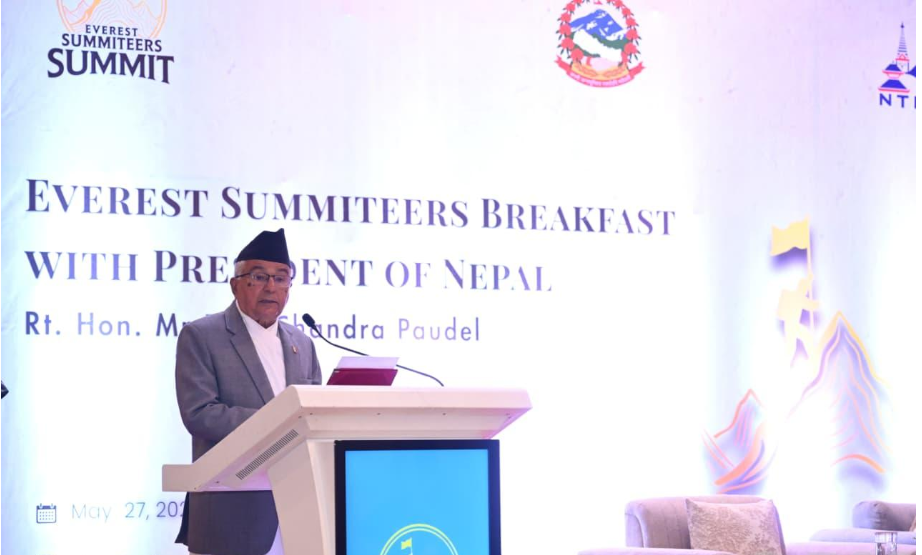
President Ram Chandra Paudel has stressed that sustainable Himalayan tourism, responsible mountaineering, and the protection of fragile mountain ecosystems have become urgent national and global priorities.
Addressing the “Everest Summiters’ Summit–2026” held in Kathmandu in honour of climbers from around the world who have successfully scaled Mount Everest, President Paudel emphasized that the Himalayas are not only Nepal’s geographical identity but also a symbol of national pride and a priceless natural heritage for the entire world.

Everest as a Global Heritage and Economic Lifeline
President Paudel stated that Everest represents more than just a mountain, describing it as a shared global asset that contributes significantly to Nepal’s international identity and tourism-driven economy.
He noted that the conservation, promotion, and balanced utilization of Himalayan resources directly support Nepal’s tourism industry and broader economic development. “Everest is not only Nepal’s geographical identity but also the pride and prestige of the entire nation and an invaluable natural heritage of the world,” he said, adding that sustainable tourism practices are essential for long-term benefits.
Climate Change and Waste Management Emerging as Major Challenges
Highlighting pressing environmental concerns, the President pointed to rising global temperatures, climate change impacts, and increasing waste accumulation in high-altitude climbing regions as serious challenges facing the Himalayas.
He warned that these issues threaten both the ecological balance and biodiversity of the Everest region and called for coordinated global action to address them. President Paudel stressed the need to make mountaineering safer, more sustainable, and technology-driven through stronger international cooperation and innovation.

Call for International Cooperation in Himalayan Conservation
The President underscored the importance of global collaboration in protecting mountain ecosystems, stating that Everest climbers from around the world can play a crucial role in raising awareness about environmental conservation.
He expressed confidence that the summit would provide a meaningful platform for climbers to share experiences and insights, contributing to global understanding of Himalayan environmental challenges. According to him, such gatherings help strengthen international dialogue and promote collective responsibility for preserving mountain environments.
Government Highlights Tourism and Climate Concerns
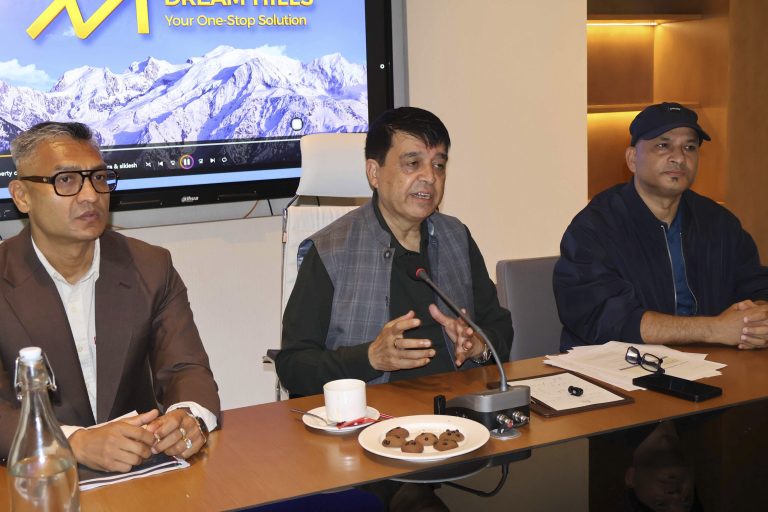
Speaking at the event, Mukunda Prasad Niraula, Secretary at the Ministry of Culture, Tourism and Civil Aviation Nepal, said that the Everest Summiters’ Summit–2026 is expected to contribute positively to Nepal’s tourism promotion efforts.
He also expressed concern over the visible impacts of climate change on Everest and other Himalayan peaks, noting increasing environmental risks for climbers and local communities. Niraula emphasized the need for sustainable tourism policies that balance economic growth with environmental protection.

Summit Brings Together Global Everest Climbers
The Everest Summiters’ Summit–2026 brought together climbers from various countries who have successfully summited Everest, creating a platform for experience sharing, environmental dialogue, and discussions on sustainable mountaineering practices. Participants discussed issues including high-altitude safety, waste management on Everest routes, and the growing need for responsible expedition practices in the face of increased climbing traffic.
The Everest Summiters’ Summit–2026 highlighted Nepal’s growing role in global discussions on climate change, sustainable tourism, and high-altitude conservation. President Ram Chandra Paudel’s call for stronger environmental protection and responsible mountaineering reinforced the urgent need to preserve the Himalayas for future generations.