A Chinese climber has achieved a rare and extraordinary mountaineering feat on Mount Everest and Mount Lhotse, completing a double ascent cycle in record time and surpassing a benchmark previously set by Nepali-British climber Nirmal “Nims” Purja.
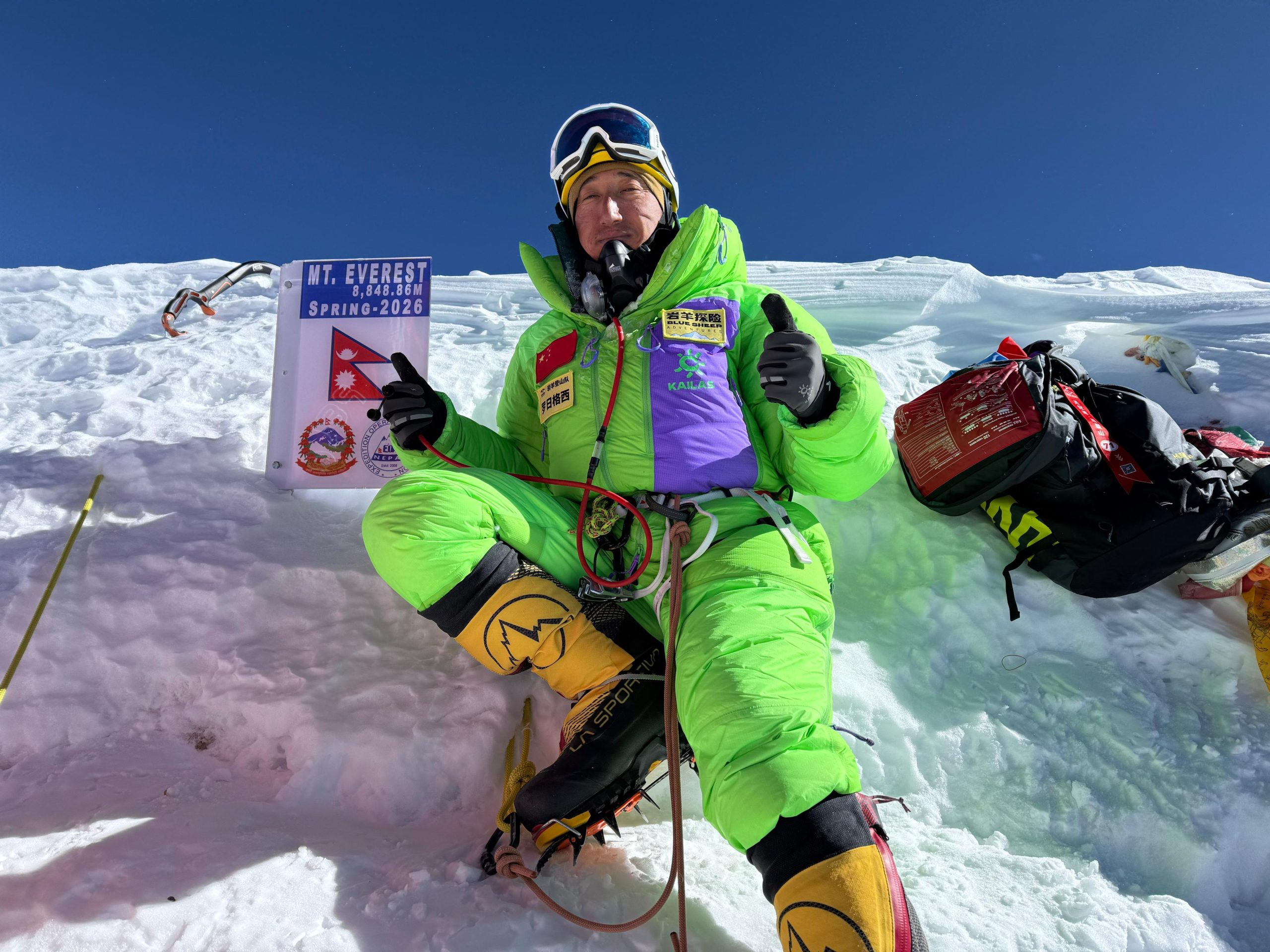
According to Chhang Dawa Sherpa, Expedition Director at Seven Summit Treks, Chinese climber Gexi Luori (43), popularly known as Luo Luo, reached the summit of Everest at around 3:30 am on May 27, marking the completion of one of the most complex high-altitude climbing sequences ever recorded.

Four-Summit Sequence Across Everest and Lhotse in Nine Days
With his latest Everest summit, Luo Luo successfully completed a demanding rotation of climbs involving both Everest and Lhotse twice within a single season. His sequence included:
- Everest summit on May 17 (7:15 am)
- Lhotse summit on May 18
- Second Lhotse summit on May 25
- Final Everest summit on May 27 (3:30 am)
This rare combination makes him the first climber to complete the Everest–Lhotse double-header in such a fast and continuous cycle. Expedition officials stated that the entire feat was completed in 9 days, 20 hours, and 15 minutes, setting a new benchmark in high-altitude performance.
Breaking a Landmark Record Set in 2022
Luo Luo’s achievement surpasses the previous record set by Nirmal Purja, who became the first climber to complete Everest and Lhotse twice between May 15 and May 28, 2022. Purja’s pioneering feat involved traversing the Everest–Lhotse route twice during the same season, a milestone that was widely regarded as one of the most demanding achievements in modern high-altitude climbing. However, expedition officials note that Luo Luo’s sequence, Everest, Lhotse, Lhotse, Everest, represents an even tighter and faster execution of the same elite climbing pattern.
Experts Call It One of the Most Remarkable 8,000-Metre Achievements
Chhang Dawa Sherpa described the performance as “one of the most remarkable achievements ever seen on an 8,000-metre peak,” highlighting both its speed and technical difficulty. He noted that climbing from Everest to Lhotse is comparatively more manageable than the reverse direction, further emphasizing the complexity of the full sequence completed by Luo Luo.
Sherpa also confirmed that the climber was initially scheduled to summit Everest on May 26 but was forced to retreat from the South Summit due to strong high-altitude winds, demonstrating the extreme and unpredictable conditions faced during the expedition. “The decision to turn back was a strong and wise one in one of the harshest environments on Earth,” he added.

A New Benchmark in High-Altitude Mountaineering
Experts in the mountaineering community are calling the achievement a significant milestone in modern Himalayan climbing, where speed, precision, and weather management are becoming increasingly critical. The Everest–Lhotse corridor remains one of the most technically demanding routes in the world, requiring climbers to navigate extreme altitude transitions within very short recovery windows.
Luo Luo’s performance is now being viewed as a new reference point in fast-cycle 8,000-metre expeditions. Gexi Luori’s record-breaking double Everest–Lhotse ascent cycle marks one of the fastest and most complex high-altitude achievements in recent mountaineering history. By completing four summit ascents across two of the world’s highest peaks in under ten days, he has redefined the limits of speed and endurance in Himalayan climbing.