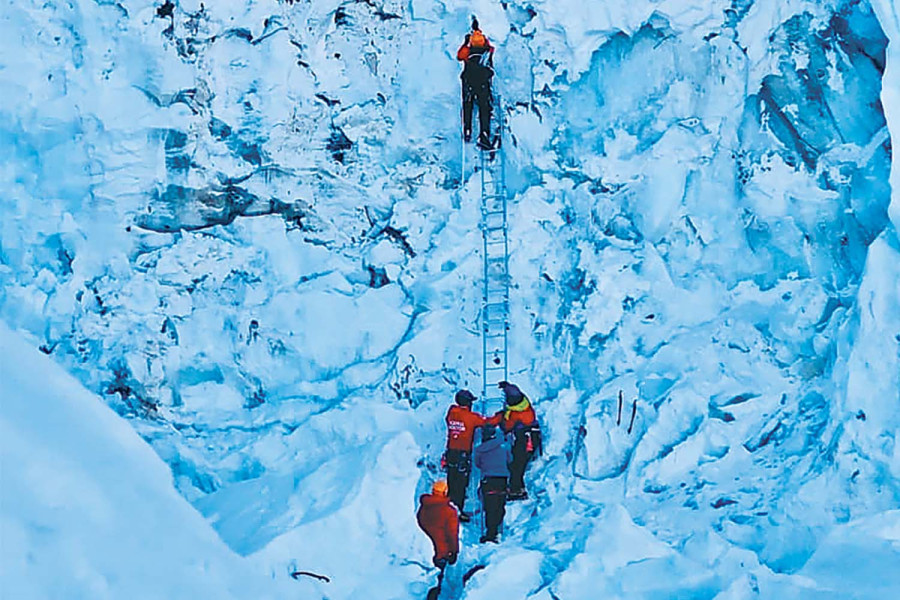
The team of Sagarmatha Pollution Control Committee (SPCC) Icefall Doctors, along with mountain guides from various expedition operators, successfully returned to Everest Base Camp at approximately 4:00 PM today after completing the opening of a critical route leading toward the Nuptse face in the Khumbu Icefall section.
A total of eight Icefall Doctors and 16 experienced mountain guides were involved in the operation, which focused on establishing a safe passage through one of the most technically challenging and hazardous sections of the Everest climbing route.

Experienced Icefall Doctors and Expedition Guides Involved
The Icefall Doctors team included Ang Sarki Sherpa, Dawa Jangbu Sherpa, Tendu Sherpa, Ngima Tenji Sherpa, Phura Chheten Sherpa, Dawa Chhirri Sherpa, Sonam Geljen Sherpa, and Mingma Gyaljen Sherpa.
They were supported by 16 mountain guides representing multiple expedition operators. Among them were Dawa Sherpa (speed team); Gelu Sherpa, Rajesh Magar, and Fur Tenjing Sherpa from Seven Summit Treks; Temba Sherpa, Phurba Sherpa, Pemtenji Sherpa, and Phudorchi Sherpa from 8K Expeditions; Dawa Sherpa, Pasang Ringee Sherpa, and Tenzi Sherpa from Tag Nepal; Dendu Sherpa and Nima Ongdi Sherpa from Pioneer Trek; Wongchu Sherpa from AGA Adventure; and Ngima Tashi Sherpa and Pasang Kami Sherpa from Phortse. The coordinated effort highlights the high level of collaboration between SPCC and Nepal’s leading expedition companies during the demanding pre-climbing season preparations.
Route Development and Serac Hazard Assessment
The Icefall Doctors began establishing the route on March 16, 2026, successfully securing passage up to the rockfall point (Section 4) by April 8, 2026. However, further progress was obstructed by a massive unstable serac that continues to dominate the section.
Over the past weeks, the team has closely monitored the ice formation using on-site inspections and drone imagery. Although part of the serac collapsed earlier, the remaining structure remains highly unstable and poses a serious ongoing risk.
As the climbing season approached, SPCC coordinated with the Department of Tourism and the Expedition Operators Association of Nepal to reassess safety conditions. A joint helicopter inspection was conducted on April 25, followed by a field visit to the rockfall zone on April 26. Both assessments confirmed that the area remains extremely hazardous.
Alternative Route Attempts and Final Decision
On April 26, SPCC was informed that a separate team led by Mingma G had attempted to secure an alternative route through the affected section. Building upon these efforts, today’s Icefall Doctors and mountain guides conducted a detailed on-ground evaluation of a proposed vertical route above the serac.
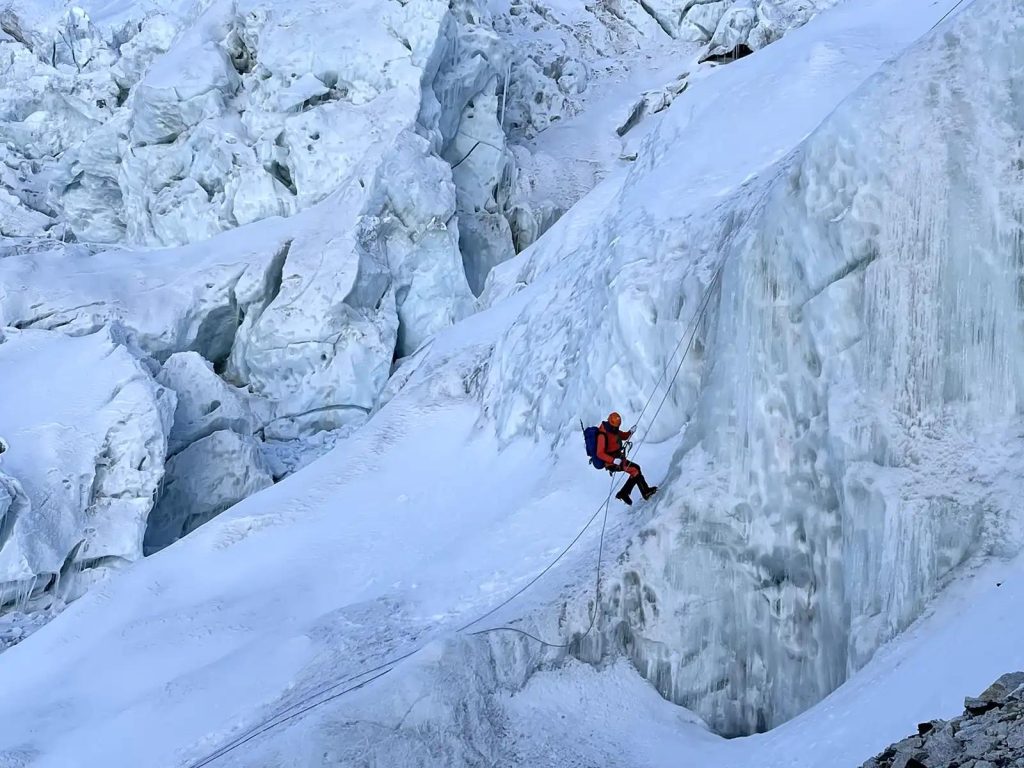
However, the route was deemed unsafe due to unstable ice conditions and the requirement of approximately 10 vertical ladders in highly exposed terrain. Additionally, recent weeks have seen frequent rockfall activity in warmer temperatures, further increasing the risk level.
After rejecting the vertical option, the team explored an alternative central passage through the section but found no viable safe route. Given the limited time before the climbing season and the hazardous conditions, the only feasible option was to establish a passage beneath the serac.
Extremely Hazardous Serac Section Identified
The serac in question measures approximately 55 meters in length, 28 meters in height, and 37 meters in breadth. It contains multiple visible cracks and remains highly unstable, with the potential to collapse at any time. SPCC has strongly emphasized that although the route has been opened, the rockfall point remains extremely dangerous and requires strict caution from all climbers and expedition teams.
Mandatory Safety Measures Issued
To minimize risk exposure, SPCC has issued strict safety protocols for all climbers and operators using the route beyond Section 4. These include:
- Climbers must pass through the section quickly to reduce exposure time
- High-altitude guides must carry minimal loads
- Only one climber is permitted on a ladder at a time
- Safety harnesses must be clipped on both sides of fixed ropes when crossing ladders
Currently, eight ladders have been installed across three sections of the route. SPCC has also indicated that additional ladders may be required as crevasses continue to expand in different areas during the season. Continuous monitoring will be maintained throughout the climbing period.

Ongoing Monitoring and Emergency Coordination
SPCC has reiterated that despite the route being open, the serac zone remains unsafe and climbers must exercise extreme caution. In case of any incident along the route, teams are instructed to immediately contact the SPCC emergency frequency 144.200.
The committee also extended gratitude to key contributors including Dawa Sherpa (speed), Pasang Kami Sherpa, Ngima Tashi Sherpa, Fur Tenjing Sherpa, and Dendu Sherpa for their crucial support during today’s operation.
Acknowledgment was also given to the drone team of Khumbu Pasang Lhamu Rural Municipality and the Snow Bar initiative, a collaboration between Airlift Technologies and SPCC, for assisting in transporting ladders and ropes required for the operation. With the route now opened under highly challenging conditions, SPCC has once again underscored that climbers must prioritize safety above all as the Everest season begins.