Nepal Rastra Bank (NRB), the central monetary authority of the country, has released the official foreign exchange rates for today. The published rates, which are applicable for transactions across the banking and financial system, provide a benchmark for buying and selling various foreign currencies. These rates may, however, differ slightly from those offered by commercial banks.
USD Exchange Rate Sees Minor Adjustment
According to the NRB’s latest figures, the buying rate for one US Dollar is fixed at NPR 137.43, while the selling rate is set at NPR 138.03. The US Dollar remains a crucial currency for trade, remittances, and reserves, and even small fluctuations can have notable effects on the national economy and individual businesses reliant on international transactions.
European Currencies Maintain Stability
The Euro, one of the most traded global currencies, is being bought at NPR 159.12 and sold at NPR 159.81. Meanwhile, the British Pound Sterling has seen slightly higher figures, with a buying rate of NPR 184.05 and a selling rate of NPR 184.86. These rates reflect a relatively stable trend in European currencies amid moderate global economic activity.

The Swiss Franc, another prominent European currency, is being exchanged at a buying rate of NPR 170.75 and a selling rate of NPR 171.50. These currencies are particularly important for businesses dealing with European markets and for travelers heading to Europe.
Oceania and North American Currencies
Among other key global currencies, the Australian Dollar is set at a buying rate of NPR 88.74 and a selling rate of NPR 89.13. Similarly, the Canadian Dollar is priced at NPR 99.81 for buying and NPR 100.24 for selling. The Singapore Dollar is also among the frequently used currencies in Nepal’s trade and tourism sectors, and its rate stands at NPR 106.79 (buying) and NPR 107.25 (selling). These currencies are frequently used by Nepali students, migrant workers, and tourists, and thus play a pivotal role in Nepal’s foreign currency earnings.
Asian Currencies Reflect Regional Market Dynamics
The Japanese Yen, which is often quoted in units of 10, is now available at a buying rate of NPR 9.24 and a selling rate of NPR 9.28. China’s Yuan Renminbi is priced at NPR 19.14 for buying and NPR 19.22 for selling. With China being Nepal’s significant trading partner, minor changes in Yuan exchange rates can impact import-export costs and trade balances.
For other regional currencies, the Saudi Arabian Riyal is being bought at NPR 36.64 and sold at NPR 36.80, while the Qatari Riyal stands at NPR 37.70 (buying) and NPR 37.87 (selling). These rates are particularly relevant for the large population of Nepali migrant workers employed in the Middle East.
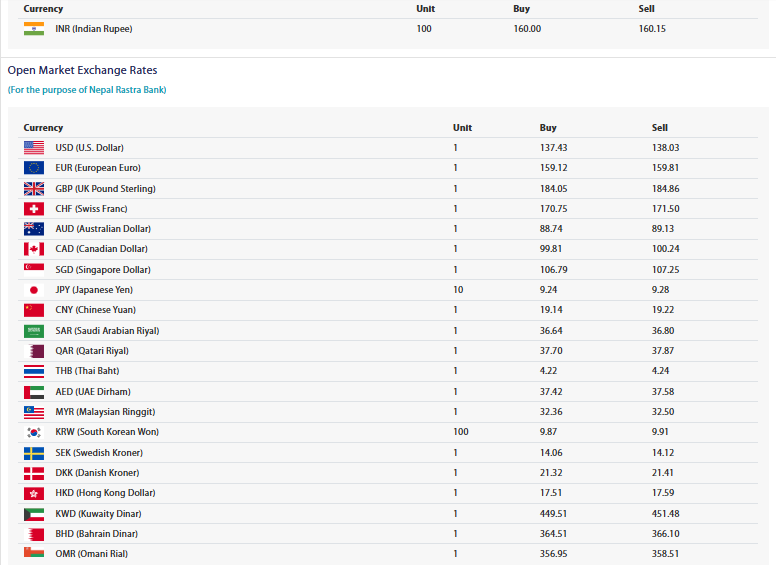
The Thai Baht is being traded at NPR 4.22 (buying) and NPR 4.24 (selling), while the United Arab Emirates Dirham is quoted at NPR 37.42 (buying) and NPR 37.58 (selling). Additionally, the Malaysian Ringgit is set at NPR 32.36 (buying) and NPR 32.50 (selling), and the South Korean Won (per 100 units) is trading at NPR 9.87 (buying) and NPR 9.91 (selling).
Scandinavian and Gulf Currencies Also Updated
Among Scandinavian currencies, the Swedish Krona has a buying rate of NPR 14.06 and a selling rate of NPR 14.12, while the Danish Krone is valued at NPR 21.32 (buying) and NPR 21.41 (selling).
In the Gulf region, where many Nepalis are employed, the exchange rates are particularly significant. The Kuwaiti Dinar, one of the highest-valued currencies globally, is quoted at NPR 449.51 for buying and NPR 451.48 for selling. The Bahraini Dinar has been fixed at NPR 364.51 (buying) and NPR 366.10 (selling), while the Omani Riyal is being exchanged at NPR 356.95 (buying) and NPR 358.51 (selling). The Hong Kong Dollar is also part of today’s list, set at NPR 17.51 for buying and NPR 17.59 for selling.

Indian Rupee – Key Bilateral Currency for Nepal
The Indian Rupee, which holds special importance for Nepal due to open-border trade and monetary ties, has been fixed at NPR 160.00 for buying and NPR 160.15 for selling per 100 Indian Rupees. Any fluctuation in this rate affects daily cross-border trade, consumer prices, and remittance values, especially in border towns and rural areas.
NRB Clarifies Scope for Revisions
Nepal Rastra Bank has clarified that these rates are subject to change as per the bank’s internal policies and market developments. The central bank reserves the right to revise the exchange rates at any time, depending on the prevailing economic situation or monetary policy requirements.
It has also been noted that the exchange rates provided by individual commercial banks may differ slightly from the NRB rates. The public and businesses are encouraged to consult with commercial banks directly or visit the NRB’s official website for the most accurate and updated exchange information before carrying out foreign currency transactions.
With global economies showing varied signs of recovery and geopolitical uncertainties affecting the forex markets, Nepal’s foreign exchange rates continue to be carefully monitored by the central bank. These daily updates serve not only as a tool for commercial and financial institutions but also as essential data for importers, exporters, migrant workers, students, and travelers alike.