On the second Monday of the auspicious Shrawan month, thousands of Bolbam pilgrims gathered at Sundarijal in the early hours of the morning to embark on their sacred journey to the revered Pashupatinath Temple. As the monsoon mist blanketed the Shivapuri hills, chants of “Bolbam! Har Har Mahadev!” echoed through the forests, streets, and riverbanks, marking the spiritual fervor that grips devotees during this holy time of the year.
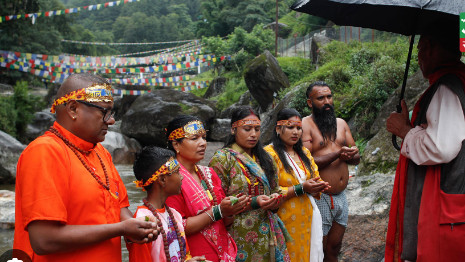
The Bolbam yatra, a deeply symbolic Hindu pilgrimage, sees devotees, often dressed in saffron and barefoot, carrying sacred water from the holy Bagmati River’s source in Sundarijal to offer at the Pashupatinath Temple. The ritual is especially significant during the month of Shrawan, considered holy for Lord Shiva. This Monday, the pilgrimage drew an overwhelming number of participants, reaffirming the cultural and spiritual importance of this annual tradition.
Organized Pilgrimage from Sundarijal to Pashupati
The Bolbam Kanwariya Association and the Sanatan Yuwa Manch jointly organized this year’s yatra, ensuring systematic coordination for the thousands of pilgrims making the approximately 20-kilometer trek from Sundarijal to the Pashupatinath Temple in Gaushala. Volunteers from both organizations were stationed along the route, providing water, medical aid, and directions to maintain the smooth flow of the procession.
The sacred journey typically takes several hours, with pilgrims walking barefoot or in minimal footwear, singing devotional songs, and often observing fasts. Many participants are young men and women, while entire families, senior citizens, and even children take part, united in their devotion to Lord Shiva.
Security and Crowd Management Measures in Place
With the expected turnout exceeding 10,000 devotees, security arrangements were significantly scaled up to ensure public safety and crowd control. According to the Nepal Police Range at Sundarijal, more than 200 police personnel have been deployed at key junctions along the pilgrimage route. Traffic management units have been assigned to coordinate road crossings and ensure minimal disruption to vehicular movement in areas such as Jorpati, Gokarna, and Chabahil.
Checkpoints were established to monitor safety, prevent overcrowding, and facilitate emergency medical response. A special team from the Metropolitan Police was also deployed at the Pashupati Temple premises to manage the influx of pilgrims entering the temple for darshan and water offering rituals.
Temple Opens Early to Welcome Devotees
To accommodate the massive number of Bolbam pilgrims, the Pashupatinath Temple opened all four of its gates as early as 3:00 am, allowing worshippers early access to the inner sanctum. According to Suvashchandra Joshi, Member Secretary of the Pashupati Area Development Trust (PADT), special arrangements were made for water offerings, cleanliness, and crowd regulation. “We have coordinated with Kathmandu Metropolitan City, security agencies, and volunteer organizations to ensure a smooth and sacred environment for all devotees,” Joshi stated.
Several temporary water collection points and handwashing facilities were installed across the Pashupati area. PADT has also taken steps to manage waste generated by the large crowd and set up mobile toilets in and around the temple complex to maintain hygiene standards during the pilgrimage.
Devotional Atmosphere and Cultural Significance
The Bolbam tradition, which originates from Vedic rituals dedicated to Lord Shiva, has been deeply rooted in Nepali Hindu culture for decades. In recent years, the number of participants has grown exponentially, reflecting the enduring spiritual pull of this sacred practice. Shrawan is especially auspicious for Lord Shiva’s devotees, and the Bolbam yatra represents their devotion, sacrifice, and the pursuit of spiritual cleansing.
Devotees carrying “kanwars” – decorated bamboo poles with water-filled pots tied on each end – are seen throughout Kathmandu today, walking in barefoot discipline, their chants intensifying as they near the holy temple. Many believers also wear blue or orange robes, symbolic of renunciation and divine connection.
“It’s not just about walking to Pashupati,” said 28-year-old Anuj Thapa, a repeat participant in the Bolbam yatra. “It’s about spiritual reflection, cleansing our minds, and offering ourselves in complete surrender to Lord Shiva.”
Road Closures and Public Transportation Support
To facilitate the pilgrimage, certain roads were either partially or fully closed to private vehicles for a few hours in the morning. Public transportation was rerouted in several parts of the city, particularly near Chabahil, Gaushala, and Guheshwori, to ensure the uninterrupted movement of pilgrims. Local residents were informed in advance, and traffic police were actively directing both pilgrims and vehicles to minimize disruption.
The Kathmandu Metropolitan City office also provided drinking water stations and mobile health units along the route. Emergency ambulances and Red Cross volunteers remained on standby in case of heat exhaustion, dehydration, or minor injuries.
Faith Marches On
As the sun rose higher, the energy among the devotees only intensified. With each step towards Pashupatinath, chants grew louder, and faith shone brighter. Despite the physical exhaustion, the mood remained one of devotion, joy, and shared spirituality.
The second Monday of Shrawan marked yet another powerful reminder of Nepal’s enduring cultural heritage and the spiritual unity it fosters. The Bolbam yatra, far from being just a religious event, is a vibrant testament to collective belief, cultural identity, and the unwavering devotion of thousands of pilgrims walking together in reverence of the divine.