Nepal Rastra Bank (NRB), the central bank of the country, has published the official foreign currency exchange rates for today, providing an important benchmark for commercial banks, importers, exporters, travelers, and financial institutions engaged in foreign transactions. These rates are updated daily based on global currency trends, trading volumes, and Nepal’s own economic parameters.
According to NRB, the exchange rate for one U.S. dollar has been set at NPR 138.13 for buying and NPR 138.73 for selling, reflecting a stable dollar trend amid global market volatility. This rate continues to play a significant role in determining the cost of imported goods and remittance values, both of which are critical to Nepal’s economy.
Euro, Pound Sterling, and Swiss Franc Rates
The European Euro is trading at a buying rate of NPR 162.19 and a selling rate of NPR 162.90, indicating slight variations due to Eurozone economic movements. Similarly, the UK Pound Sterling, one of the strongest global currencies, has a buying rate of NPR 185.63 and a selling rate of NPR 186.43, continuing to maintain its strong value in the Nepali market. The Swiss Franc, known for its financial stability and use in international reserves, has been fixed at a buying rate of NPR 173.78 and a selling rate of NPR 174.54.
Exchange Rates for Other Major Currencies
Among other widely traded currencies, the Australian Dollar stands at NPR 90.70 (buying) and NPR 91.10 (selling), while the Canadian Dollar has been priced at NPR 100.81 for buying and NPR 101.25 for selling. The Singapore Dollar, frequently used for trade in Southeast Asia, is being exchanged at NPR 107.80 (buying) and NPR 108.27 (selling).
From Asia’s two economic giants, the Japanese Yen (per 10 units) is trading at NPR 9.35 for buying and NPR 9.39 for selling, whereas the Chinese Yuan has been fixed at NPR 19.27 (buying) and NPR 19.35 (selling). These rates hold significance given Nepal’s extensive trade relations and border connectivity with China and Japan.
Exchange Rates for Middle Eastern Currencies
The remittance-dependent Nepali economy heavily relies on the Gulf nations, making Middle Eastern currencies highly relevant. The Saudi Arabian Riyal has been priced at NPR 36.82 for buying and NPR 36.98 for selling. The Qatari Riyal is trading at NPR 37.79 (buying) and NPR 37.96 (selling). Likewise, the UAE Dirham, one of the most frequently exchanged currencies in Nepal, is fixed at NPR 37.61 (buying) and NPR 37.77 (selling).
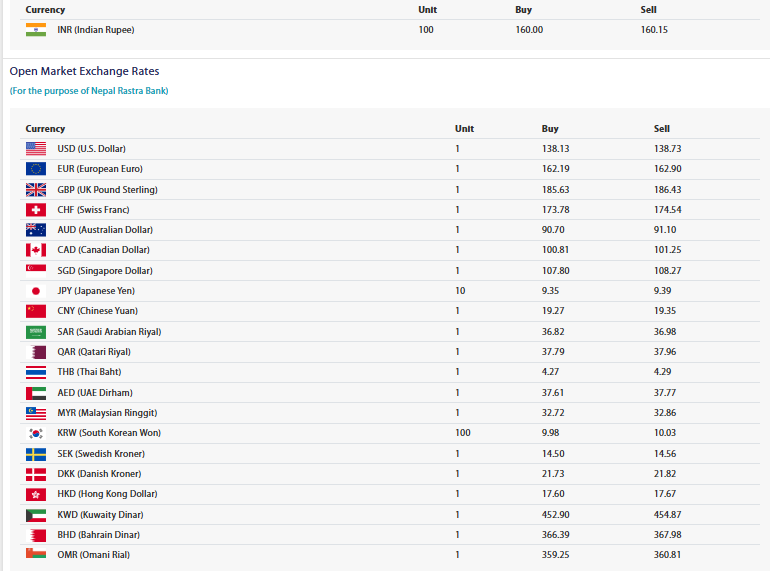
For other Gulf currencies, the Kuwaiti Dinar, which holds one of the highest exchange values globally, is set at a buying rate of NPR 452.90 and selling rate of NPR 454.87. The Bahraini Dinar follows closely at NPR 366.39 (buying) and NPR 367.98 (selling). The Omani Riyal, another key currency from the Gulf region, is set at NPR 359.25 for buying and NPR 360.61 for selling.
Exchange Rates for Regional and Asian Currencies
Among Asian currencies, the Thai Baht is exchanging at NPR 4.27 (buying) and NPR 4.29 (selling), while the Malaysian Ringgit is priced at NPR 32.72 (buying) and NPR 32.86 (selling). The South Korean Won (per 100 units) is being traded at NPR 9.98 for buying and NPR 10.03 for selling, reflecting the importance of Korean remittance and bilateral cooperation.
Scandinavian and Hong Kong Currency Rates
The Swedish Krona has been set at NPR 14.50 for buying and NPR 14.56 for selling, while the Danish Kroner is being traded at NPR 21.73 (buying) and NPR 21.22 (selling). The Hong Kong Dollar, used widely for business and travel, stands at NPR 17.60 for buying and NPR 17.67 for selling.
Exchange Rate for Indian Rupee
The Indian Rupee, with which Nepal maintains a fixed peg, remains steady at NPR 160.00 for buying and NPR 160.15 for selling per 100 Indian Rupees. This controlled rate is important for day-to-day trade and travel across the open Nepal-India border.
Rates Subject to Change and Clarifications
Nepal Rastra Bank has clearly stated that these exchange rates are subject to change as per market conditions, currency supply-demand dynamics, and international economic developments. The bank reserves the right to amend the rates at any time as needed. It also notes that the rates published by commercial banks may differ slightly, depending on their internal policies and transaction costs.
For the most accurate and updated information, NRB encourages the public and stakeholders to refer to its official website, where real-time rates are regularly updated. These foreign exchange rates serve as a critical economic indicator and assist not only in daily transactions but also influence Nepal’s import-export pricing, foreign debt management, and overall macroeconomic planning.