The Nepal Rastra Bank (NRB), the country’s central bank, has released the official foreign currency exchange rates for Sunday, providing the buying and selling values for major global currencies against the Nepalese Rupee. The new rates, which serve as the benchmark for commercial banks, are subject to change depending on market conditions and central bank directives.
U.S. Dollar and Major Western Currencies
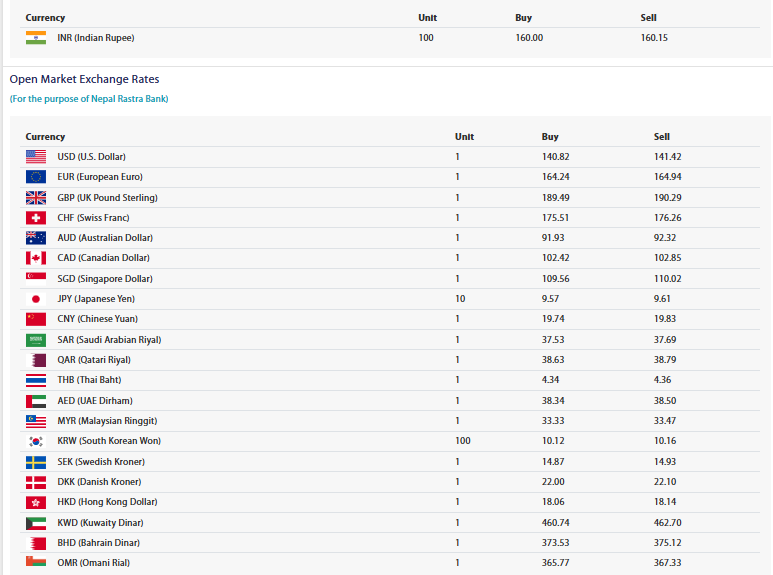
According to NRB’s daily bulletin, the buying rate for one U.S. Dollar has been set at Rs. 140.82, while the selling rate stands at Rs. 141.42. This slight fluctuation from the previous day reflects ongoing adjustments based on international market movements.
For the European Euro, the buying rate is Rs. 164.24, and the selling rate is Rs. 164.94. Meanwhile, the British Pound Sterling continues to hold its high value, with the buying rate fixed at Rs. 189.49 and the selling rate at Rs. 190.29. The Swiss Franc also remains strong, trading at Rs. 175.51 for buying and Rs. 176.26 for selling.
Oceania and North American Currencies
In the Oceania region, the Australian Dollar has been set at Rs. 91.93 for buying and Rs. 92.32 for selling. The Canadian Dollar, another major trading currency, has a buying rate of Rs. 102.42 and a selling rate of Rs. 102.85. Singapore’s Dollar is priced at Rs. 109.56 for buying and Rs. 110.02 for selling, reflecting the strong trade and investment ties between Nepal and the Southeast Asian financial hub.
Asian Currencies: Yen, Yuan, and Gulf Currencies
Among Asian currencies, the Japanese Yen is traded in multiples of 10 units. The buying rate for 10 Yen is Rs. 9.57, and the selling rate is Rs. 9.61. The Chinese Yuan, a significant currency for Nepal’s trade with its northern neighbor, is set at Rs. 19.74 for buying and Rs. 19.83 for selling.
In the Gulf region, the Saudi Arabian Riyal stands at Rs. 37.53 for buying and Rs. 37.69 for selling, while the Qatari Riyal is fixed at Rs. 38.63 for buying and Rs. 38.79 for selling. These rates are particularly relevant for Nepal’s large migrant workforce in the Middle East, whose remittances form a substantial part of the country’s economy.
Other Asian and Middle Eastern Currencies
The Thai Baht is set at Rs. 4.34 for buying and Rs. 4.36 for selling. The United Arab Emirates Dirham is valued at Rs. 38.34 for buying and Rs. 38.50 for selling. The Malaysian Ringgit has been set at Rs. 33.33 for buying and Rs. 33.47 for selling. Meanwhile, the South Korean Won is quoted per 100 units, with a buying rate of Rs. 10.12 and a selling rate of Rs. 10.16. For Scandinavian currencies, the Swedish Kroner is fixed at Rs. 14.87 for buying and Rs. 14.93 for selling, while the Danish Kroner stands at Rs. 22.00 for buying and Rs. 22.10 for selling.
Hong Kong Dollar and High-Value Middle Eastern Currencies
The Hong Kong Dollar is priced at Rs. 18.06 for buying and Rs. 18.14 for selling. Among the highest-value currencies listed by NRB, the Kuwaiti Dinar tops the chart with a buying rate of Rs. 460.74 and a selling rate of Rs. 462.70. The Bahraini Dinar follows at Rs. 373.53 for buying and Rs. 375.12 for selling, while the Omani Riyal is set at Rs. 365.77 for buying and Rs. 367.33 for selling.
Indian Rupee Rate
Given Nepal’s open border and close economic ties with India, the exchange rate for the Indian Rupee is of particular significance. The NRB has fixed the rate at Rs. 160.00 for buying and Rs. 160.15 for selling per 100 Indian Rupees. This rate remains pegged within a narrow range due to the longstanding fixed exchange rate system between the Nepalese and Indian currencies.
Central Bank’s Advisory and Market Adjustments
The NRB has stated that the published rates may be revised at any time depending on the movement of foreign exchange markets. Commercial banks in Nepal are allowed to set their own rates for currency exchange transactions, which may differ slightly from the NRB’s reference rates.
The central bank also emphasized that the most accurate and updated rates are available on its official website, encouraging the public and financial institutions to check online for the latest information before conducting large transactions.
Economic Implications of the Rates
Foreign exchange rates have a direct impact on Nepal’s trade, remittances, and tourism sectors. A stronger U.S. Dollar, for example, benefits remittance receivers but increases the cost of imports, while fluctuations in regional currencies such as the Indian Rupee and Chinese Yuan affect cross-border trade volumes.
Similarly, the valuation of Gulf currencies such as the Saudi Riyal, Qatari Riyal, and UAE Dirham has significant implications for migrant workers’ earnings when converted to Nepali Rupees. High-value currencies like the Kuwaiti Dinar and Bahraini Dinar provide substantial returns to families receiving remittances from these countries.
With Nepal’s economy heavily reliant on imports, foreign investment, and remittances, even small shifts in exchange rates can influence inflation, cost of living, and overall economic stability.