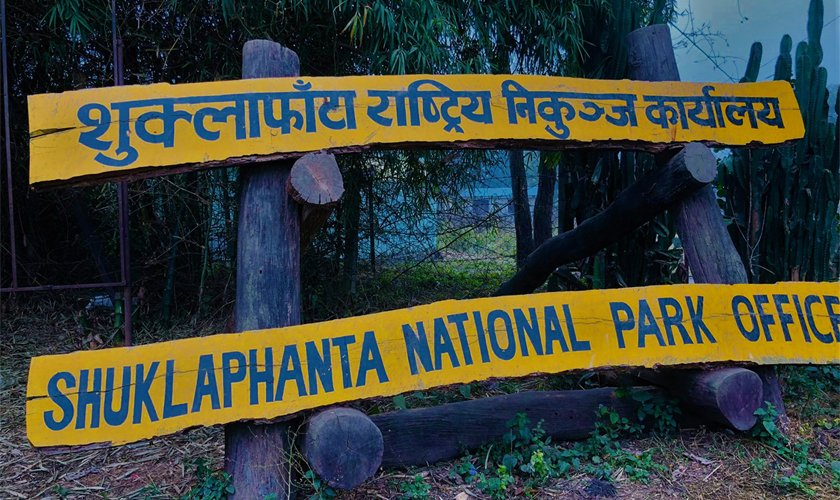
Shuklaphanta National Park, renowned for its rare wildlife and plant species, has been struggling to attract significant tourist numbers in recent years, with post-pandemic recovery still far from complete.
Visitor Decline Since COVID-19 Pandemic
According to park records, the number of visitors has not rebounded to pre-pandemic levels. In fiscal year 2075/76 (2018/19), the park welcomed 12,138 visitors, including 308 foreign tourists, 350 from SAARC nations, and 11,480 domestic visitors. However, after the outbreak of COVID-19, tourism in the park sharply declined and has yet to recover fully.
Park Information Officer Purushottam Wagle stated that both domestic and international tourist arrivals have been significantly lower since the pandemic. “Before COVID-19, we had a steady flow of both foreign and domestic visitors. But after the pandemic, foreign tourists almost vanished, and domestic numbers also dropped noticeably,” Wagle said.
Year-by-Year Tourist Statistics
In fiscal year 2076/77 (2019/20), only 1,603 tourists visited Shuklaphanta. The following years saw slight increases: 2,927 in 2077/78 (2020/21) and 2,579 in 2078/79 (2021/22), including 45 visitors from SAARC nations and 105 foreigners.
By 2079/80 (2022/23), the number rose to 3,278 visitors, with 158 foreigners and 121 SAARC tourists. Fiscal year 2080/81 (2023/24) recorded 3,762 visitors, including 132 foreigners and 112 SAARC nationals. In the current fiscal year 2081/82 (2024/25), so far, 3,371 tourists have visited, including 199 foreigners and 152 from SAARC countries. Despite these gradual improvements, numbers remain far below pre-pandemic levels.
Revenue Collection Also Impacted
With fewer visitors, the park’s revenue from entry fees and vehicle permits has been limited. Last fiscal year, the park collected only NPR 2 million in revenue. Wagle explained that the park’s rich biodiversity alone is not enough to draw significant tourist traffic without proper infrastructure and promotion.
Challenges in Attracting Tourists
Wagle noted several reasons for the low tourist turnout: inadequate tourism infrastructure, difficulties for visitors at the Nepal–India border, and a lack of effective promotion. “Apart from jungle safaris, there are limited activities for tourists here. The absence of private sector investment has also slowed growth,” he added.
Tourism entrepreneur Parmanand Bhandari echoed similar sentiments, saying Shuklaphanta has great potential but is not a government priority. “With the right infrastructure and promotional campaigns, Shuklaphanta could become a top destination,” he said. The park’s serene environment, vast grasslands, and concentration of rare wildlife make it an attractive location, yet the lack of facilities discourages longer stays.
Lack of Infrastructure and Skilled Workforce
Former President of the Hotel Entrepreneurs Association of Kanchanpur, Jagdish Bhatta, pointed out that access issues at major entry points for foreign tourists remain a problem. “We lack skilled human resources for tourism services, and there has been minimal government investment in infrastructure,” he said. “If the state prioritizes tourism here, the industry can flourish. But without promotion of our biodiversity and attractions, the park will remain underutilized.”
Biodiversity Treasure Trove
Shuklaphanta National Park is home to a diverse range of wildlife and plants. It hosts 56 species of reptiles, 15 amphibians, 88 fish, 111 butterflies, 461 bird species, and 56 mammal species. Rare animals such as the Bengal florican, swamp francolin, sarus crane, lesser adjutant stork, and hispid hare can be found here.
The park is also home to iconic species like the Bengal tiger, one-horned rhinoceros, elephants, barasingha (swamp deer), blackbuck, pangolin, nilgai, leopards, spotted deer, hog deer, wild boar, and many others. Covering an area of 305 square kilometers, Shuklaphanta is particularly famous for its population of swamp deer, numbering over 2,323.
Unique Attractions Yet Untapped Potential
The park’s lakes, rivers, and wetlands attract numerous migratory birds, making it a paradise for birdwatchers. Its relatively small area allows visitors to see a high concentration of rare wildlife in a short period, something few other parks in the region can offer.
Despite these advantages, tourism potential remains untapped due to poor marketing, limited accommodation options, and lack of entertainment or cultural activities for tourists. Local tourism entrepreneurs say that improving roads, building quality lodges, and organizing annual wildlife festivals could help boost visitor numbers.
Need for Strategic Promotion and Partnerships
Experts and stakeholders agree that a coordinated approach between the government, private sector, and local communities is essential to revive tourism in Shuklaphanta. Investment in eco-tourism, cross-border tourism packages with India, and targeted campaigns to attract birdwatchers and wildlife enthusiasts could prove highly effective.
If proper facilities, trained guides, and well-maintained safari vehicles are made available, and if the park’s unique biodiversity is showcased to international markets, Shuklaphanta could become one of Nepal’s leading wildlife tourism destinations.