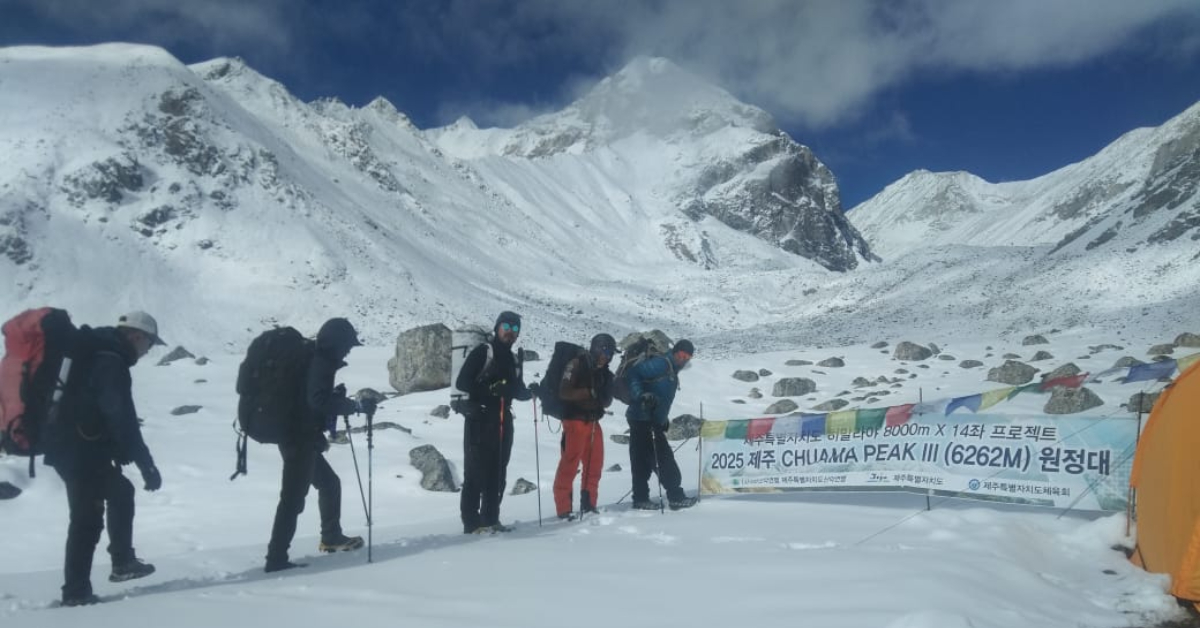
A mountaineering expedition team has successfully achieved the first-ever ascent of Chhuama Himal (6,213 meters), located in the remote Upper Mustang region of Nepal. According to the Annapurna Conservation Area Project (ACAP) Office in Lo Manthang, the climb was completed on November 2, marking a major milestone for mountaineering and tourism development in one of Nepal’s most secluded Himalayan regions.
The successful ascent was carried out by a group of eight climbers, including three South Korean mountaineers and five Nepali climbing guides. The South Korean climbers have been identified as Dongjin, Namyong, and Hinchul, who scaled the peak together with their Nepali counterparts after a challenging and technically demanding climb that took nearly ten hours from base camp to the summit.

Route and Ascent Details
Chhuama Himal lies within Lo Manthang Rural Municipality–4, a high-altitude settlement of Namdo village in Upper Mustang. The ascent route begins from Namdo village and continues up to the Chhuama Base Camp at approximately 5,480 meters, before ascending toward the main peak.
According to Umesh Paudel, Chief of the ACAP Lo Manthang Office, the expedition began its final summit push at 2:00 a.m. on November 2 and reached the summit around noon, after a strenuous ten-hour climb under freezing and windy conditions.
“The South Korean team, supported by five experienced Nepali mountain guides, successfully reached the top of Chhuama Himal for the first time in recorded history,” said Paudel. “This is not only a moment of pride for Nepal’s climbing community but also a historic step toward introducing new Himalayan destinations in the Upper Mustang area.”
Third Peak of the Chhuama Range Conquered
Chhuama Himal consists of three distinct summits within the same massif, and this expedition marked the first successful ascent of the third peak, which stands at an elevation of 6,213 meters. The climbers safely descended back to Lo Manthang following their successful summit.
“This marks the first-ever ascent by foreign climbers in the Upper Mustang region, opening a new chapter for Himalayan exploration in an area previously less explored by mountaineers,” Paudel added.
Before this historic climb, a reconnaissance visit had been conducted by a Trekking Camp Nepal team on October 18, to assess the route’s feasibility and safety conditions for mountaineering. That groundwork helped pave the way for the South Korean expedition’s success.
Recognition and Celebration of the Historic Achievement
Upon the team’s return to Lo Manthang, the ACAP Lo Manthang Office organized a felicitation ceremony to honor the climbers. The team members were welcomed with traditional khadas (ceremonial scarves) and received certificates recognizing their pioneering achievement. ACAP officials, local representatives, and tourism entrepreneurs attended the ceremony, expressing their pride and optimism that the ascent would promote adventure tourism and local economic growth in Upper Mustang.
“This first ascent of Chhuama Himal will play a crucial role in promoting Himalayan tourism in Upper Mustang,” said Paudel. “It demonstrates that this region has immense potential for sustainable adventure tourism beyond its cultural and spiritual significance.”
Tourism and Mountaineering Potential in Upper Mustang
The Upper Mustang region, once a restricted area due to its sensitive border proximity and unique cultural heritage, has only recently opened up for limited trekking and exploration. Known for its ancient monasteries, barren trans-Himalayan landscapes, and Tibetan-influenced culture, the area has long drawn trekkers and researchers, but mountaineering expeditions have remained rare.
The successful ascent of Chhuama Himal now signals a new phase of mountaineering development in Mustang. Tourism officials believe that with proper management and conservation, the region could emerge as a world-class destination for high-altitude climbing, complementing its existing trekking routes such as the Upper Mustang Trail and Damodar Kunda Trek.
Paudel emphasized that the ACAP is committed to ensuring that future expeditions adhere to environmental and safety standards, protecting the fragile Himalayan ecosystem. “We will continue to collaborate with local communities, trekking companies, and climbers to promote responsible and eco-friendly tourism,” he stated.
A Symbol of International Friendship and Cooperation
The collaboration between South Korean climbers and Nepali guides also underscored the spirit of international friendship and mountaineering cooperation that defines Nepal’s Himalayan expeditions. Officials from the ACAP noted that the South Korean team expressed deep appreciation for the guidance, hospitality, and expertise provided by the Nepali climbers throughout the expedition.

The success has also inspired local youths and guides in Upper Mustang to explore careers in adventure tourism and mountain guiding. “This achievement will inspire local climbers to take up new challenges and participate in future expeditions,” said a local guide from Lo Manthang who assisted the team.
Looking Ahead
Following the expedition’s success, the ACAP Lo Manthang Office is now considering opening new peaks in the Chhuama range for mountaineering under regulated conditions. The office is also working to improve rescue preparedness, trekking infrastructure, and communication facilities in the region to ensure climber safety. Local stakeholders are optimistic that the first ascent of Chhuama Himal will not only boost adventure tourism but also generate socioeconomic benefits for the remote Mustang communities, creating new opportunities for employment, homestays, and cultural tourism.