Nepal’s mountain guides have called on the government to prioritize investment in skilled human resources to strengthen the country’s mountaineering tourism sector, citing rising international demand for professionally trained Nepali guides and a growing shortage of qualified manpower.
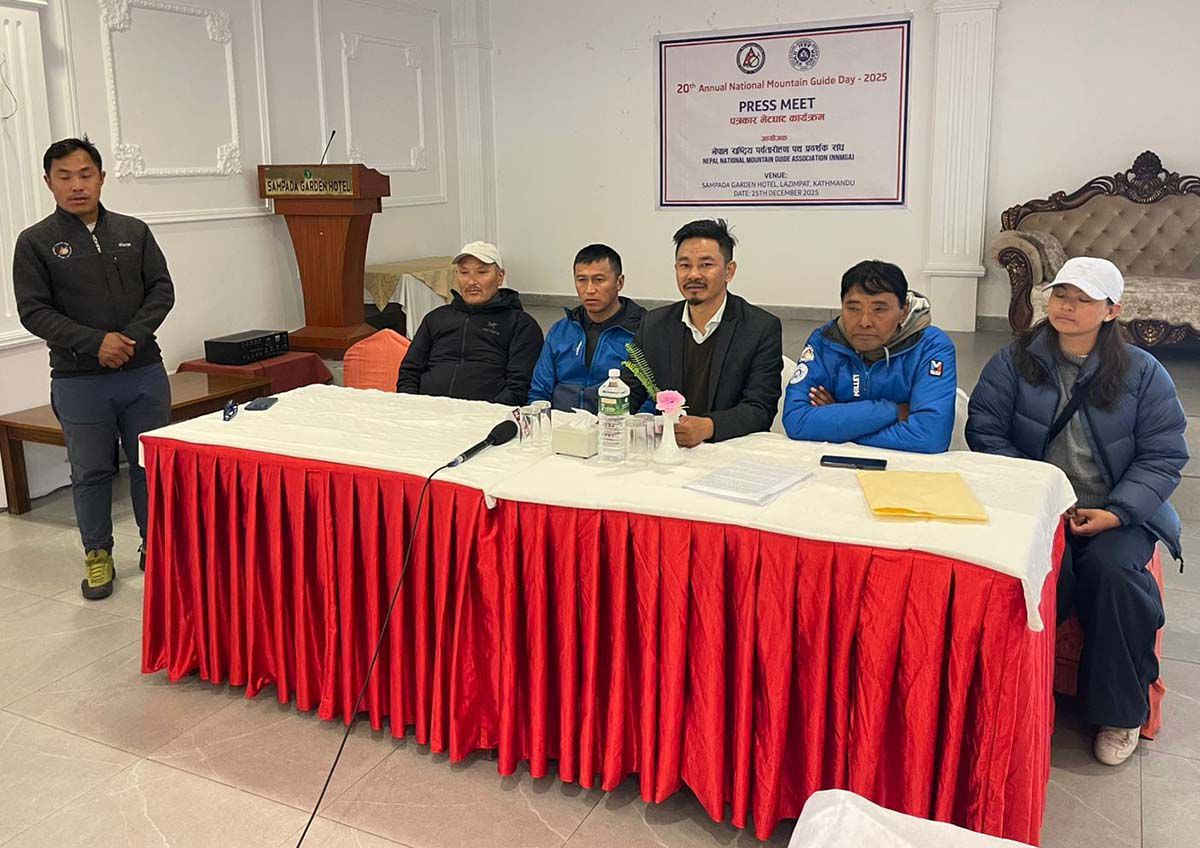
Speaking at a press conference organised in Kathmandu on the eve of National Mountain Guide Day, the Nepal National Mountain Guide Association (NNMGA) stressed that sustained state support is critical to producing competent guides with strong technical skills, safety knowledge and international credibility. The association warned that without immediate policy focus and financial backing, Nepal risks losing valuable opportunities in one of its most important tourism segments.

International Demand Outpaces Supply
NNMGA stated that the number of mountaineers visiting Nepal continues to increase every year, driving high demand for reliable and certified guides. However, limited training opportunities and the high cost of professional qualification have prevented the country from producing enough skilled guides to meet this demand.
NNMGA President Tul Singh Gurung said that mountaineering tourism is among Nepal’s major income-generating tourism sectors, yet its full potential remains underutilized due to manpower constraints.
“There is strong international demand for Nepali guides, not only within Nepal but also across Europe and North America. Unfortunately, we do not have enough qualified manpower to fulfil this growing demand,” Gurung said.
According to the association, Nepali guides work seasonally in several European, North American and Scandinavian countries, with around 15 guides traveling to Norway alone each year. During the 2025 Everest climbing season, many expedition companies sought IFMGA-certified Nepali guides but were unable to secure them due to limited availability.
Long Training Period and High Cost
Established in 2004, NNMGA received official recognition from the International Federation of Mountain Guides Associations (IFMGA) in 2012, becoming Nepal’s national representative body. Since then, the association has produced more than 100 internationally certified guides, the highest professional qualification in mountaineering.
An IFMGA licence allows guides to lead, train and teach rock climbing, ice climbing and alpine mountaineering in member countries worldwide. However, becoming an internationally certified guide is a lengthy and costly process.
According to NNMGA, it takes nearly seven years to complete the required training, with total expenses amounting to approximately Rs 1.7 million per candidate. The association said this has discouraged many young people from entering the profession, especially in the absence of government subsidies. NNMGA General Secretary Pemba Tenzing Lama emphasized the need for youth-targeted support programs to attract new entrants and ensure continuity in the sector.
Topo Map Construction Launched
On the occasion of its 20th anniversary, NNMGA also announced the launch of Nepal’s first-ever topo map construction for rock climbing sites. The initiative aims to improve climber safety, enhance route accessibility and support better pre-climb planning.
National Mountain Guide Day is observed on Poush 10 (December 25), marking the official recognition of mountain guiding in Nepal in 2004. During the press meet, NNMGA announced that topo mapping has begun at the Hattiban rock climbing site and will gradually be expanded to major climbing destinations across the country.
The topo maps will provide climbers with detailed information on climbing routes, difficulty grades, safety requirements and access points. President of the Nepal Mountaineering Instructors Association (NMIA), Tshering Pandey Bhote, said rock climbing forms the foundation of mountaineering training, and the expansion of topo mapping will help raise training standards while encouraging more climbers to explore Nepal’s climbing destinations.

Over 100 Certified Guides Represent Nepal Globally
NNMGA reported that Nepal currently has 107 internationally certified mountain guides. Although new guides are not produced every year due to the demanding nature of training, interest in the profession is steadily increasing.
These internationally certified Nepali guides are currently working in 26 mountainous countries and also serving as instructors in neighbouring countries such as India and China. As a not-for-profit professional body, NNMGA continues to promote professional guiding standards and advocate for the development of Nepal’s mountaineering tourism at both national and international levels, reinforcing Nepal’s reputation as a global hub for high-altitude adventure tourism.