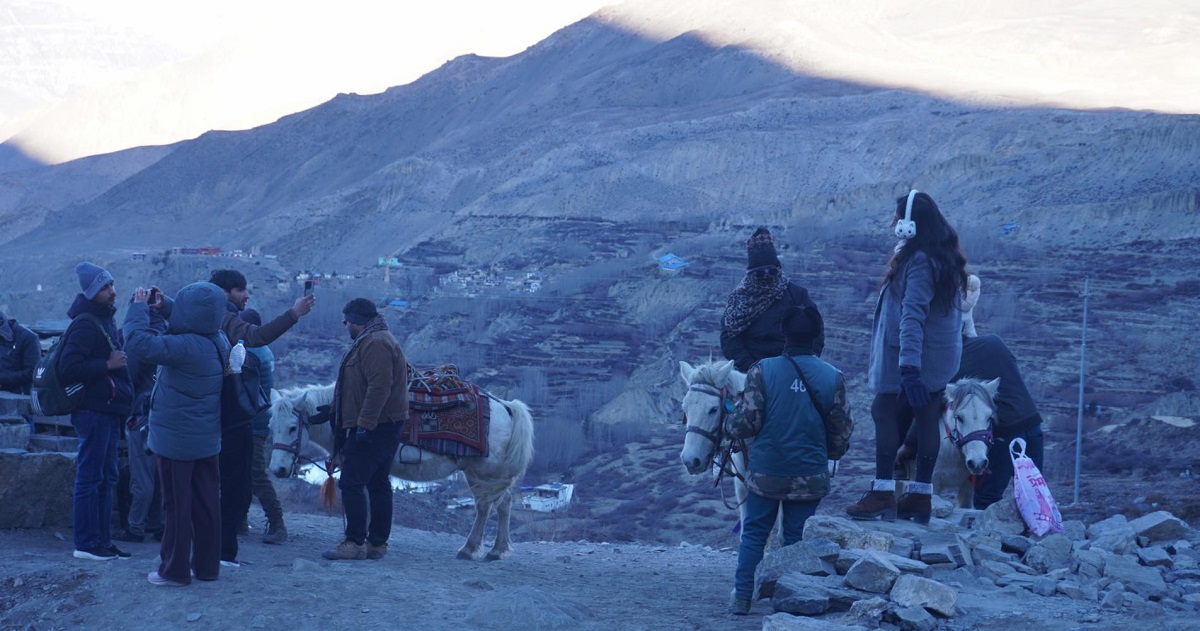
Mustang, one of Nepal’s most iconic Himalayan destinations, welcomed 325,558 tourists during the first seven months of the current fiscal year, reflecting its continued appeal as a centre for pilgrimage, adventure, and cultural tourism. According to data released by the District Police Office, the arrivals include 69,814 foreign tourists and 252,664 domestic visitors entering the trans-Himalayan district between Shrawan and Magh. Although the figure demonstrates sustained travel interest, it represents a slight decline compared to the same period last fiscal year, when 340,729 tourists visited the region.
Monthly Arrival Trends Show Seasonal Peaks
Tourist inflow varied significantly across the months, with the autumn season recording the highest movement. Statistics show that 19,781 visitors entered Mustang in Shrawan, followed by 23,205 in Bhadra. The numbers rose sharply in Ashwin to 75,599 and further increased to 83,766 in Kartik, marking the peak travel window aligned with favourable weather and major festivals.

The arrival trend gradually tapered off in the winter months, with 49,050 visitors recorded in Mangsir, 39,153 in Poush, and 32,004 in Magh. Despite colder temperatures, the district continued to attract pilgrims and domestic travellers seeking spiritual and scenic experiences.
Slight Decline Compared to the Previous Year
Authorities reported that tourist arrivals decreased by 18,171 visitors (5.33 percent) compared to the same seven-month period last year. Officials attribute this modest drop to weather-related travel disruptions and changing travel patterns, although the overall flow remains strong.
According to Police Inspector Nawaraj Neupane, visitor records are maintained at multiple entry points to ensure accurate data collection and tourist monitoring.
Multiple Entry Routes Contribute to Visitor Movement
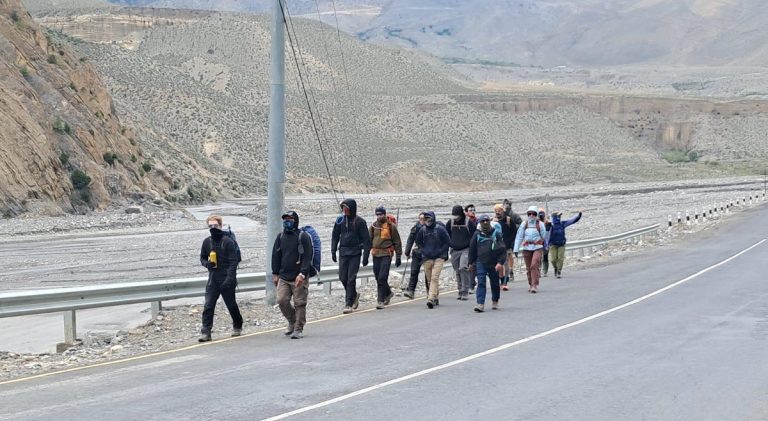
Most tourists enter Mustang via the National Pride Beni–Jomsom–Korala Road, a strategic roadway that has significantly improved accessibility to the once-remote region. The police post at Ghassa serves as a primary checkpoint where both domestic and foreign visitor records are compiled.
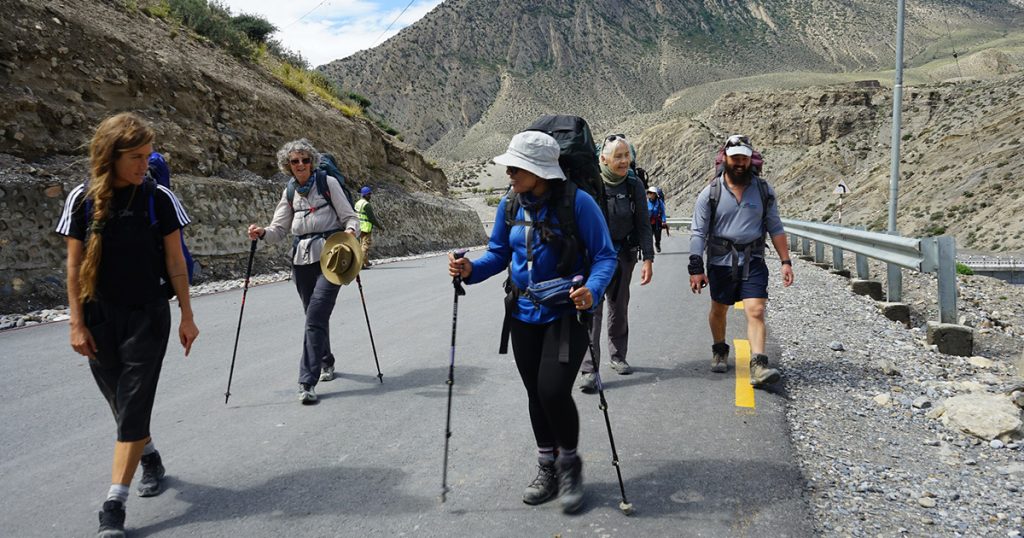
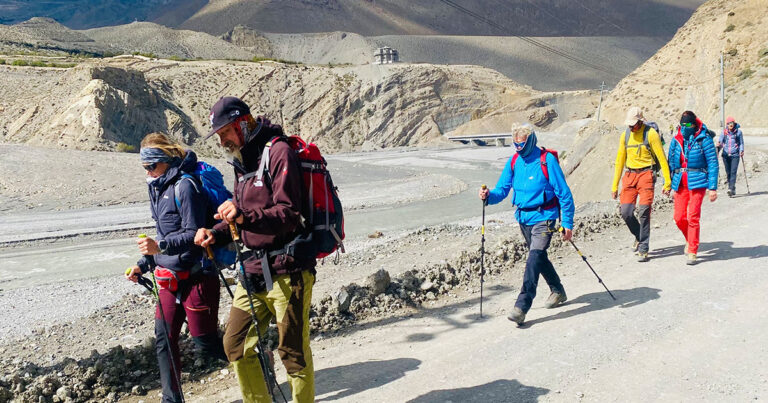
In addition to the road network, travellers also arrive by air through flights from Pokhara to Jomsom, while a considerable number of trekkers enter Mustang after crossing Thorong La via Manang as part of the Annapurna Circuit.
Long-Term Growth Driven by Infrastructure Development
Tourism statistics over recent fiscal years illustrate Mustang’s rapid emergence as a major destination. The district recorded 454,326 visitors in fiscal year 2080/81, and the number surged to 705,779 in 2081/82, highlighting a strong upward trajectory fueled largely by road expansion and improved travel facilities.
The gradual upgrading of the Beni–Jomsom–Korala corridor has reduced travel time and made year-round access more feasible, encouraging not only international trekkers but also domestic tourists travelling by jeep, motorcycle, and private vehicles.
Pilgrimage Tourism Remains a Major Draw
Religious tourism continues to play a central role in Mustang’s visitor economy. A large proportion of SAARC-country travellers, particularly Indian pilgrims, visit the sacred Muktinath Temple, one of the most revered shrines for both Hindus and Buddhists.
Similarly, Nepali visitors increasingly travel to Kagbeni to perform ancestral rituals and shraddha ceremonies believed to bring spiritual merit and liberation for departed souls. This blend of faith-based travel and scenic exploration has helped Mustang maintain year-round relevance.
Upper Mustang and Korala See Gradual Rise in Exploration
While the majority of travellers visit Lower Mustang, about three percent of foreign tourists continue onward to Upper Mustang, drawn by its unique Tibetan-influenced culture, desert landscapes, and restricted-area mystique.
Improved road conditions toward the northern frontier have also enabled a growing number of domestic travellers to reach the Korala Border, once an arduous journey, now increasingly accessible to adventure seekers.

Mustang Strengthens Its Position as a Himalayan Hub
Tourism stakeholders believe Mustang’s combination of spirituality, dramatic landscapes, and improving infrastructure will sustain long-term growth despite short-term fluctuations. With enhanced connectivity, diversified travel routes, and rising domestic mobility, the district is steadily transforming from a remote trekking destination into a multi-dimensional tourism hub.
As Nepal continues investing in strategic road networks and destination management, Mustang is expected to remain at the forefront, offering pilgrims, trekkers, and cultural travellers an experience that is both ancient in heritage and evolving in accessibility.