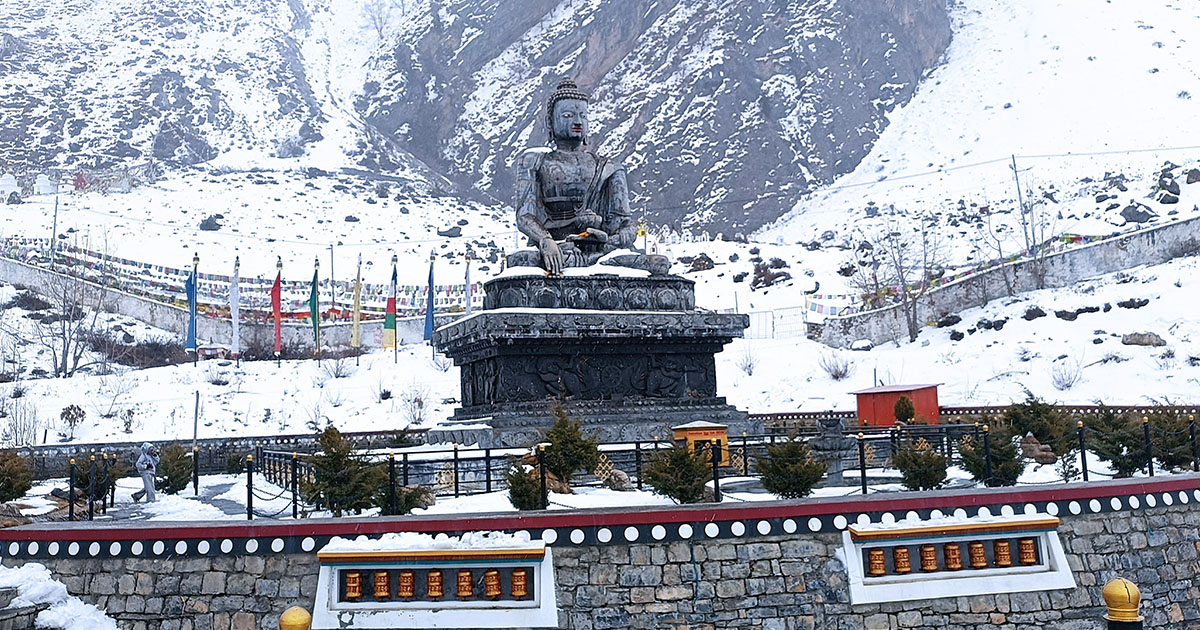
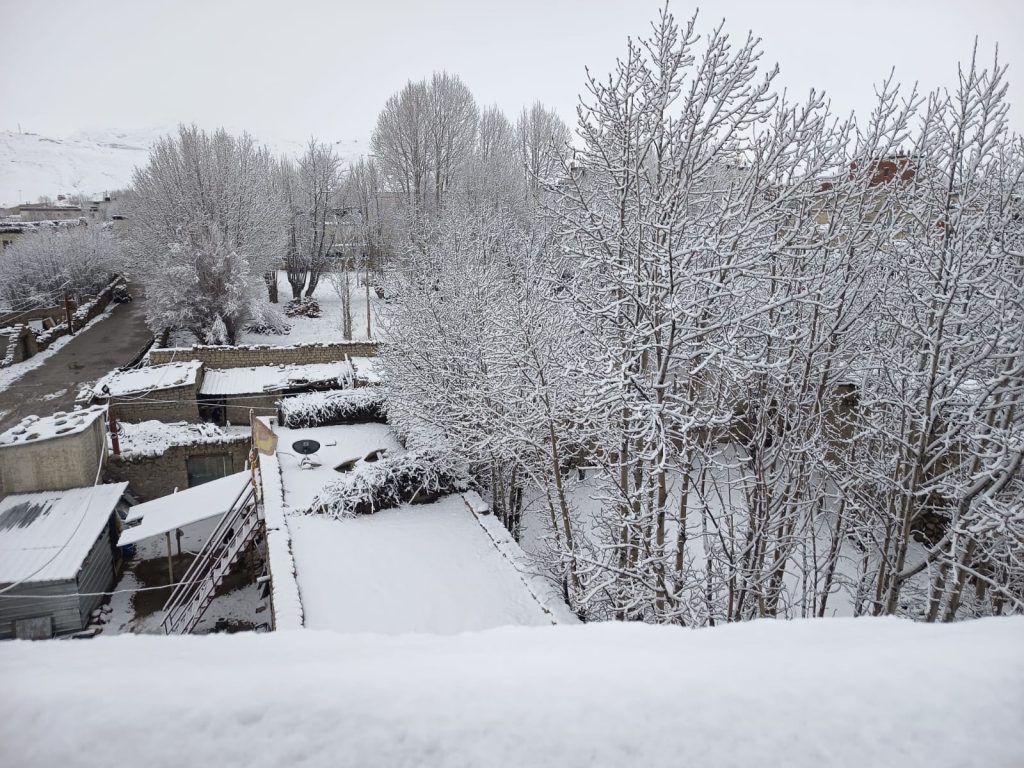
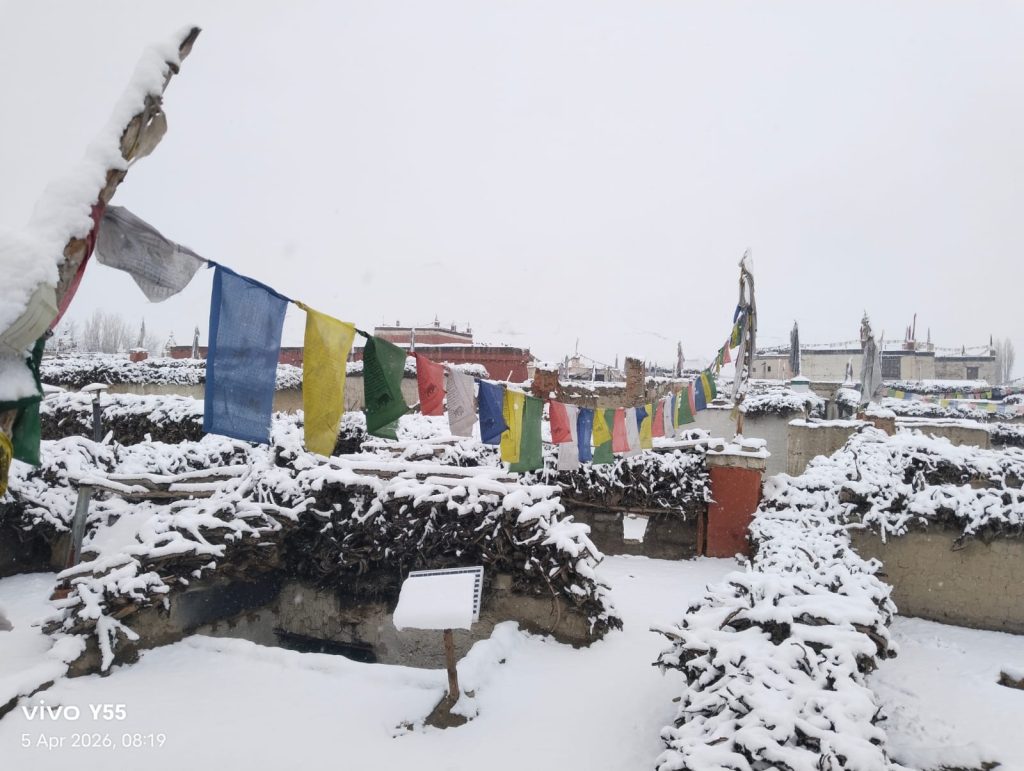
The upper Mustang region and the sacred Muktinath area have experienced heavy snowfall since Saturday night, marking the sixth instance of snowfall this winter season and turning the entire landscape white while disrupting daily life for residents. According to officials, the snowfall began on Saturday night and has continued unabated, with accumulation reaching up to one foot in settlement areas. The region had recorded its first snowfall of the season on Kartik 10, and with this latest spell, the current winter season has now witnessed six separate snowfall events, a frequency that local observers have noted as significant.
Snow Extends from Syangboche to the Korala Border
Umesh Paudel, Office Chief of Ekyaap Lomanthang, informed that heavy snowfall has been occurring since Saturday night in the settlements and high pasturelands of upper Mustang. The entire area from Syangboche in Baragung Muktikshetra-3 up to the Korala border has been completely covered in white, with snow blanketing every hill and ridge. According to Paudel, approximately one foot of snow has accumulated in the settlement areas of Upper Mustang. The persistent snowfall has not only affected accessibility but has also raised concerns about the well-being of both residents and their livestock in one of Nepal’s most climatically extreme regions.

Sixth Snowfall of the Season Affects Multiple Settlements
The sixth heavy snowfall of the season has been recorded in numerous locations, including Syangboche and further up to Ghiling, Ghami, Charang, Lomanthang, Thingar, Chhoser, Samdzung, Namasung, Bharsa, Yara, Ghara, Dhi, and Surkhang. Uday Timilsina, an employee of Lomanthang Rural Municipality, reported that the snowfall shows no signs of stopping. “The snow that began falling on Saturday night has not stopped yet. The snowfall continues. If it continues until evening, we could see more than two feet of snow accumulation,” he said. The ongoing snowfall has severely impacted normal life, making movement difficult and forcing residents to remain indoors.
High Pasturelands Completely Covered; Farmers Face Hardship
With this sixth snowfall of the ongoing season, the high pasturelands of upper Mustang have been completely buried under snow, turning traditional grazing grounds into vast white expanses. As the snowfall continues, temperatures in upper Mustang are steadily dropping, adding to the hardships faced by local residents and livestock farmers. Farmers who depend on animal husbandry have reported significant difficulties, as the thick snow cover prevents livestock from accessing grazing areas and forces them to rely entirely on stored fodder. The extreme cold and snow have also raised concerns about the survival of young animals during this period.
Unexpected Winter Snow Brings Mixed Blessings for Farmers
Upper Mustang traditionally supports only one crop per year. Residents have a custom of returning to their villages after enduring the winter cold elsewhere, and then planting monsoon crops when the season arrives. While the current snowfall is occurring just as the monsoon farming season is about to begin, experts have noted that this could actually benefit farmers by providing much-needed moisture for the soil. The snow acts as a natural reservoir, gradually releasing water as it melts and replenishing groundwater levels. However, the timing and intensity of this particular snowfall have left many farmers uncertain about whether the benefits will outweigh the immediate hardships.
Muktinath Area Also Receives Heavy Snow; Devotees Face Partial Difficulties
Similarly, the Baragung Muktinath area experienced snowfall on Saturday night. Heavy snow was recorded in locations including Khimga, Jarkot, Pudaak, Chenggur, and Muktinath itself within Baragung Muktikshetra-1. Kaisang Thokya Thakuri, a resident of Muktinath, informed that while the snowfall has created partial difficulties for devotees coming to visit the holy Muktinath Temple, the beauty of the fresh snow has actually added to the excitement and enthusiasm among tourists. The sight of the temple complex surrounded by pristine white snow is considered a rare and cherished experience for pilgrims and travelers alike.
Heavy Rainfall in Lower Mustang Damages Apple Blossoms
While upper Mustang and the Muktinath region experienced heavy snowfall, lower areas, including Jomsom, received heavy rainfall. According to Roshan Thakali, Agriculture Officer of Gharpajhong, the heavy rainfall occurring at the time when apple trees are beginning to bloom has negatively impacted apple cultivation. “The apple trees have already started flowering. This is also the time for pollination of apple flowers,” Thakali explained. “Snowfall and rainfall at such a time is not good for farmers.” The untimely rain threatens to reduce fruit set and overall yield, potentially causing significant economic losses for apple farmers in the region who depend heavily on this crop for their livelihood.

Climate Change Linked to Erratic Snowfall Patterns
Experts suggest that the effects of climate change are beginning to be felt directly and indirectly in Nepal’s Himalayan districts. Before this season, Mustang had witnessed three consecutive years with little to no snowfall. The fact that six separate snowfall events have occurred this season has been analyzed as a potential impact of changing climate patterns.
Climate change is causing uneven and unpredictable snowfall patterns in the Himalayan region, leading to a cycle where some years bring heavy snowfall, other years bring only partial snowfall, and still other years bring no snow at all. Scientists warn that this erratic pattern disrupts the delicate ecological balance of the trans-Himalayan region, affecting water availability, agriculture, animal husbandry, and the livelihoods of local communities who have traditionally adapted to more predictable seasonal rhythms. As temperatures continue to fluctuate and weather events become more extreme, communities in Mustang and similar high-altitude regions will likely face increasing challenges in maintaining their traditional ways of life.