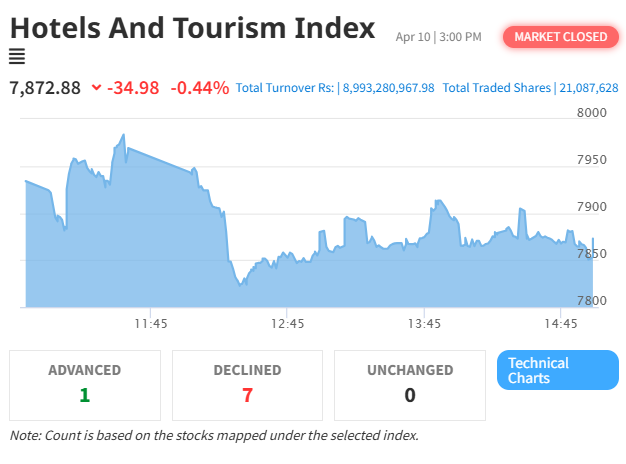
The Hotels and Tourism Index witnessed a notable decline on Friday, dropping by 34.98 points or 0.44 percent to close at 7,872.88, reversing gains from the previous trading session. The sector-specific index had surged by 185.01 points earlier, but profit-booking and market correction contributed to the day’s downturn.

Hotel and Tourism Sector Sees Correction
The Hotels and Tourism Index opened at 7,933.93 and climbed to an intraday high of 7,983.49 before slipping to a low of 7,818.64. Despite early optimism, the index gradually declined throughout the session, indicating cautious sentiment among investors in the tourism and hospitality sector.
Market analysts suggest that the drop may be attributed to short-term adjustments following recent gains, as investors opted to secure profits amid fluctuating market conditions.
NEPSE Also Ends in Negative Territory
The broader market, represented by the Nepal Stock Exchange (NEPSE), also closed lower, falling by 13.45 points or 0.47 percent to settle at 2,837.78. This decline follows a gain of 48.71 points recorded in the previous session, indicating a slight correction in the overall market trend.
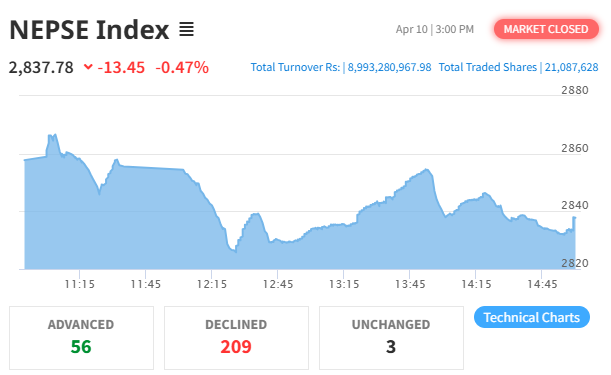
The benchmark index opened at 2,857.76, reached an intraday high of 2,866.63, and dropped to a low of 2,825.30 during the trading day.
Trading Activity and Market Performance
Despite the decline in indices, trading activity remained robust. The total turnover for the day stood at approximately Rs. 8.99 Arba, with 21,087,628 shares traded across 335 companies through 97,480 transactions. This reflects continued investor participation and liquidity in the market.
The total market capitalization was recorded at Rs. 48.24 Kharba, while the float market capitalization stood at Rs. 16.20 Kharba, indicating the overall value of listed companies and actively traded shares.

Market Outlook
The simultaneous decline in both the Hotels and Tourism Index and the NEPSE benchmark suggests a phase of market correction following recent gains. While short-term fluctuations persist, analysts remain cautiously optimistic about long-term growth, particularly in sectors like tourism that are expected to benefit from policy support and seasonal demand. Investors are advised to monitor market trends closely as the stock market continues to respond to both domestic economic developments and global financial signals.