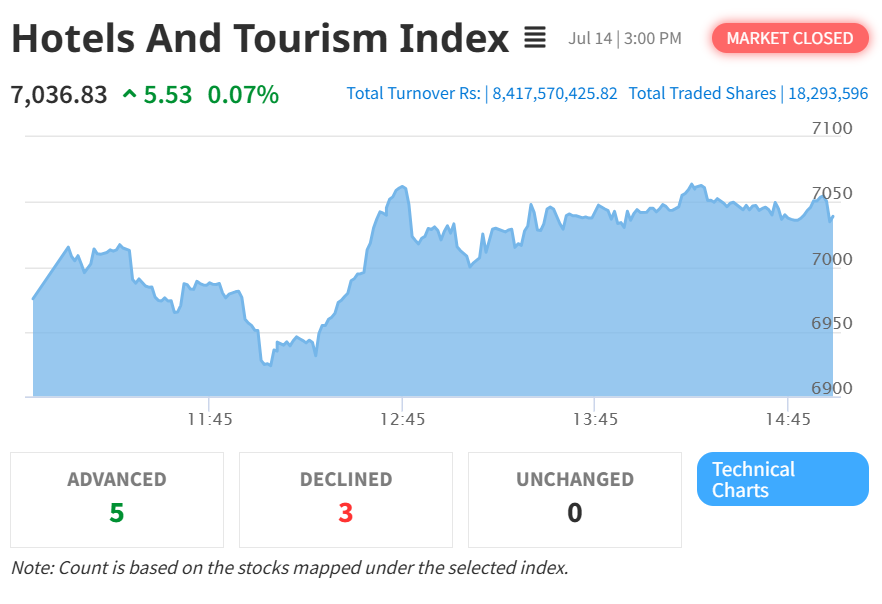
The Hotels and Tourism Index on the Nepal Stock Exchange (NEPSE) rebounded on Tuesday, posting modest gains after suffering a sharp decline in the previous trading session. The sectoral index climbed 5.53 points (0.07%) to close at 7,036.83, recovering from a 142.99-point loss recorded during the last trading day.

Tourism Index Shows Intraday Volatility
The Hotels and Tourism Index opened at 6,975.32 and witnessed notable fluctuations throughout the trading session. During the day, the index touched an intraday high of 7,063.67 and a low of 6,921.65 before settling at 7,036.83, reflecting cautious investor sentiment in tourism-related stocks. Although the gain was marginal, the positive close indicated renewed buying interest following the previous session’s steep correction.
NEPSE Benchmark Also Ends in Positive Territory
The broader Nepal Stock Exchange (NEPSE) also finished higher, gaining 6.11 points (0.23%) to close at 2,576.29.
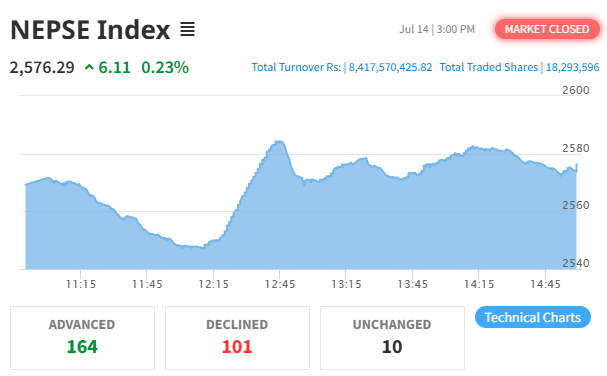
The benchmark index had declined 30.60 points in the previous trading session but recovered modestly as buying activity improved across several sectors. NEPSE opened at 2,569.20 and traded within a range of 2,546.69 to 2,584.30 before ending the day in positive territory.
Turnover Exceeds Rs. 8.41 Billion
Investor participation remained strong during the session, with total daily turnover reaching Rs. 8.41 billion. A total of 18.29 million shares of 383 listed companies were traded through 53,854 transactions, highlighting continued activity in the secondary market. Following the day’s trading, the total market capitalization stood at Rs. 44.26 trillion, while the float market capitalization reached Rs. 14.94 trillion.

Investor Sentiment Shows Signs of Stabilization
The recovery in both the Hotels and Tourism Index and the broader NEPSE benchmark suggests improving investor confidence after the previous session’s losses. Market analysts noted that while the tourism sector recorded only a modest gain, the rebound reflects continued investor interest in hospitality and tourism-related stocks as the market searches for stability.