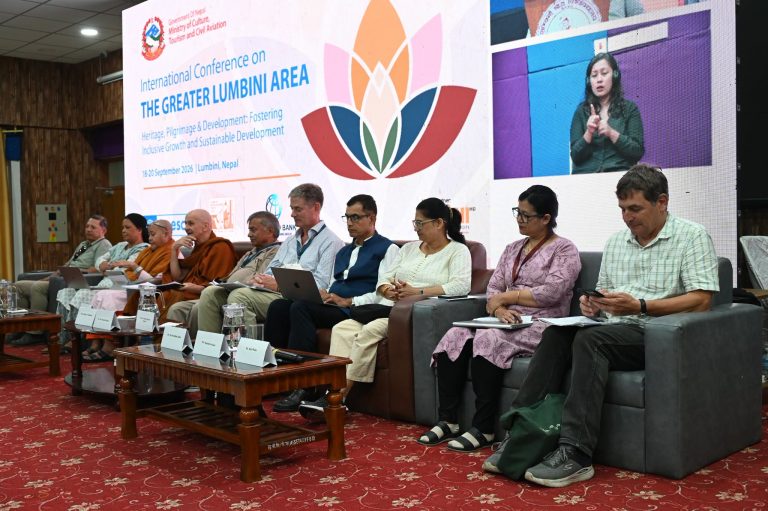
The International Centre for Integrated Mountain Development (ICIMOD) and Nepal’s National Disaster Risk Reduction and Management Authority (NDRRMA) have brought together regional experts and government authorities to strengthen cooperation in managing cascading risks in mountain areas.
The meeting followed the recent Rasuwa-Kyirong flood by ICIMOD and NDRRMA, which highlighted the complex and interconnected nature of disasters in the Himalayan region. Such events can trigger a chain of hazards, affecting communities, infrastructure, transportation networks, and other essential services across borders.

Regional Cooperation for Mountain Disaster Risk
The gathering OF ICIMOD and NDRRMA focused on strengthening regional coordination to better understand and manage cascading mountain hazards. Experts and authorities discussed ways to improve preparedness and ensure that information about emerging risks can be shared more quickly among countries and relevant agencies. The discussions recognized that mountain disasters can develop rapidly and create impacts beyond the area where an initial hazard occurs.
Participants also agreed on key elements of a draft Action Plan designed to strengthen risk monitoring, cross-border information sharing and early warning systems. The proposed measures aim to support more coordinated disaster preparedness and response, particularly in mountain regions where hazards can spread across administrative and national boundaries.
Focus on Early Warning and Information Sharing
Timely and reliable information remains essential for managing mountain risks and protecting vulnerable communities. Participants discussed the importance of strengthening hazard monitoring and communication mechanisms so that authorities can receive and share critical information more efficiently when risks emerge.
The discussions also highlighted the need for greater cooperation among countries and regional institutions, as mountain hazards often extend beyond a single location. Stronger information-sharing mechanisms and early warning systems can help authorities make faster decisions, improve preparedness and coordinate responses when communities face multiple or cascading hazards.
Switzerland and Nepal Share Mountain Resilience Lessons
Swiss Ambassador Danielle Meuwly chaired the closing roundtable, which provided an opportunity for participants to exchange experiences and lessons on mountain disaster preparedness and resilience. Switzerland shared lessons from the evacuation of Blatten in 2025, offering insights into how communities can prepare for and respond to hazards in mountainous environments.
At the same time, Switzerland also drew lessons from partners across the Himalayan region. Switzerland and Nepal, both mountain countries exposed to a range of natural hazards, continue to cooperate on strengthening resilience and improving approaches to mountain risk management. The exchange highlighted the value of sharing practical experiences between mountain regions facing different but interconnected challenges.

Building a More Resilient Mountain Region
The regional meeting underscored the importance of continued cooperation in addressing increasingly complex mountain risks. Improved monitoring, timely early warnings, and effective cross-border communication can help authorities and communities better prepare for emergencies and reduce the potential impacts of cascading disasters, as discussed during the meeting of ICIMOD and NDRRMA.
The cooperation between ICIMOD, NDRRMA, and regional partners is expected to contribute to more coordinated approaches to disaster risk reduction and resilience in mountain areas. For Nepal and other countries across the Hindu Kush Himalaya, such collaboration is particularly important as communities, tourism destinations, transportation networks, and critical infrastructure remain exposed to multiple and interconnected mountain hazards discussed by ICIMOD and NDRRMA.