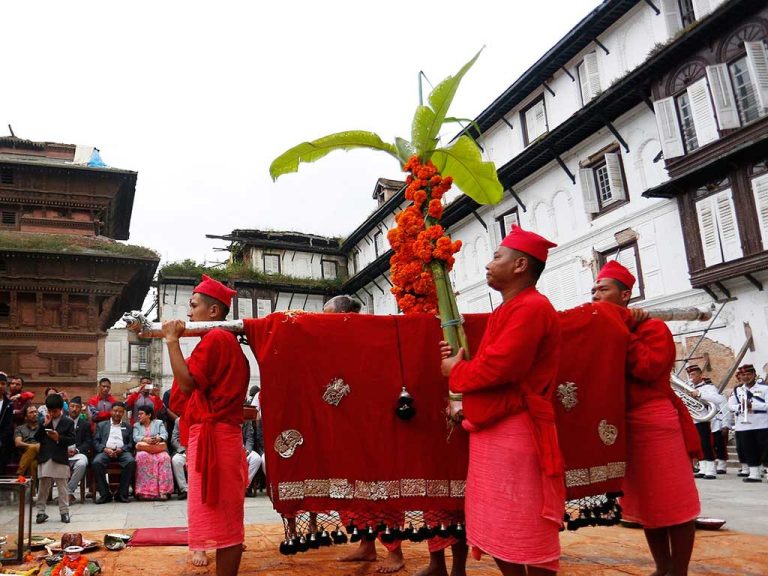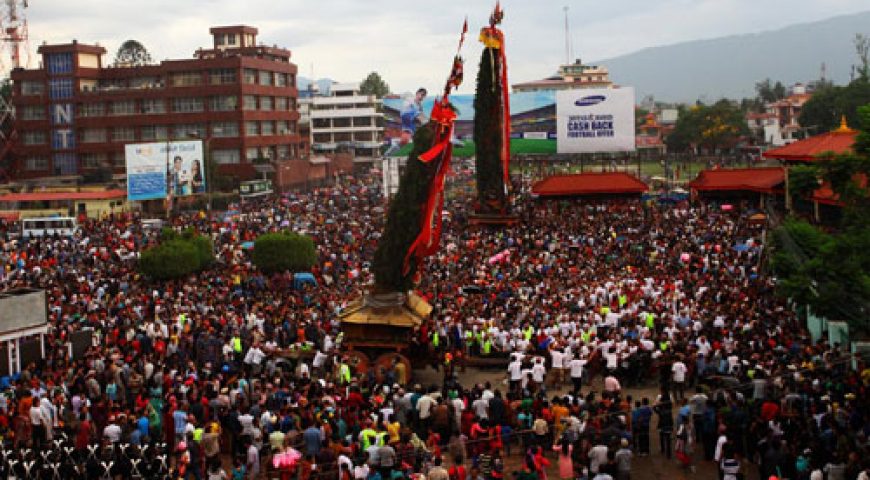
The traditional Pulukisi (Airavata Elephant) Jatra in Bhaktapur was successfully concluded this evening, marking the final day of the Indra Jatra celebrations. This unique procession, which began at Lakulache locality, paraded through various parts of Bhaktapur, including Bulucha, Nasamana, Itache, Durbar Square, Bhola, Mahalaxmisthan, Thalanche, and Surya Madhi.
In Lakulache, the community constructs the Pulukisi, a symbolic representation of Airavata, the elephant of Lord Indra. Using bamboo mats and blue fabric to mimic the appearance of an elephant, they attach a trunk and begin the procession. The Pulukisi is carried by four individuals, with one person inside ringing a bell, signifying the start of the procession at the Akash Bhairav Temple in Taumadhi, Bhaktapur.
As part of the tradition, the Pulukisi is offered rice at crossroads like Vamsagopal, Itache, and Bhola. Fire rituals are performed at Durbar Square, and water is given to the Pulukisi at the Tunchi well in Suryamadi. According to local beliefs, anyone touched by Pulukisi’s trunk may face bad luck, prompting people to run away during the procession.
Additionally, the Khadg Jatra of Shamsan Bhairav, another form of Akash Bhairav, was held alongside the Pulukisi Jatra. The ritual began with special musical performances and the formal commencement of the chariot procession after offerings were made to Bhairav at Guthi Sansthan. The Manandhar community of Tallo Tol celebrated the Mupatra Jatra for three days, lighting two Yama Mata lamps in front of the stone spout at Bulucha.
Locals believe that if Pulukisi encounters Mupatra, he will trample over it without causing harm to the people involved in the procession. Hence, the Mupatra Jatra only starts after the Pulukisi procession has covered most of the town.
The Manandhar community of Tekhacho brought two Yama Mata lamps, which were placed in front of Buluchahiti to face the Chakhuncha Falcha area, and the lamps were lit as part of Bhairav’s procession. The chariot of Bhairav was moved with great devotion, as explained by Vijay Prasad Dhoubadel, former president of Taumadhi Youth Club.
During the procession, an image of Shamsan Bhairav painted on a mat, known as Pulu Bhailadya, was also paraded. Pulukisi, dressed in blue, was part of today’s celebrations, with the ritual concluding at the Bhairavnath Temple’s main gate. The Mupatra Jatra continued this evening with offerings and prayers made as part of the ancient traditions.
Historian Prof. Dr. Purushottam Lochan Shrestha explains that, according to legend, Devaraj Indra descended to Earth in search of a bitter fruit called ‘Khayasi’ and a Parijat flower for his mother Vasundhara, who was fasting on the day of Ganesh Chaturthi. When the locals realized that Indra had stolen the fruit, they captured him and tied him to a post at a crossroads for everyone to see.
On the first day of Indra Jatra, the effigy of Yambadya, erected at intersections, is believed to represent Indra himself. Upon learning of her son’s capture, Vasundhara disguised herself as a Dakini, arrived on Earth with Airavata, and created a mist to obscure the view of the locals. She then freed Indra and returned him to the heavens, which is why the Pulukisi procession is held on the last day of Indra Jatra.
Another legend states that Jayanta, Indra’s son, was sent to Earth in search of the Parijat flower needed for his mother’s fast. Jayanta was captured by demons and tied to a post. Upon discovering this, Indra waged a battle against the demons and eventually won. The demons then took Indra to where Jayanta was held captive and released him, leading to the tradition of parading a demon in the procession.
Although the Indra Jatra dates back to the Dwapar Yuga, it was during the reign of Bhaktapur’s King Jagat Prakash Malla that the tradition was formalized based on the stories from the Devi Purana and Padma Purana.
The conclusion of the Pulukisi Jatra signifies the end of Bhaktapur’s Indra Jatra festivities, a vibrant and historically rich celebration.