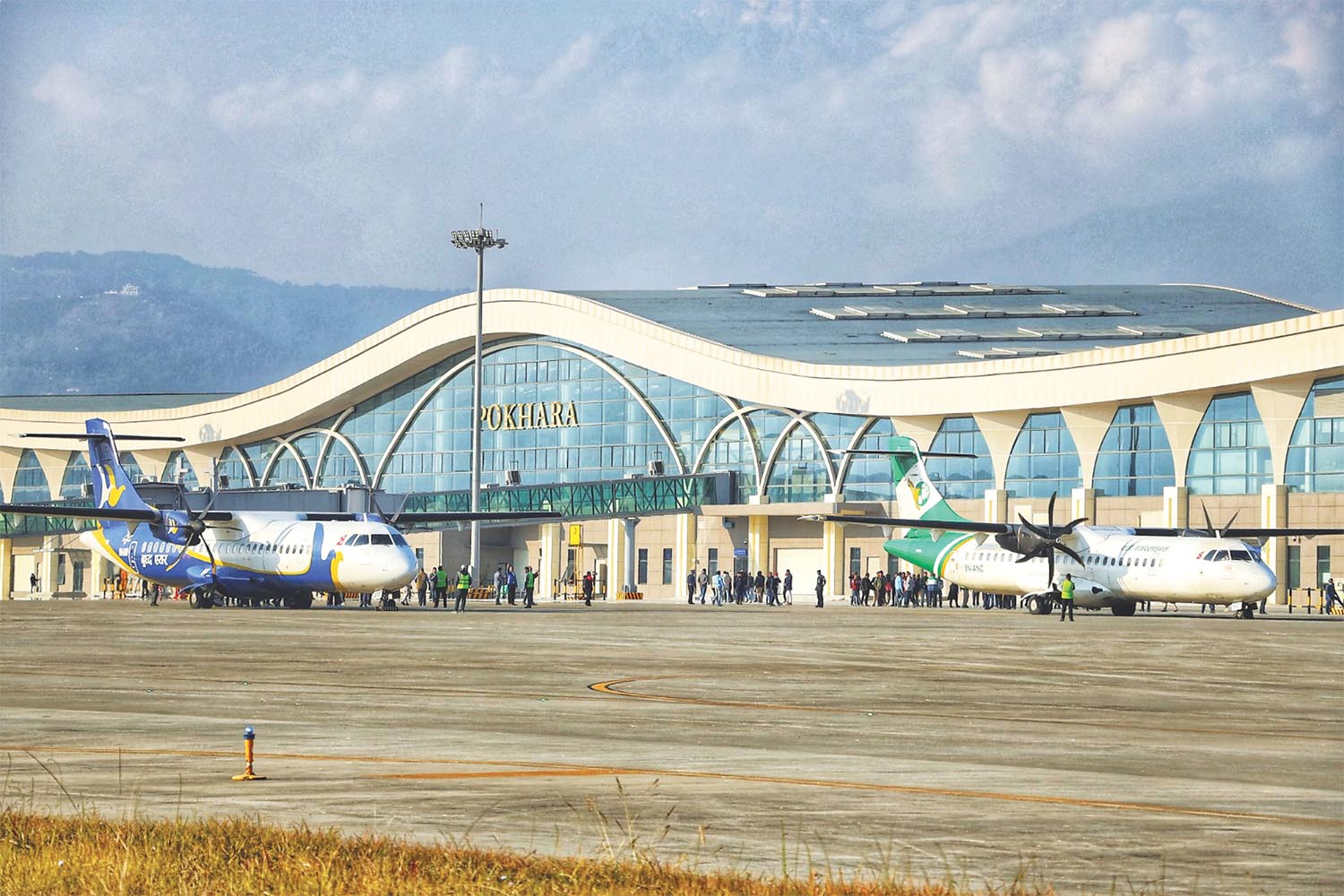
Airlines have largely opted out of operating regular flights to the Gautam Buddha International Airport (GBIA) in Bhairahawa and the Pokhara International Airport during the upcoming winter season, dealing a major blow to Nepal’s ambitions of transforming its new regional airports into active international aviation hubs. Despite government efforts and ongoing negotiations, the winter schedule approved by the Civil Aviation Authority of Nepal (CAAN) shows minimal foreign airline engagement at both newly built international airports.
Limited International Operations at Gautam Buddha International Airport
According to CAAN’s newly issued winter schedule, only Nepal Airlines Corporation (NAC) and Thai AirAsia will conduct scheduled international flights at the Gautam Buddha International Airport during the winter period.

Under the approved timetable:
- NAC will operate one weekly flight on Mondays, following the Kathmandu–Malaysia–Bhairahawa–Kathmandu route.
- Thai AirAsia will conduct flights from Bangkok to Bhairahawa and back twice a week, on Sundays and Wednesdays.
The extremely low frequency reflects a much smaller operational scale than anticipated when the airport was inaugurated as Nepal’s second international gateway. The government had hoped GBIA would attract significant traffic, especially from Southeast Asia and the Middle East, but the lack of consistent airline interest continues to hinder its growth.
Pokhara International Airport Limited to a Single Operator
The situation is similarly discouraging at Pokhara International Airport, where Himalaya Airlines remains the only carrier operating international routes in the winter schedule. CAAN has allowed Himalaya Airlines to operate one flight every Monday. The airline has been running Pokhara–Lhasa flights since March 31, marking the airport’s only active regular international service. No other foreign airline has applied to begin or resume flights from Pokhara this season.
This reality contrasts sharply with earlier government expectations that Pokhara would attract strong tourist inflow and direct international connections, especially from China, India, and Southeast Asia.
Three Airports Approved Under Winter Schedule, But Flights Concentrated at TIA
In total, 30 airlines have received authorization to operate flights under the winter schedule across Nepal’s three international airports, Tribhuvan International Airport (TIA), Gautam Buddha International Airport, and Pokhara International Airport.
However, the data clearly shows that Tribhuvan International Airport continues to dominate Nepal’s international aviation sector, handling nearly all foreign airline traffic. These 30 airlines will conduct 93 daily flights at TIA alone, underscoring its continued central role in Nepal’s air connectivity.
NAC and Himalaya Airlines Lead in Flight Permits
Tribhuvan Airport’s winter schedule shows strong activity from major carriers:
- Nepal Airlines Corporation (NAC) holds the highest number of permits (12) during the season.
- Himalaya Airlines follows closely with 10 permits.
- Air India has received 6 flight approvals.
Several regional and international carriers have moderate to strong presence:
- Kuwait Airways, Singapore Airlines, and Bhutan Airlines each have 5 approved flights.
- Air Arabia, Fly Dubai, IndiGo, and Qatar Airways will each operate 4 daily flights.
- Malaysia Airlines, Jazeera Airways, and Batik Air Malaysia have 3 flights each.
This sharp contrast in airline presence between TIA and the two newly developed airports continues to raise concerns among aviation experts regarding Nepal’s airport planning, debt investment sustainability, and long-term operational viability.

Major Concerns Over Utilization of Newly Built Airports
Nepal has invested billions of rupees, much of it in loans, to construct GBIA and Pokhara International Airport. However, persistent challenges such as insufficient demand forecasting, lack of airline incentives, geopolitical constraints, limited marketing, and operational inefficiencies have prevented the airports from attracting carriers.
Experts warn that continued underutilization could result in:
- Difficulty in repaying construction loans
- Pressure on government subsidies
- Loss of confidence among potential airline partners
- Negative economic impacts on regional tourism and employment
Industry observers emphasize that aggressive airline engagement, targeted subsidies, bilateral negotiations, and improved tourism promotion are necessary to reverse the downward trend.