The Dhorpatan Valley, home to Nepal’s only hunting reserve, is witnessing a flourishing horse safari business, transforming the daily lives of locals who once relied solely on horse rearing for subsistence. With a steady increase in tourist arrivals in recent years, horse owners are now fully engaged in offering guided rides, scenic tours, and photography services to visitors eager to experience the beauty of the region on horseback.
Tourist Influx Boosts Local Income
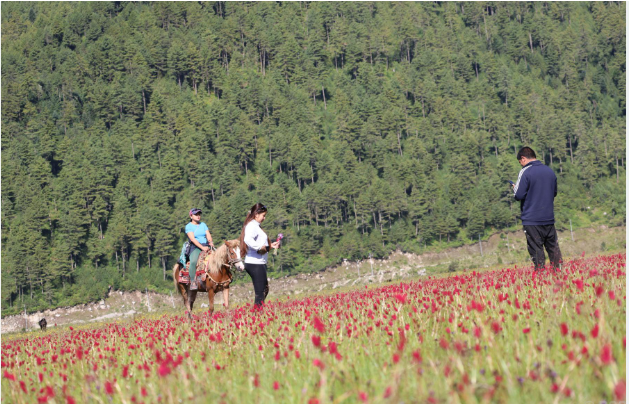
In recent months, the number of visitors to Dhorpatan has surged, delighting local horse entrepreneurs. The valley’s vibrant wildflowers, especially the seasonal Buki blossoms, have become a major draw for domestic tourists from across Nepal. Visitors are keen to ride horses among the flower fields, take videos, pose for photographs, and even create TikTok videos, bringing new opportunities for income generation.
Anish BK, a resident of Dhorpatan Municipality–9, has been sustaining his household through horse riding services. He shared that his daily income has more than tripled due to the rise in tourist activity. “Earlier, it was difficult to earn even NPR 1,000 in a day. Now, I can make up to NPR 3,000. Tourists especially love riding among the Buki flowers,” BK said.
He explained that nearly every visitor to Dhorpatan opts for a horse ride. “They enjoy taking photos and videos on horseback, and I often help them with the shoots. For a short ride with photos and videos, I charge NPR 200. For a trip to Dhor Barahi temple, I take NPR 500, and for a ride all the way to Buki Patan, the charge can go up to NPR 3,000. Most tourists prefer going to the flower fields,” he added.
Seasonal Attractions Keep Visitors Coming
Despite being in the monsoon season, the Buki flowers remain a prime attraction for tourists from Butwal, Kathmandu, Pokhara, Baglung, and neighboring municipalities. Between mid-June and mid-September, various species of wildflowers bloom in the valley, carpeting the meadows with vibrant colors.
In the winter months of mid-November to mid-January, heavy snowfall transforms the landscape into a winter wonderland, drawing another wave of visitors who come specifically to play in the snow. Tourists rarely leave Dhorpatan without riding a horse, and many travel all the way to Buki Patan, a scenic highland meadow, on horseback. This has kept horse owners busy throughout much of the year.
Challenges of Horse Rearing
While the business is thriving, locals acknowledge the challenges of maintaining horses in such a remote and rugged environment. Maitaram BK, another horse owner, said that the income from tourism has been essential for supporting his household. With two horses, he not only offers rides but also uses them to transport goods for visitors heading to Buki Patan.
“During the three winter months of heavy snowfall, we have to keep the horses fed with grain as they cannot graze outside. This is costly and labor-intensive. In other seasons, tourists come in good numbers, but in winter, horses cannot be used for rides. Still, when the snow melts, we are ready to take tourists to Buki Patan, and they pay between NPR 3,000 and NPR 4,000 for the trip,” he said.
The reduced feeding costs during the grazing months allow horse owners to save between NPR 1,000 and NPR 2,000 per day after expenses. For many, horse safari services have become the primary source of income, alongside running homestays.
Homestay and Safari Synergy
Local homestay operators have also benefited from the tourism boom, as horse safaris often go hand-in-hand with overnight stays. Ram Bahadur Gharti, a homestay owner in the area, said that the increasing number of visitors has significantly boosted both sectors. “Tourists usually book a horse ride during their stay. The combination of cultural hospitality, natural beauty, and horseback exploration is what makes Dhorpatan so special,” Gharti explained.
According to official records, 23,000 tourists visited the Dhorpatan Hunting Reserve in the last fiscal year, which is 1,000 more than the previous year. The consistent growth is encouraging locals to invest further in tourism-related services.
Dhorpatan’s Unique Appeal
Dhorpatan is not only the country’s only hunting reserve but also a biodiversity hotspot, with a mix of alpine pastures, forests, and wildlife. It is located at the junction of Baglung, Rukum, and Myagdi districts, making it accessible from multiple regions. The reserve is known for blue sheep, Himalayan tahr, pheasants, and a variety of rare plants.
The horse safari has become one of the most distinctive ways to experience this landscape, allowing tourists to traverse meadows, riversides, and flower-covered slopes with ease. For many first-time visitors, the horseback journey itself is as memorable as the destination.
A Promising Future for Rural Tourism
With continued tourist interest, locals are optimistic about the future of the horse safari business in Dhorpatan. Some are already discussing the possibility of organizing seasonal horse festivals or guided trekking packages that include horse rides as part of the itinerary.
The combination of stunning natural scenery, cultural experiences, and accessible adventure activities positions Dhorpatan as a rising rural tourism hub in Nepal. If infrastructure development, road maintenance, and promotional efforts continue, the region could see even greater visitor numbers in the coming years, further cementing horse safaris as a hallmark of its tourism economy.