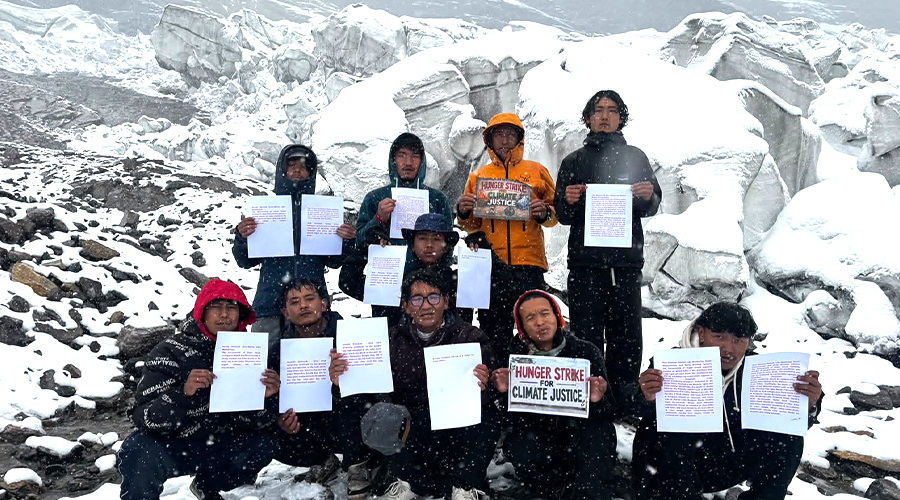
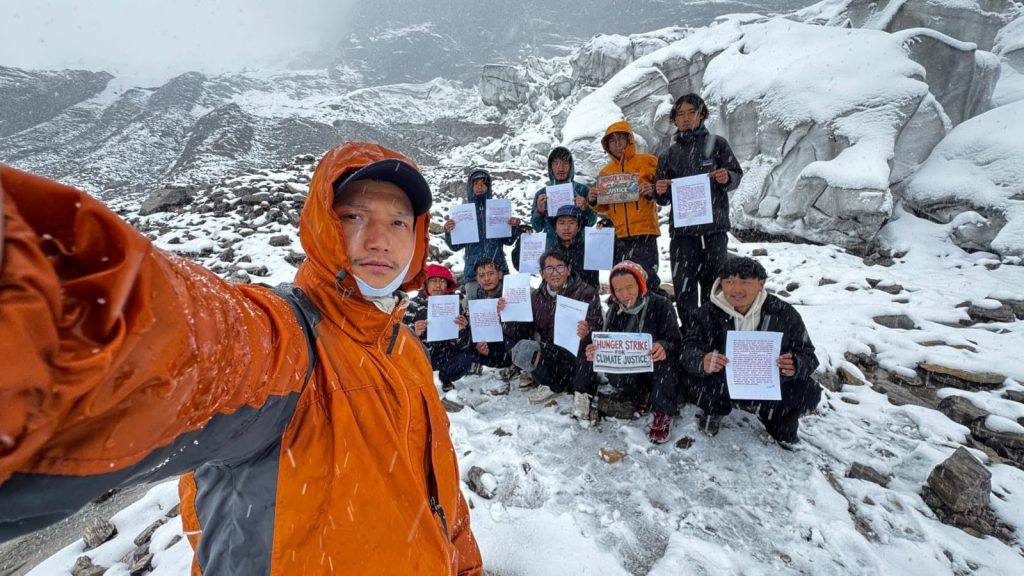
The three day old hunger strike by youths at Manaslu Base Camp ended after the Office of the Chief Minister and Council of Ministers of Gandaki Province and the Manaslu Conservation Area Project (MCAP) agreed to address concerns raised by the protesters through consultations. The call for indefinite hunger strike was initiated on Friday by local youths demanding measures to address climate related risks, including glacial lakes and possible outbursts and potential glacial lake outburst floods (GLOFs) that could affect Himalayan settlements. According to protest leader Dawa Norbu Lama, the decision to lift the hunger strike followed the concerned authorities giving a written commitment to consider their demands.
The protesters called off the hunger strike and headed back to Samagaun after authorities requested consultations in response to their demands. The youths had demanded surveillance on glacial lakes and rivers, installation of warning sirens in vulnerable village, and preparedness for climate related disasters. Their primary concern focused on the changing Himalayan climatic conditions and possible impacts on the people of the region. The demands also included climate education, joint surveillance of glacial lakes on both Nepal and China sides, and climate justice and compensation to Nepal.

Rising Glacial Lake Risks Put Himalayan Communities On Alert
The hunger striker was led by 36 year old Dawa Norbu Lama of Samagaun with 11 other youths from the village. The group of protesters included Nima Chhiring Lama, Lekshya Lama, Pasang Norbu Lama, Chhiring Phuntsok Lama, Tashi Dundup Lama, Chhewang Gyurme Lama, Chhewang Baba Lama, Karma Chhiring Lama, Pemba Chhiring Lama and Pemba Gurung of Ward No. 7. They initiated the protest above Manaslu Base Camp in response to the increasing environmental and climatic risks threatening Himalayan communities. The protesters asserted that the proliferation of lakes in the higher reaches and rising water levels in some of the lakes required scientific surveillance and disaster management.
Among the key concerns raised by the hunger strikers was the formation of new green lakes above Himalayan settlements and rising water levels in Birendra Lake. The youths demanded the installation of technology to monitor lake and river levels to provide early warnings of possible outbursts that could trigger floods. They also called for warning sirens to be placed in vulnerable communities to enable people to evacuate to safer grounds when possible disaster occurred. According to the protesters, early warnings and preparedness would minimize loss of life and property if glacial lake outburst (GLOF) occurred.
Demand For Detailed Lake Studies And Continuous Monitoring
The protesters also demanded detailed studies on glacial lakes posing threats to Himalayan communities in the Manaslu region and beyond. They specifically requested an assessment on the depth and water levels of vulnerable lakes prone to GLOF and the possible impact of the outburst on downstream settlements.
According to the youths, the authorities needed scientific data on each of the vulnerable lakes to understand the extent of risk and take appropriate disaster management measures accordingly. The demand for continuous surveillance of water levels in glacial lakes and other mountainous bodies of water was to complement existing early warning systems, and provide a reliable mechanism for responding to disaster.
In addition, the protesters demanded joint surveillance of the glacial lakes and mountains in Nepal and China by the two nations. It was asserted that the collaboration would help manage the rising environmental challenges threatening Himalayan communities along the borders.
Moreover, the youths called for regular monitoring of the glacial lakes and water levels in Nepal to provide the necessary data for disaster preparedness. This demand included setting up protection and conservation agencies that could monitor the lakes and mountains within their jurisdiction. In addition, the youths demanded installation of warning sirens in vulnerable communities to provide early warnings of possible disaster.
Climate Education And Justice Added To The Protest Demands
Another key demand of the protesters included incorporating climate change education in the curricula of schools in Himalayan communities. They argued that the youths and locals needed to understand the climate change impacts and early warning systems to help mitigate the effects.
The hunger strikers also demanded an end to the neglect of Himalayan communities by urban dwellers. The youths urged climate change adaptation and mitigation agencies and other non governmental organizations to conduct study tours in Himalayan communities to sensitize the people on the impacts of climate change. In addition, the protesters requested climate change adaptation and mitigation agencies and NGOs to hold dialogues in the Himalayan region to enable the authorities to understand the challenges first hand.
The youths also raised the issue of climate compensation and justice, arguing that Nepal contributed minimally to climate change but bore the majority of the impacts. The protesters urged the government to demand climate justice from developed nations that contributed significantly to environmental degradation. Moreover, the hunger strikers also warned of the impacts of rising global temperatures on glaciers, lakes and water levels, and demanded measures to minimize the possible effects.
Government Commitment Shifts Focus From Protest To Action
The decision to lift the hunger strike followed the Gandaki Province government and MSCP notifying the protesters of their intention to address the concerns raised through consultations. The Office of the Chief Minister and Council of Ministers stated that the issues raised by the protesters were of great sensitivity and directly affected the public. Therefore, the matters needed to be addressed through coordination between the local, provincial and national levels, including civil society. MSCP also declared its commitment to collaborating with local and national agencies in addressing the issues raised by the protesters.

The demands of the youths carry implications for the wider region as Manaslu is a major tourism center with residents, tourists and other stakeholders living in a delicate mountainous ecosystem. Surveillance of glacial lakes and early warning systems would help enhance safety and security for the locals and visitors in the region. Similarly, providing climate change education and encouraging community participation in disaster management could help boost Nepal’s tourism industry by making the mountainous region safer for exploration
The hunger strikers had also raised concerns over the rising temperatures that could impact the Himalayan region, including glaciers, rain patterns, and prolonged dry seasons. They called for preparedness for natural disaster management and mitigation measures to minimize the effects on the communities. The response by the authorities to the demands of the protesters will be a useful initiative in addressing the possible impacts of climate change on the region.